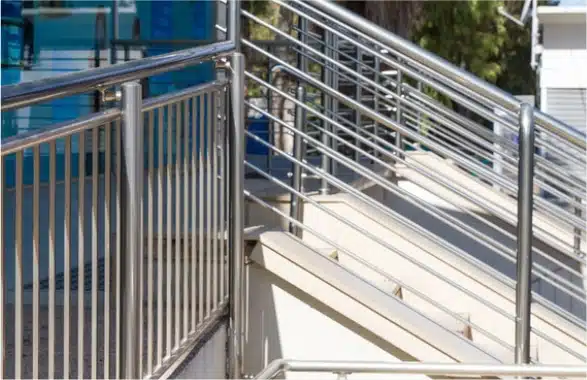
Metal fences are often built from round, square or rectangular tubes that need more than simple cut-to-length processing. Fence posts, rails, frames, gates and decorative components may require holes, slots, notches or angled ends before welding and assembly.
Tube laser cutting allows many of these features to be produced directly on the tube from a digital drawing. This can reduce separate sawing, drilling, slotting and marking operations while providing consistent parts for downstream welding and assembly. Tube laser cutting is widely used in fencing, railing and other architectural metal fabrication.
Tube Laser Cutting Applications in Metal Fence Manufacturing
Fence Posts
Fence posts need to connect rails, panels, brackets or other structural components. Depending on the fence design, a post may require several mounting holes, slots or connection openings along its length.
Instead of drilling these features after cutting the tube, a tube laser cutting machine can produce the required holes and profiles in the same CNC process.
This is particularly useful for fence manufacturers producing different post designs or changing hole positions for different installation systems.
Fence Rails and Horizontal Supports
Horizontal rails commonly use square, rectangular or round tubes. They may require repeated holes or slots for connecting vertical pickets, panels or brackets.
Laser cutting makes it possible to program these features according to the required spacing and position. Once the tube is cut, it can move directly to welding, assembly or surface treatment.
For serial production, this repeatability helps maintain consistent spacing between components without relying on manual marking for every tube.
Metal Gates
Metal gates often combine several tubular components with different angles and connection points.
A single gate frame may require:
- Cut-to-length tube sections
- Mounting holes
- Hinge and locking holes
- Mitre or angled cuts
- Notches for tube intersections
- Connection slots
Tube laser cutting can produce these features directly from the design file, making it easier to prepare accurate components before welding the gate frame.
For customized gates, the same production system can handle different designs by changing the cutting program rather than producing new mechanical tooling.
Decorative Metal Fence
Decorative fencing places additional demands on tube cutting because appearance and geometry can be part of the product itself.
Manufacturers may use holes, slots, repeated patterns and shaped tube ends to create different visual designs. Laser cutting provides greater freedom to change these details without relying on dedicated punches or dies.
This is especially useful for manufacturers serving residential, commercial and architectural projects where fence styles and dimensions can vary between orders. Laser tube cutting is also used for ornamental fencing and railing applications where customized profiles are required.
Cut the Features Before Welding
One of the biggest advantages of tube laser cutting for fencing is that the tube can be prepared for assembly before it reaches the welding station.
A traditional workflow may require:
Cutting → Measuring → Marking → Drilling → Slotting → Notching → Welding
With a tube laser, many parts can follow a simpler route:
Tube Loading → Laser Cutting → Welding → Surface Treatment → Assembly
The laser can create the holes, slots and connection geometry together with the tube profile. This reduces manual positioning work and gives welders parts that are already prepared for assembly.
For fence manufacturers processing hundreds or thousands of similar components, reducing these front-end operations can have a significant effect on production efficiency.
Better Fit-Up for Tubular Fence Structures
Fence frames and gates often contain multiple tubes that meet at specific angles.
Instead of simply making square cuts and leaving the welder to manually adjust the joint, tube laser cutting can create shaped ends and notches that match the connecting tube.
This improves fit-up before welding and can reduce the amount of manual grinding, trimming and adjustment required during fabrication.
For manufacturers producing standardized fence systems, consistent joint geometry can also help make the finished frames more uniform.
Flexible Production for Different Fence Designs
Fence manufacturers rarely produce only one tube configuration. A single production line may handle several tube sizes, materials and product designs.
Laser cutting is well suited to this environment because the cutting pattern is controlled digitally. Hole positions, slot dimensions, tube lengths and decorative patterns can be changed in the program without changing mechanical punching tools.
This allows the same machine to support:
Standard Fences · Security Fences · Garden Fences · Decorative Fences · Metal Gates · Railings · Guardrails
The technology is also suitable for serial production because automated loading systems can reduce manual tube handling between jobs.
Round, Square and Rectangular Tube Processing
Metal fences can use different tube shapes depending on the structural and visual requirements of the product.
Round tubes are common in handrails, decorative structures and some fence components, while square and rectangular tubes are often used for posts, rails and rigid frames.
A suitable tube laser cutting machine should therefore be selected according to the actual tube range rather than by laser power alone.
For example, a manufacturer focused on small fence rails and posts may benefit more from high-speed processing and automatic loading, while a producer of heavy security fences or large architectural structures may need a larger tube capacity and higher load capability.
Recommended Tube Laser Cutting Machines for Metal Fence
LX-K9 — For Fast Production of Small and Medium Fence Tubes
إن LX-K9 processes round and square tubes from Φ10–90 mm and supports tube lengths up to 7100 mm. Its 7th-generation system reaches up to 3.0G X-axis acceleration, with automatic tube handling options for high-volume production.
It is a good fit for fence manufacturers working mainly with smaller tubes for rails, pickets, posts, decorative structures and gate components.
LX-K19 — For a Wider Range of Fence Tubes
إن LX-K19 covers round and square tubes from Φ15–180 mm, with up to 1.5G acceleration, ±0.05 mm processing accuracy and a 1.8-ton automatic loading capacity.
Its wider tube range makes it suitable for manufacturers producing different fence systems on the same production line, from standard rails and frames to larger posts and structural components.
LX-K24 — For Large and Heavy Fence Structures
For large-diameter or heavier tubular components, the LX-K24 processes round and square tubes up to Φ230 mm, with tube lengths up to 6700 mm and a rated capacity of up to 300 kg per tube.
It is suited to heavier fence posts, structural frames, large gates and other tubular components where greater tube capacity and load handling are required.
Choosing a Tube Laser for Fence Production
The right machine depends on the parts rather than the fence name itself.
Before choosing a tube laser cutting machine, manufacturers should define the tube shape, diameter, wall thickness, material, tube length and required features. Production volume is also important when deciding whether automatic loading, high-speed motion or other automation should be included.
For manufacturers mainly producing small and medium fence tubes, the LX-K9 provides a high-speed option. The LX-K19 offers a broader tube range for mixed production, while the LX-K24 is designed for larger and heavier tubular structures.
From fence posts and rails to gates and decorative structures, tube laser cutting can turn a multi-step tube fabrication process into a more consistent CNC workflow, preparing parts for welding and assembly with fewer separate operations.
Tell us your tube size, material, wall thickness and fence design. LONX will recommend the appropriate tube laser cutting machine for your production requirements.