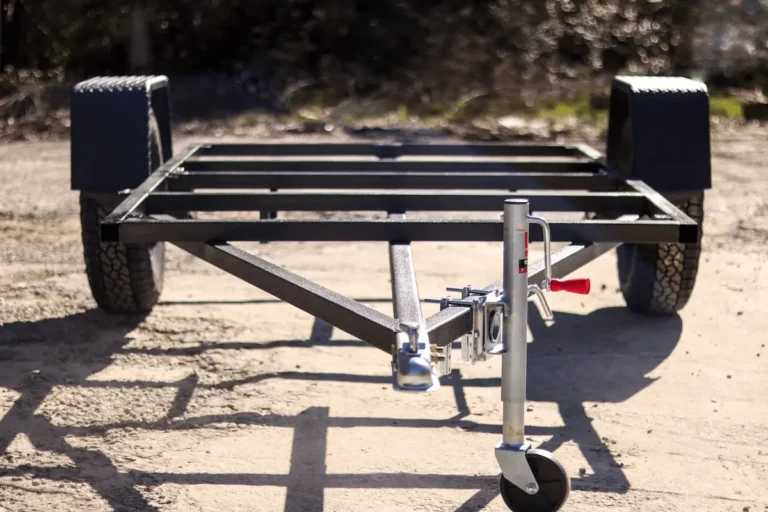
Trailer manufacturing depends heavily on tubular structures. Main chassis rails, cross members, side supports, ramps, brackets and reinforcement sections are commonly fabricated from square, rectangular or round steel tube.
But trailer tube fabrication is rarely limited to cutting members to length. Chassis components may also require mounting holes, slots, notches, angled ends and connection profiles before they are assembled in a welding jig.
Tube laser cutting brings many of these operations into a single CNC process. Instead of moving each tube through separate sawing, marking, drilling and notching operations, manufacturers can create the required geometry directly from the digital drawing and send the finished components to welding and assembly.
Where Tube Laser Cutting Fits in Trailer Manufacturing
A trailer frame is essentially a welded structural assembly made from many individual tube components.
Depending on the trailer type, tube laser cutting can be used for:
Main Chassis Rails · Cross Members · Side Rails · Drawbar Components · Support Structures · Ramp Frames · Guards · Brackets · Reinforcement Members
Tube and structural-profile laser cutting is already used in transportation manufacturing for chassis frames, trailer parts and welded tubular assemblies.
The advantage becomes more significant when these components require several features before welding.
Trailer Chassis Rails
The main chassis rails carry much of the structural load of a trailer and often use square or rectangular hollow sections.
These members may require:
- Mounting holes
- Suspension-related openings
- Cross-member connection slots
- Bracket mounting points
- Drainage or access openings
- Angled or shaped ends
With conventional fabrication, a long tube may first be saw-cut and then moved to a drilling or marking station.
A tube laser can create the length and many of the required features in the same setup.
For trailer manufacturers, this means the chassis member can reach the welding jig with the required connection geometry already prepared.
Cross Members and Chassis Connections
Cross members need to connect accurately to the main rails.
If a cross member is simply cut square, additional fitting may be required at the welding station. Depending on the frame design, tube laser cutting can instead create a notch, cope or shaped end that matches the connection.
This can make fit-up more predictable and reduce manual grinding before tack welding.
The concept is particularly useful when the trailer frame contains many repeated cross members. Each component can be produced from the same digital program, maintaining the position of the holes and joint features across the production batch.
Drawbars, A-Frames and Support Structures
Trailer drawbars and A-frame structures often combine several tubular members at different angles.
These parts can benefit from laser-cut tube ends because the connection geometry can be prepared before the tubes are placed into the welding fixture.
Instead of:
Cut → Mark → Manually Notch → Grind → Fit
the production can move toward:
Laser Cut → Position → Tack Weld → Weld
The exact geometry depends on the trailer design and welding method, but the principle is the same: prepare the tube for the final assembly rather than treating cutting as an isolated operation.
Trailer Ramps and Access Structures
Many utility, equipment and transport trailers include ramps, loading structures and access components made from tubular frames.
These parts can contain repeated holes, slots and angled tube joints.
Tube laser cutting allows the mounting and connection features to be programmed together with the main tube profile. When multiple ramp sizes or designs are produced, the manufacturer can change the cutting program rather than setting up separate drilling and notching tooling for each variant.
This makes tube laser cutting especially relevant to trailer manufacturers serving different payload classes or customer requirements.
Trailer Brackets and Reinforcement Components
Not every laser-cut tube becomes a main chassis member.
Trailer manufacturers also use smaller tubular supports and reinforcements around:
- Suspension mounting areas
- Drawbar structures
- Side supports
- Ramp assemblies
- Guard structures
- Rear frames
- Access systems
Many of these parts have several holes or connection features on different sides of the tube.
Because the tube remains under controlled positioning while it rotates during cutting, these features can be produced according to their programmed locations without repeatedly setting the part up on different machines.
Thick-Wall Tube and Structural Joints
Trailer frames often need relatively thick-wall tube because the finished chassis must withstand road loads and the weight of the intended payload.
This changes the production problem.
A bandsaw can cut a thick-wall tube to length, but the resulting square end may still need manual grinding when it forms an angled structural joint.
Recent trailer-chassis production reporting describes this exact problem: thick-wall RHS and SHS trailer frame members required manual marking and grinding of bevelled joints after sawing, while a five-axis tube laser was introduced to produce the required joint geometry directly from the CAD design.
For suitable trailer designs, this can remove a labor-intensive preparation step before welding.
Tube Laser Cutting for Weld-Ready Trailer Frames
For trailer manufacturers, the goal is usually not just a clean tube cut.
The real objective is a weld-ready component.
A typical conventional workflow may look like:
Saw Cutting → Layout → Drilling → Grinding → Fit-Up → Welding
A more integrated tube laser workflow can be:
Tube Loading → Laser Cutting → Fit-Up → Welding
The laser can produce holes, slots, miters and shaped tube ends during the same CNC process.
This can reduce:
Secondary drilling · Manual marking · Manual coping · Grinding · Repeated positioning
and allow the welding team to spend more time assembling the frame rather than preparing individual tube components.
Consistency Across Trailer Production
A trailer may contain dozens of similar tube components.
If every cross member, side rail or support is manually measured and drilled, small dimensional differences can accumulate during frame assembly.
CNC tube laser cutting uses the same programmed geometry for every repeated component. Hole locations, tube lengths and connection profiles can therefore be reproduced consistently across a batch.
This is useful for manufacturers producing standardized trailer models, but it is equally useful for companies producing several variants from the same basic chassis design.
A revised trailer may only require a different hole pattern or tube length. Because the cutting geometry is digital, the production file can be updated without creating a new set of mechanical drilling dies.
Material Utilization Matters for Trailer Frames
Trailer manufacturers consume significant quantities of structural tube, so the amount of usable material obtained from each stock length is important.
A tube laser system can optimize the arrangement of components along the raw tube, while movable or multiple-chuck configurations can reduce the amount of material that must remain outside the cutting area.
إن LX-K9, for example, uses intelligent chuck avoidance and a movable chuck configuration designed to reduce unusable tube remnants. It processes round and square tubes from Φ10–90 mm and supports tube lengths up to 7100 mm.
For trailer production, material utilization should be considered together with cycle time, labor and the number of secondary operations eliminated.
Different Trailer Types, Similar Tube Processes
The final trailer design can vary significantly, but many of the underlying tube fabrication requirements remain similar.
Tube laser cutting can support:
Utility Trailers · Equipment Trailers · Flatbed Trailers · Cargo Trailers · Agricultural Trailers · Transport Frames · Trailer Racks and Supports
A manufacturer may use the same basic tube laser system to produce components for several product lines, provided the tube range and processing requirements are compatible.
This is an important advantage for trailer factories with a high product mix: the machine does not need to be dedicated to a single trailer model.
Automation for Batch Trailer Production
Once a trailer manufacturer moves from prototype work into repeat production, material handling becomes an important part of machine productivity.
Automatic loading can reduce the time required to place raw tube into the cutting system, while follow-up supports can stabilize longer workpieces during cutting.
إن LX-K28-3, for example, processes round and square tubes from Φ20–280 mm with tube lengths up to 12,000mm. Its three-chuck configuration and servo follow-up support are designed for stable processing of large tubes, while automated loading can handle multiple large pipe materials in a production cycle. LONX specifically lists trailer manufacturing for frames, chassis components, support structures, axles and tubular reinforcement parts.
For larger trailer chassis and heavy-duty tubular structures, this type of configuration becomes more relevant than a small-tube machine.
Recommended LONX Tube Laser Cutting Machines for Trailers
Trailer manufacturers should select the machine according to the actual tube sizes used in the chassis and the required production volume.
LX-K9 — For High-Speed Trailer Tube Production
إن LX-K9 processes round and square tubes from Φ10–90 mm, with tube lengths up to 7100 mm and acceleration up to 3.0G. Its automated handling options and intelligent chuck-avoidance functions are designed for high-volume small- and medium-tube production.
Suitable for: trailer brackets, supports, smaller cross members, ramp components and other repetitive tubular parts.
LX-K19 — For a Wider Range of Trailer Chassis Components
إن LX-K19 extends the working range to round and square tubes up to approximately 180 mm, making it more suitable for mixed trailer production where both smaller components and larger structural members are processed.
Suitable for: chassis rails, cross members, supports, drawbar components and medium-sized trailer structures.
For manufacturers producing several trailer models, its broader tube capacity can allow more components to be processed on the same machine.
LX-K28-3 — For Large Trailer Frames and Heavy Tubes
إن LX-K28-3 covers round tubes from Φ20–280 mm and square tubes up to 280 × 280 mm, with tube lengths up to 12,000mm. Its three-chuck configuration, servo follow-up support and automatic loading are designed for larger and longer tubular workpieces. LONX specifically lists trailer manufacturing as an application.
Suitable for: heavy trailer chassis, large cross members, structural supports and larger tubular reinforcement components.
When Does Tube Laser Cutting Make Sense for Trailer Manufacturing?
Tube laser cutting becomes particularly valuable when a trailer component needs more than a simple cut to length.
If the part requires:
Multiple holes + slots + angled ends + notches + connection profiles
then processing everything through separate machines can add substantial handling and labor.
The more features contained in the tube component, the greater the opportunity to consolidate those operations into one CNC process.
For a simple straight-cut tube, a conventional saw may still be sufficient. For a fabricated trailer frame with repeated connection geometry, holes and angled joints, the production benefits of tube laser cutting become much more significant.
From Trailer Tube to Finished Chassis
A trailer frame may ultimately require welding, coating, wiring, axle installation, suspension assembly and final inspection.
Tube laser cutting does not replace those downstream processes. Its role is to prepare the tubular components more completely before they enter them.
The basic production sequence becomes:
Digital Trailer Design → Tube Cutting → Tube Bending Where Required → Welding → Finishing → Chassis Assembly
When the laser-cut parts arrive with their holes and connection profiles already prepared, the welding operation can focus on assembly rather than extensive tube preparation.
For trailer manufacturers, this can mean a more consistent production flow, fewer separate machining operations and greater flexibility when new trailer models or chassis configurations are introduced.
Choose a Tube Laser Built Around Your Trailer
The right tube laser cutting machine depends on the actual trailer rather than the word “trailer” alone.
Key parameters include:
Tube profile → Tube size → Wall thickness → Material → Tube length → Joint geometry → Hole and slot requirements → Production volume
Small and medium trailer components may be well suited to high-speed tube lasers such as the LX-K9. A broader production mix can benefit from the larger range of the LX-K19, while heavy trailer chassis and long tubular structures may call for the three-chuck capacity of the LX-K28-3.