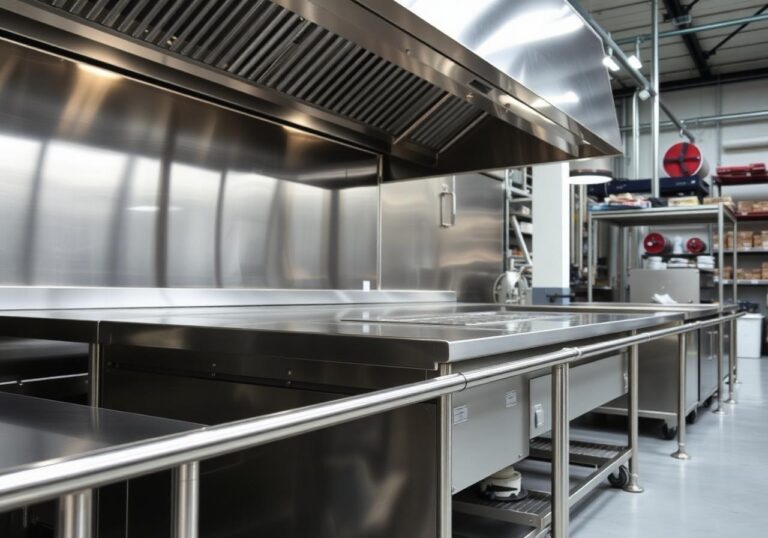
Commercial kitchens rely on durable equipment designed for frequent use, regular cleaning, and demanding working environments. From stainless steel worktables and storage cabinets to ventilation hoods, equipment panels, and support brackets, many products incorporate sheet metal components that must fit together accurately and meet specific functional and appearance requirements.
For commercial kitchen equipment manufacturers, fiber laser cutting provides a flexible method for producing flat metal parts with programmed contours, holes, slots, and other openings. These components can then proceed to bending, welding, polishing, and assembly according to the final product design.
LONX offers fiber laser cutting machines for different sheet metal manufacturing requirements. The right solution depends on the materials being processed, component dimensions, required cutting quality, production volume, and the downstream operations used to manufacture the finished equipment.
Common Commercial Kitchen Equipment Applications
Commercial kitchen equipment includes a wide range of products, from stainless steel furniture to cooking and ventilation equipment. Laser cutting is most relevant to the flat sheet metal components that require defined contours, openings, or mounting features.
Stainless Steel Worktables and Countertops
Commercial kitchens use worktables, preparation counters, splashbacks, and other stainless steel surfaces for food preparation and general kitchen operations.
Depending on the design, these products may incorporate flat panels, shaped blanks, mounting holes, cutouts, and connecting components. Fiber laser cutting can produce many of these features before the parts are bent, joined, or assembled.
For visible surfaces, manufacturers should consider surface protection during handling, edge condition, dimensional requirements, and the finishing process. The cutting layout should also account for the final geometry of formed edges and adjoining components.
Commercial Kitchen Cabinets and Storage Units
Kitchen cabinets, shelving systems, drawers, and storage units may contain side panels, doors, shelves, brackets, and other sheet metal parts.
These components often require repeated holes, slots, shaped edges, and fastening locations. CNC laser cutting allows manufacturers to adapt cutting programs to different cabinet sizes and configurations without requiring a dedicated cutting tool for every new contour.
The appropriate cutting solution depends on the sheet dimensions, material thickness, part complexity, and expected production volume.
Ventilation Hoods and Exhaust Equipment
Commercial cooking areas commonly use ventilation hoods and associated equipment to collect cooking fumes and manage airflow.
Sheet metal components may include hood panels, covers, mounting brackets, filter supports, and connection flanges. Laser cutting can produce the required flat profiles and openings before the components are bent, joined, or assembled.
The complete ventilation system may also require specialized duct-forming, welding, sealing, or other fabrication processes. Laser cutting should be considered as part of the overall manufacturing workflow rather than a replacement for every production operation.
Cooking Equipment Panels and Housings
Commercial ovens, grills, cooking ranges, and other food-service equipment may incorporate metal covers, access panels, control panels, and structural sheet metal components.
These parts can require openings for controls, fasteners, ventilation, and equipment interfaces. Laser cutting can produce many of these features directly from programmed designs.
Manufacturers should evaluate material suitability, temperature exposure, component geometry, and the requirements of subsequent forming and assembly. The finished equipment design determines which materials and fabrication methods are appropriate.
Sink Components, Trays, and Custom Stainless Steel Parts
Commercial kitchens also use stainless steel sinks, drainage components, trays, and customized sheet metal parts.
Laser cutting may be suitable for producing flat blanks, mounting panels, shaped openings, and selected components before forming or joining. Deep-drawn bowls, rolled parts, and other three-dimensional components may require additional processes or alternative manufacturing methods.
For custom products, sample drawings and representative parts help determine which features should be laser cut and which require separate forming operations.
Why Consider Fiber Laser Cutting for Kitchen Equipment Manufacturing?
Flexibility for Custom Designs
Commercial kitchen manufacturers may produce different equipment sizes, layouts, and configurations for restaurants, hotels, catering facilities, and other food-service environments.
CNC laser cutting allows cutting programs to be adjusted to different part geometries. This can be useful for custom orders, product variants, prototypes, and production involving frequent design changes.
The practical benefit depends on programming time, material handling, production volume, and the complexity of the components.
Precise Openings and Component Profiles
Kitchen equipment parts may require holes, slots, control openings, fastening features, and shaped edges.
Fiber laser cutting can produce many of these features according to a programmed cutting path. Actual dimensional accuracy and edge quality depend on the machine configuration, material, thickness, cutting parameters, and part geometry.
Where components must align with purchased hardware or mating parts, manufacturers should identify critical dimensions and verify them through representative cutting trials.
Efficient Preparation for Bending and Assembly
Many kitchen equipment products are manufactured from flat blanks that are subsequently bent into cabinets, panels, covers, hoods, and other shapes.
Cutting programs should account for bend locations, flange dimensions, joining interfaces, and the final geometry of the assembled product. Poorly positioned openings or insufficient clearance near a bend can create problems during forming or assembly.
Coordinating cutting with downstream processes helps manufacturers assess the complete production workflow.
Support for Different Production Volumes
Some manufacturers produce standard equipment in recurring batches, while others focus on custom stainless steel products.
Laser cutting can accommodate varied part geometries without dedicated cutting tools for every contour. However, simple repetitive parts at high production volumes may be better suited to shearing, punching, stamping, or other processes, depending on tooling costs and production requirements.
The most appropriate method depends on the part design, order quantity, material utilization, and required flexibility.
From Stainless Steel Sheet to Finished Kitchen Equipment
A typical manufacturing workflow may involve the following stages.
01. Design and Material Review
Review the part drawings and confirm the material grade, sheet thickness, dimensions, cutouts, and critical interfaces. Consider the equipment’s operating environment, surface appearance, cleaning requirements, and intended finishing process.
02. Nesting and CNC Programming
Arrange the required components on the sheet according to their dimensions, material specifications, and production quantities. Prepare the cutting program and check that the planned layout supports practical material utilization.
03. Fiber Laser Cutting
Cut the required profiles, holes, slots, and openings. Cutting results depend on the material grade, thickness, laser power, assist gas, and process settings.
For stainless steel parts with visible surfaces, evaluate edge condition, possible heat tint or dross, and whether additional finishing is needed.
04. Bending and Forming
Form the flat blanks into worktable sections, cabinet panels, hood components, brackets, and other shapes. The appropriate forming process depends on the component geometry and production requirements.
05. Welding, Polishing, and Assembly
Complete the required joining, surface finishing, hardware installation, and assembly. Depending on the product design, visible surfaces may require brushing or polishing, while seams and joints may need additional attention to meet cleaning and appearance requirements.
Laser cutting is one stage in the process. The final product quality depends on the entire manufacturing workflow.
How to Choose a Laser Cutting Machine for Commercial Kitchen Equipment
Selecting the right machine requires understanding the actual components and production requirements rather than choosing based on laser power alone.
Material Grade and Thickness
Commercial kitchen equipment may use stainless steel, galvanized steel, or other sheet materials depending on the product design and operating environment.
Identify the materials and thicknesses used most frequently, along with the maximum thickness required for regular production. Confirm that the proposed machine configuration can process the specified material and thickness while meeting the required edge quality.
Material grade, surface finish, protective film, and downstream polishing requirements should also be considered during process evaluation.
Working Area and Component Dimensions
Consider the dimensions of your largest worktable panels, cabinet sides, hood sections, and other flat components.
The machine’s working area should accommodate the parts and support practical nesting layouts. Larger equipment panels may require a larger working area, while smaller brackets and components may fit within a more compact system.
Evaluate the dimensions of your actual production parts before selecting a machine configuration.
Cutting Quality and Surface Requirements
Commercial kitchen equipment may contain visible stainless steel surfaces where scratches, discoloration, or inconsistent edges can affect the finished appearance.
Define the required edge condition, critical dimensions, and surface finish before choosing the machine. Evaluate representative parts and determine whether protective film management, deburring, brushing, or polishing will be necessary after cutting.
Laser cutting alone does not guarantee a finished cosmetic surface or eliminate every secondary operation.
Production Volume and Machine Configuration
Manufacturers producing custom equipment may prioritize flexibility and convenient changeovers. Businesses producing repeated batches may place greater emphasis on throughput, material handling, and minimizing interruptions between sheets.
Open-type and exchange-table machines offer different operating arrangements. Compare them according to production volume, available floor space, loading and unloading requirements, and the way cut parts move to downstream operations.
Future Production and Automation
Consider whether your business expects to add new product sizes, increase batch volumes, or introduce more automated material handling.
A suitable machine should match current requirements while allowing reasonable flexibility for future production. Evaluate automation according to its actual contribution to the production workflow rather than assuming that a more automated system is always the best investment.
The appropriate configuration depends on material, thickness, working area, production volume, required cutting quality, and downstream manufacturing processes.
Explore our Laserové řezací stroje na plech to compare available machine categories and identify a suitable starting point for your application.
Často kladené dotazy
Can fiber laser cutting process stainless steel for commercial kitchen equipment?
Fiber laser cutting can process many stainless steel sheet components used in commercial kitchen equipment. The practical cutting range and edge quality depend on the material grade, thickness, machine configuration, assist gas, and cutting parameters.
What commercial kitchen parts can be laser cut?
Typical examples include flat panels, cabinet doors, worktable components, ventilation hood panels, mounting brackets, shelves, and custom sheet metal parts with holes or shaped contours. Some components, such as deep-drawn sink bowls, require additional forming processes.
Does laser cutting eliminate the need for polishing or deburring?
Not necessarily. The resulting edge condition depends on the material, thickness, cutting parameters, and required finish. Visible stainless steel surfaces may still require deburring, brushing, polishing, or other finishing operations.
Is laser cutting suitable for both custom and high-volume kitchen equipment production?
It can support both, but the most economical process depends on the part geometry and order quantity. Laser cutting offers flexibility for varied designs, while shearing, punching, stamping, or dedicated tooling may be more suitable for some repetitive high-volume parts.
How do I select a suitable laser cutting machine for stainless steel kitchen equipment?
Start with your material grades, typical and maximum thicknesses, largest sheet dimensions, representative part drawings, and production volume. Evaluate the required edge quality and downstream forming or finishing operations before selecting the machine configuration.