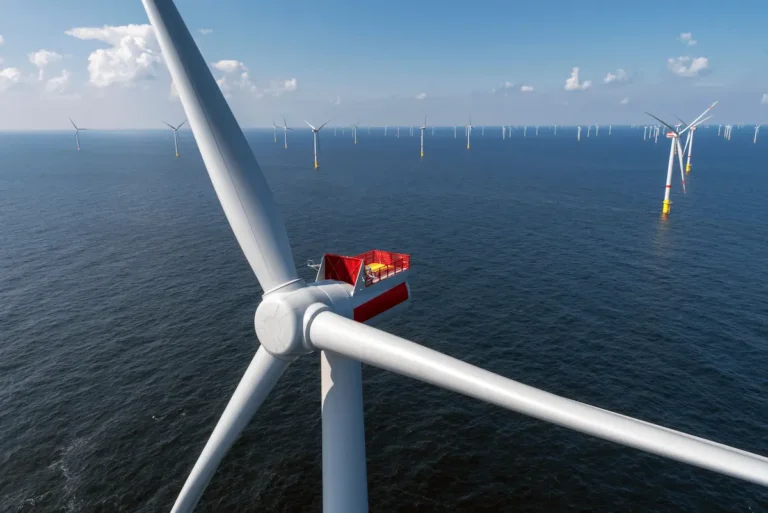
Wind power equipment contains far more fabricated steel components than the turbine tower shell itself. Inside a wind turbine tower and around the equipment structure are platforms, ladders, support frames, cable supports, guardrails, brackets and reinforcement members that must be cut, fitted and welded before installation.
Many of these components are made from round tubes, square tubes, rectangular tubes and structural profiles. They may require holes, slots, notches, angled ends and connection geometry rather than simple cut-to-length processing.
Tube and profile laser cutting can produce these features directly from digital drawings, helping wind power manufacturers reduce separate drilling, notching, manual marking and fitting operations. Wind-energy fabrication applications commonly include tower internals, platform supports, guardrails and other tubular or structural components.
Where Tube Laser Cutting Fits in Wind Power Manufacturing
The main tower shell of a wind turbine is generally manufactured from steel plate that is cut, rolled and welded into cylindrical or conical sections. Tube laser cutting is more relevant to the components installed inside or around the tower, as well as to other tubular structures used in wind power equipment.
Typical laser-cut components include:
Tower Internal Platforms · Ladders · Cable Supports · Handrails · Guardrails · Equipment Supports · Brackets · Structural Frames · Reinforcement Members
For manufacturers supplying wind-tower internals or related steel structures, this creates an opportunity to turn raw tube or profile into a more complete component before welding and assembly.
Wind Turbine Tower Internals
Inside a wind turbine tower, structural components are required to support personnel access, cables, electrical equipment and maintenance systems.
These structures can include:
- Service platforms
- Walkways
- Ladder supports
- Internal frames
- Cable tray supports
- Equipment mounting brackets
- Handrails and safety railings
- Maintenance supports
Custom wind-tower fabricators also list internal platforms, access platforms, ladder brackets, cable supports, equipment mounting structures and safety railings among typical tower-internal components.
A tube laser can prepare many of these components with mounting holes, slots and connection features already incorporated into the tube or profile.
Platform Supports and Structural Frames
Platforms inside and around wind turbines are often assembled from multiple structural members.
The individual tubes or profiles may need repeated holes for bolted connections, slots for mounting adjustment or shaped ends for welded joints.
Rather than processing these features separately after sawing, manufacturers can cut them together with the main profile.
This creates a more integrated workflow:
Raw Tube / Profile → Laser Cutting → Fit-Up → Welding → Coating → Assembly
The more connection features a component requires, the more useful this integrated approach becomes.
Wind-power fabrication case studies describe tube laser systems being used for tower internals, platform supports, guardrails and other heavy structural components where older plasma and drilling processes created efficiency and precision limitations.
Cable Supports and Equipment Mounting Structures
Wind turbines contain substantial electrical and control equipment, which requires reliable support structures and cable-management systems.
Tubular brackets and frames may need several mounting holes positioned on different sides of the tube. With rotary tube cutting, these features can be produced according to their programmed positions without repeatedly removing the workpiece for drilling.
This is useful for components such as:
Cable Tray Supports · Electrical Equipment Brackets · Control Equipment Frames · Junction-Box Supports · Tubular Mounting Structures
For project-based wind-energy fabrication, these designs can also change from one turbine model or tower configuration to another. CNC programming allows the feature layout to be changed without creating new mechanical punching tools.
Handrails, Guardrails and Access Structures
Wind turbines require safe access to internal platforms and maintenance areas.
Handrails, guardrails, ladders and related tubular structures may appear simple, but they often contain multiple connection points and angled joints.
The laser can cut:
- Mounting holes
- Connection slots
- Tube ends
- Miters
- Notches
- Intersecting profiles
Preparing these features before welding can make the components easier to fixture and assemble.
For repeated tower designs, the same cutting program can also reproduce identical components with consistent dimensions.
Tube Joints for Wind Tower Structures
The connection between two tubes is often more important than the straight tube cut itself.
A conventional saw produces a basic end. The fabricator may then need to mark and grind the tube to create a suitable connection.
A tube laser can instead create a shaped end based on the required joint geometry.
For example, two tubular supports meeting at an angle can be cut with complementary profiles so they fit together more naturally before welding.
This can reduce:
Manual marking → Manual coping → Grinding → Repeated fitting
and shift more of the preparation work into the CNC cutting stage.
For heavy wind-power structures, where many welded joints are repeated across platforms and support assemblies, consistent joint geometry can simplify downstream fabrication.
Bevel Cutting for Wind Power Components
Some wind-power structures require bevel preparation before welding.
If cutting and beveling are performed as separate processes, the component has to be moved to another machine or station. A bevel tube laser can combine both operations for suitable geometries.
LONX’s LX-T52 III is designed specifically for large and heavy tube fabrication, combining triple-chuck clamping with one-step 45° full bevel cutting. It handles round and square tubes from Ø80–500 mm, with tube lengths up to 12,000 mm, and LONX explicitly lists wind power among its target applications.
This is relevant when wind-power components require larger tubular sections and the bevel is part of the welding preparation.
Large Tubes Need Stable Clamping
Wind-power components can be long and heavy. As the tube diameter and length increase, maintaining stable positioning during rotation becomes increasingly important.
A heavy workpiece can sag or vibrate if it is not adequately supported. Multi-chuck systems and servo follow-up supports help keep the material stable while the laser processes the profile.
Tento LX-K28-3 handles round and square tubes from Φ20–280 mm, with lengths up to 12,000 mm. Its three-chuck configuration and servo follow-up support are designed specifically for long, large-diameter tubes, while automated loading can feed multiple large pipe materials for continuous production. LONX lists Wind Power Equipment as one of its applications.
For medium and large tubular wind-power components, this type of support becomes more important than simply increasing laser power.
Structural Profiles Beyond Round Tubes
Wind-power fabrication is not limited to conventional pipes.
Tower internals and support structures can also use:
H-Beams · I-Beams · Channel Steel · Angle Steel · Square Tubes · Rectangular Tubes · Round Tubes
Once fabrication moves into these open structural profiles, a conventional tube laser may no longer be the right machine. A dedicated profile laser provides the multi-axis access required to process the web, flanges, holes, corners and ends of these sections.
LONX’s LX-H65, for example, supports round and square sections from 100–650 mm as well as H-beam, I-beam, channel steel and equal angle steel. Its five-axis RTCP system is designed for structural-profile processing, while TEKLA model recognition can be integrated into the automated production workflow.
This makes profile laser processing relevant to larger tower-internal frames, structural supports and wind-power steelwork that goes beyond ordinary pipe.
Very Large Structural Components
For extremely large wind-power structures, the section size can exceed the practical range of conventional tube laser machines.
Tento LX-H100 is designed for very large tubular and structural sections, processing round sections from Ø150–1000 mm and square sections from 150 × 150 to 850 × 850 mm, with lengths up to 12,000 mm.
It supports H-beams, I-beams, channel steel and angle steel, together with 3D five-axis RTCP processing and automatic recognition of structural-steel TEKLA digital models. Wind power equipment is one of the applications listed by LONX for this system.
For large-scale wind-energy fabrication, this allows tubular and open structural members to be processed on the same production platform rather than requiring several specialized machines.
Automation for Wind Power Component Production
Wind-energy projects can involve large quantities of structurally similar components, even when the overall project is customized.
For example, a tower may require multiple identical ladder supports, cable brackets, platform members or guardrail components.
Automatic loading and unloading can reduce manual handling, while intelligent nesting and chuck positioning can improve material utilization on long raw tubes.
LONX’s LX-T52 III supports customized automatic loading and unloading for 12 m tube lengths, designed for handling large and heavy material in higher-volume production.
For medium-sized components, the K28-3 provides automated loading with support for four large pipe materials at a time.
The appropriate automation level depends on whether the manufacturer is producing standardized tower components, project-specific structures or a mixture of both.
Material Utilization in Wind Power Fabrication
Wind-power structures can consume substantial quantities of carbon steel and other structural materials.
When long tubes are used, material utilization becomes particularly important because even a relatively small amount of unused material at the end of every tube can accumulate across a large production order.
LONX’s three-chuck systems use movable or independently controlled chuck configurations to reduce unusable tube remnants. The LX-T52 III, for example, uses a movable central chuck designed for near-zero tail processing under applicable conditions.
For manufacturers processing many long support tubes or structural members, material savings should be evaluated together with machine utilization, handling time and secondary processing.
From Wind Power Design to Weld-Ready Components
Wind-energy structures are often engineered from detailed drawings or 3D structural models.
A digital workflow allows the geometry to move more directly from engineering into production.
The process can be:
3D Model / CAD Drawing → Profile Loading → Laser Cutting → Fit-Up → Welding → Coating → Assembly
Instead of manually transferring every hole location, cut length and connection dimension to the shop floor, the digital geometry can be used to define the CNC cutting program.
LONX’s structural-profile systems support TEKLA model recognition, while its tube laser systems are designed for programmable holes, contours, notches and tube-end processing.
This is particularly useful for wind-power suppliers producing components to customer drawings.
Recommended LONX Laser Cutting Machines for Wind Power Equipment
Machine selection should begin with the component rather than the wind turbine itself.
LX-K28-3 — For Medium and Large Tubular Components
Tento LX-K28-3 covers round and square tubes from Φ20–280 mm and supports lengths up to 12,000 mm. Its three-chuck system, servo follow-up support and automatic loading make it suitable for long tubular components requiring stable processing. LONX specifically lists wind power equipment among its applications.
Suitable for: tubular supports, frames, brackets, structural members and tower-internal components.
LX-T35-3 — For Large Tubes with Bevel Requirements
Tento LX-T35-3 extends tube processing to approximately Ø40–350 mm and combines three-chuck support with ±45° bevel cutting.
It is suitable when wind-power components require larger tubular sections and integrated weld preparation.
Suitable for: large tubular supports, heavy structural components and welded wind-power assemblies.
LX-T52 III — For Large-Diameter Tube Fabrication
Tento LX-T52 III handles round and square tubes from Ø80–500 mm, with lengths up to 12,000 mm. Its triple-chuck configuration, dynamic servo support and one-step 45° full bevel cutting are designed for large and heavy tube fabrication. LONX explicitly includes wind power among its application industries.
Suitable for: large tower-internal structures, heavy tubular supports, large pipe components and wind-power structures requiring bevel preparation.
LX-H65 — For H-Beams and Structural Profiles
When the component uses H-beam, I-beam, channel steel or angle steel rather than ordinary round or square tube, the LX-H65 provides a dedicated structural-profile solution.
It processes sections up to 650 mm and combines five-axis RTCP processing with structural-profile model recognition.
Suitable for: large tower internals, support frames, platform structures and structural wind-power components.
LX-H100 — For Very Large Wind-Power Structures
For oversized tubular and structural sections, the LX-H100 extends processing to Ø1000 mm-class round sections and large square sections, with lengths up to 12,000 mm. It supports 3D five-axis cutting and automated processing of structural steel profiles.
Suitable for: very large structural supports, heavy tower-internal structures and oversized wind-power steel components.
Choosing the Right Laser Cutting System for Wind Power
Wind-power fabrication covers several very different component types, so machine selection should be based on the actual production part.
For ordinary tubular components, start with:
Tube Diameter → Wall Thickness → Length → Material → Holes / Slots / Joint Geometry
For larger tubular structures, also consider:
Workpiece Weight → Chuck Configuration → Follow-Up Support → Bevel Requirements → Automation
When the components include H-beams, I-beams, channels or angles, the section type becomes equally important and a dedicated profile laser may be more suitable.
The tower shell itself is a different manufacturing process, generally involving plate cutting, rolling, welding and flange assembly rather than conventional tube laser cutting.
Build More Complete Wind Power Components with LONX
Tube and profile laser cutting can move more fabrication work into a controlled CNC process.
A cable-support tube can be produced with its mounting holes already cut. A platform member can receive its connection geometry before welding. A large tubular component can be cut and beveled in one process. An H-beam or channel can be processed directly from the structural model.
This is where laser cutting becomes useful in wind-power manufacturing—not as a replacement for every fabrication process, but as a way to produce more complete, repeatable components before welding and assembly.
From medium tubular supports to large structural profiles, LONX provides laser cutting systems covering different wind-power fabrication requirements.