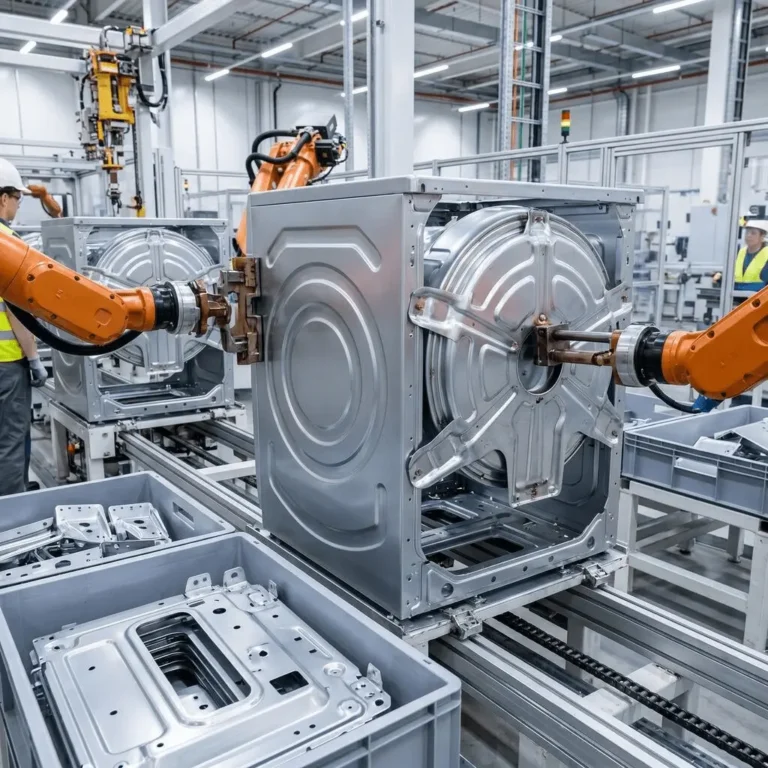
Home appliance manufacturers need sheet metal components that fit accurately, maintain a consistent appearance, and move efficiently through production. Refrigerators, washing machines, dishwashers, ovens, and other household appliances contain metal panels, covers, brackets, and internal structural parts that must work together during assembly.
The manufacturing challenge is balancing product quality with production cost. Different appliance models may require different panel dimensions, mounting holes, ventilation openings, and internal components. Design changes can create additional tooling costs, while visible surfaces and pre-coated materials require careful handling throughout production.
Fiber laser cutting offers a programmable way to produce suitable sheet metal components with defined contours, holes, slots, and openings. It can be particularly useful for prototypes, customized parts, and production runs in which designs change frequently.
However, many household appliances are manufactured in large volumes using stamping, roll forming, and other dedicated processes. Laser cutting is not automatically the most economical choice for every part. Its value depends on the component geometry, production quantity, material, and the manufacturing operations that follow.
Where Home Appliance Manufacturers Face Production Challenges
1. Product Design Changes Increase Tooling Costs
Appliance manufacturers regularly update product dimensions, control layouts, mounting arrangements, and exterior designs. A change to a refrigerator panel or washing machine enclosure may require adjustments to openings, contours, and fastening locations.
When a component relies on dedicated cutting dies, design revisions can involve tooling modifications, additional preparation, and delays before the updated part enters production.
How fiber laser cutting helps
CNC fiber laser cutting produces suitable flat components from programmed cutting paths. When a design changes, the cutting file can be revised without manufacturing a dedicated cutting die for every new contour.
This can simplify prototype production, product development, customized models, and smaller production batches.
The advantage is less significant when a design is stable and millions of identical components are required. In those cases, stamping may spread the tooling investment across enough parts to achieve a lower unit cost.
2. Panel Openings Must Match Installed Components
Household appliances contain control panels, displays, switches, cable entries, ventilation openings, and mounting points. These features must align with the components installed during assembly.
If an opening is incorrectly positioned or sized, workers may need to modify the part manually, replace it, or adjust subsequent assembly operations. Such problems can become expensive when several components must fit together.
How fiber laser cutting helps
Programmed cutting allows external contours and multiple openings to be incorporated into the same digital part layout. This reduces the need for separate manual marking and positioning operations for suitable parts.
For repeated production, validated cutting programs can be reused to help maintain consistent programmed geometry across batches.
Actual assembly accuracy still depends on the complete manufacturing process, including material variation, bending tolerances, hardware dimensions, and inspection. Critical openings should be checked against approved drawings and the actual components they accommodate.
3. Surface Damage Creates Additional Finishing Work
Many household appliances use painted steel, pre-coated sheet metal, stainless steel, or other materials selected for their appearance and operating environment.
Scratches, burrs, cutting residue, and inconsistent edge conditions can increase finishing work or affect the appearance of visible panels. Pre-coated materials also require particular care because cutting and subsequent forming can expose edges or damage the surrounding finish.
How fiber laser cutting helps
A suitable cutting process can produce controlled profiles and openings without the mechanical cutting contact associated with some conventional methods.
However, laser cutting does not guarantee a scratch-free surface or eliminate all deburring and finishing operations. The result depends on the material, coating, thickness, cutting parameters, and handling process.
Manufacturers should evaluate whether protective films are compatible with the cutting process and whether exposed edges require additional treatment. Parts should also be handled carefully during unloading, bending, and assembly to avoid damage after cutting.
For highly visible exterior panels, the complete manufacturing route matters as much as the initial cutting operation.
4. Inconsistent Components Increase Assembly Rework
Appliance enclosures often contain multiple panels, mounting brackets, internal supports, and formed components. Their dimensions must remain compatible throughout bending, joining, and final assembly.
A flat panel may meet its cutting dimensions but still create problems if its bend locations, flange dimensions, or mounting features do not match the surrounding components.
How fiber laser cutting helps
Cutting programs can be prepared from approved flat-pattern drawings that account for the intended forming process and component interfaces.
Coordinating the cutting layout with bending and assembly requirements can reduce avoidable mismatches before parts reach the assembly line.
Manufacturers should validate representative parts after bending, not only immediately after cutting. This is especially important for long panels, multiple bends, and components with closely spaced mounting features.
5. Material Waste Adds to the Cost of Appliance Components
An appliance production line may require different panel sizes, brackets, covers, and support parts. Poorly arranged cutting layouts can leave unused spaces between components and increase material consumption.
The problem becomes more noticeable when a production order contains multiple part designs or when material costs account for a significant share of the finished component cost.
How fiber laser cutting helps
Nesting software can arrange different components on a sheet to improve material utilization. Manufacturers can compare alternative layouts before production and group suitable parts according to material, thickness, and order requirements.
This flexibility can be useful for customized components and production batches containing different part sizes.
Actual savings depend on component geometry, sheet dimensions, spacing constraints, and the production mix. Nesting should be evaluated alongside handling, unloading, and finishing requirements rather than treated as a guaranteed percentage reduction in material costs.
Which Home Appliance Components Can Be Laser Cut?
Refrigerator Panels and Cabinet Components
Refrigerators and freezers contain exterior panels, internal mounting plates, brackets, access covers, and other sheet metal components.
Depending on the appliance design, these parts may require customized contours, mounting holes, cable openings, or ventilation features.
Laser cutting can produce suitable flat blanks before the parts are bent, joined, or assembled. It may be especially useful during product development or when manufacturers need different panel configurations without investing in dedicated cutting tools for every design.
High-volume exterior panels with stable designs may be better suited to stamping, roll forming, or automated panel-processing equipment.
Washing Machine and Dishwasher Enclosure Parts
Washing machines and dishwashers may use metal side panels, rear panels, support brackets, mounting plates, and internal structural components.
These parts must accommodate the appliance’s internal assemblies and maintain the required fit during production. Depending on the design, openings may be needed for fasteners, service access, cable routing, and other installed components.
Programmed laser cutting can accommodate customized flat profiles and changing hole layouts. Subsequent forming and joining operations create the final three-dimensional components.
For large production volumes, the most suitable route may combine laser cutting for selected parts with stamping or dedicated forming processes for standardized components.
Oven Panels and Appliance Covers
Ovens and other household cooking appliances may contain exterior panels, covers, control-panel blanks, mounting plates, and supporting components.
These parts can require defined openings, external contours, and mounting features. Laser cutting can produce suitable blanks according to the approved drawings, particularly for customized configurations and lower-volume production.
Material selection and finishing must reflect the component’s location and operating temperature. The finished appliance also depends on appropriate insulation, thermal design, joining, and safety validation; cutting alone does not establish those properties.
Air Conditioner Panels and Metal Housings
Household air conditioners and related appliances may use sheet metal covers, mounting plates, access panels, and internal supports.
Laser cutting can produce suitable flat components with customized contours and openings. The resulting parts may then be bent, coated, joined, or assembled with other components.
Outdoor units require materials and finishes appropriate to their operating environment. Corrosion resistance, water exposure, vibration, and installation requirements must be addressed through the complete product design rather than relying on the cutting process alone.
Mounting Brackets and Internal Structural Components
Many household appliances use small brackets, reinforcement plates, motor supports, and mounting components to position internal assemblies.
These parts may contain multiple holes, slots, and irregular contours. Laser cutting can be useful when the geometry changes between product models or when a component is needed in relatively small quantities.
However, brackets with embossed features, drawn shapes, or complex three-dimensional geometry may require stamping or additional forming operations. The best process depends on the finished geometry and production requirements.
How Fiber Laser Cutting Supports Appliance Production
Accommodate Design Changes Without Dedicated Cutting Dies
Laser cutting can produce suitable flat components from revised digital files. This can reduce dependence on dedicated cutting dies when appliance designs are still changing or when several configurations share a similar manufacturing process.
It is particularly useful for prototypes, engineering changes, customized panels, and smaller production runs.
Dedicated tooling may remain the better option for stable, high-volume components, especially when the same die can perform multiple cutting and forming operations efficiently.
Coordinate Cutting With Bending and Assembly
Cutting is only one stage in the production of appliance panels and enclosures. Many parts must be bent, joined, coated, or assembled with other components before they become finished products.
Preparing cutting files from approved flat patterns helps coordinate openings, bend locations, mounting features, and external dimensions.
Manufacturers should validate the complete component after forming because bend allowances, springback, material variation, and assembly tolerances can affect the final dimensions.
Improve Material Utilization Through Nesting
Nesting software can help arrange multiple parts on a sheet and reduce unused material between components. This is useful when a production batch includes different panel sizes or customized brackets.
The effectiveness of nesting depends on the geometry of the parts, material requirements, spacing constraints, and the planned production quantity.
Material utilization should be evaluated alongside cutting time, part handling, and downstream finishing. A layout that saves material may not necessarily minimize the total production cost if it creates additional handling or processing work.
Support Flexible Production Without Replacing Every Existing Process
A laser cutting machine can be integrated into a broader appliance manufacturing workflow alongside stamping, punching, bending, welding, and coating.
For example, a manufacturer may use laser cutting for prototypes and customized panels while retaining stamping for high-volume standardized components.
This approach avoids treating laser cutting as an all-or-nothing replacement for existing equipment. The objective is to select the appropriate process for each component based on cost, geometry, production quantity, and quality requirements.
Laser Cutting vs. Stamping for Home Appliance Parts
Laser cutting and stamping both have important roles in household appliance manufacturing. They differ in tooling requirements, production economics, and the types of features they can produce efficiently.
Laser cutting is worth considering when:
- Product designs change frequently or several configurations are required.
- Parts have customized contours or varied opening patterns.
- Prototypes and smaller production batches are common.
- Dedicated cutting tooling would create unnecessary upfront investment.
Stamping is worth considering when:
- Designs are stable and production quantities are high.
- The same component is manufactured repeatedly over a long period.
- Dedicated dies can combine cutting and forming operations.
- Low cycle times and consistent high-volume production are priorities.
There is no universal production quantity at which stamping always becomes cheaper. The crossover depends on part complexity, die investment, material utilization, secondary operations, machine capacity, and expected lifetime demand.
Manufacturers should compare the complete production route rather than the cutting cost alone. A laser-cut blank may still require separate bending, fastening, or forming operations, while a stamping die may combine several operations into a single production sequence.
Is Fiber Laser Cutting the Right Choice for Home Appliance Manufacturing?
Fiber laser cutting is worth evaluating when appliance production involves customized panels, changing product designs, complex flat profiles, or components that do not justify dedicated cutting tooling.
It can provide flexibility during product development and for selected low- to medium-volume parts. However, large-scale production of standardized appliance components may be more economical with stamping, roll forming, or dedicated automated equipment.
The right decision depends on component geometry, material, thickness, production quantity, surface requirements, and subsequent manufacturing operations.
For manufacturers evaluating laser cutting, the most useful starting point is to compare representative component drawings and actual production requirements against the capabilities of the proposed process. The goal is to improve the complete manufacturing workflow, not simply replace one cutting method with another.
Preguntas frecuentes
Can fiber laser cutting process thin sheet metal for home appliances?
Yes. Fiber laser cutting can process suitable thin sheet metal components used in appliance panels, covers, brackets, and housings. The appropriate settings and process depend on the material, thickness, coating, and required edge condition.
Is laser cutting better than stamping for appliance panels?
Not always. Laser cutting offers flexibility for customized designs, prototypes, and smaller batches. Stamping is often more economical for stable, high-volume components when tooling costs can be spread across a large number of parts.
Can laser cutting process pre-painted or coated steel?
Some coated materials can be laser cut, but suitability depends on the coating, substrate, cutting process, and equipment manufacturer’s recommendations. Cutting may damage the coating near the edge or create fumes and residue that require appropriate extraction and handling. The complete process should be tested before production.
How can manufacturers reduce rework after cutting and bending?
Use approved flat-pattern drawings, coordinate cut features with bend locations, validate representative parts, and inspect critical dimensions after forming. Checking only the flat blank may not reveal dimensional changes introduced by bending or assembly.
What information is needed to evaluate a suitable cutting machine?
Useful information includes representative part drawings, material grades, thicknesses, maximum sheet dimensions, production quantities, critical tolerances, surface finish requirements, and details about bending, forming, and assembly. These details help determine whether laser cutting is appropriate for the intended production process.