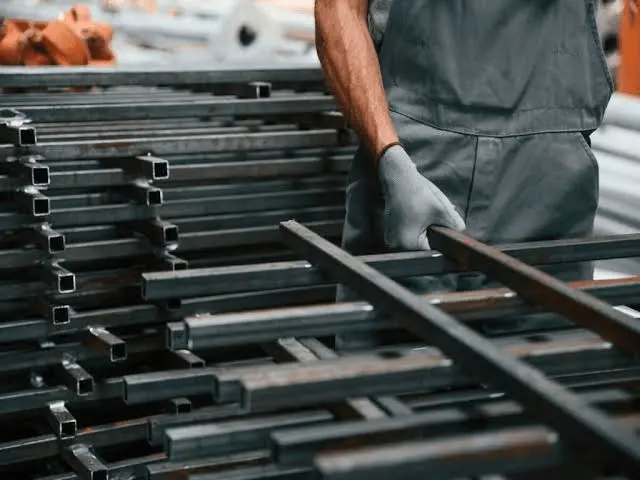
Metal tube fabrication covers a wide range of products, from machine frames and equipment structures to brackets, guards, racks and welded assemblies. Most of these projects use round, square or rectangular tubes, but the fabrication process often involves much more than cutting the material to length.
A fabricated tube may need holes, slots, notches, angled ends, miters or connection profiles before it can be welded into the finished assembly. Tube laser cutting brings many of these operations into one CNC process, allowing fabricators to produce repeatable, weld-ready tube components directly from digital drawings.
What Makes Tube Fabrication Different from Simple Tube Cutting?
A bandsaw can cut a tube to length efficiently when the only requirement is a straight cut.
The situation changes when the same tube also needs a series of holes, slots or shaped ends.
A conventional fabrication workflow may involve:
Saw Cutting → Measuring → Marking → Drilling → Notching → Grinding → Welding
For suitable components, a tube laser can combine many of these operations:
Tube Loading → Laser Cutting → Part Sorting → Welding / Bending → Assembly
The difference is not simply cutting speed. The tube leaves the machine with much of the geometry required for the next fabrication step already completed. This is why tube laser cutting is particularly useful for fabricated parts with multiple features or repeated production requirements.
What Can Be Fabricated from Laser-Cut Tubes?
Tube laser cutting is suitable for many types of fabricated metal components.
Machine Frames and Equipment Structures
Machine bases, equipment frames, guards and support structures frequently use square or rectangular tubes.
These parts may require mounting holes, cable openings, access slots and connection points. Cutting those features directly into the tube can reduce the amount of manual layout and secondary drilling before welding.
For equipment builders producing different machine configurations, the digital cutting process also makes it easier to adapt the tube geometry from one project to another.
Welded Frames and Supports
Many fabricated structures depend on tubes meeting at specific angles.
Rather than using a simple straight tube end and manually grinding the joint to fit, the laser can produce miters, copes and shaped ends according to the drawing. Properly designed tube joints can therefore arrive at the welding station with better initial fit-up.
This is useful for:
Frames · Bases · Stands · Supports · Guards · Racks · Platforms
Brackets, Mounts and Connection Components
Tubular assemblies often include smaller parts whose main purpose is to connect two sections together.
A tube may need mounting holes on several faces, elongated slots for adjustment or a shaped end that matches another component. With rotary tube processing, these features can be positioned around the tube without repeatedly removing and repositioning the workpiece.
That reduces separate setup steps and helps maintain the relationship between features on different faces of the same tube.
Structural and Architectural Fabrication
Structural fabricators work with a wide variety of hollow sections and profiles. Round and square tubes may be combined with other metal components to create railings, structural frames, architectural elements and custom assemblies.
For these applications, tube laser cutting can add holes and connection geometry before welding or installation. Larger systems can also be configured for rectangular or special profiles depending on machine capability.
Cut the Joint, Not Just the Tube
One of the biggest opportunities in tube fabrication is to design the connection itself into the laser-cut geometry.
A tube laser can produce:
-
Mitre cuts
-
Saddle and cope cuts
-
Tube-end contours
-
Mounting holes
-
Elongated slots
-
Notches
-
Connection openings
-
Weld-preparation features
-
Tabs and locating features where the design allows
These features can help components locate against one another before welding and reduce manual fitting. Current tube-laser design guidance increasingly recommends designing the joint around the laser process rather than simply copying a part originally intended for sawing and drilling.
For example, when two square tubes form a welded frame, the cut geometry can be designed so that the parts locate more naturally during assembly. When a round tube intersects another tube, a contoured end can be produced to match the connection instead of leaving the welder to create the joint by hand.
The exact design still needs to account for wall thickness, feature size, joint tolerance and the downstream welding process.
One Process for Multiple Tube Profiles
Metal fabricators rarely work with only one tube shape.
Depending on the job, production may involve:
원형 튜브
Used for rails, supports, handles, frames and tubular structures.
사각 튜브
Common for machine frames, furniture structures, racks and welded assemblies.
Rectangular Tube
Useful where orientation and structural stiffness are important.
Special Profiles
Some tube laser systems can also process selected open or custom profiles, depending on the machine configuration.
This flexibility is particularly important for job shops and contract manufacturers that need to switch between different customer projects rather than producing one standardized product all day.
A Better Fit for High-Mix Fabrication
Metal fabrication is often characterized by relatively frequent design changes.
One customer may require a batch of machine frames. Another may need equipment supports. A third may order a set of welded racks using a different tube size.
With conventional mechanical tooling, each change can introduce new drilling positions, fixtures or setup work.
Tube laser cutting uses digital cutting geometry instead. Once the tube size and cutting program are prepared, a new hole pattern, tube length or joint profile can be introduced without manufacturing a new punch or notching die.
This makes the technology suitable for both repeat production and high-mix fabrication, particularly when individual tube components contain several different features.
Material Utilization Matters Too
For a fabrication shop processing a high volume of steel or stainless steel tubing, material waste can become a significant production cost.
Tube utilization depends on more than nominal tube length. The chuck arrangement, cutting sequence, part nesting and minimum usable tail length all affect how much material remains after a production run.
LONX’s newer tube laser systems include configurations designed to reduce unusable tube remnants. The LX-K9, for example, combines intelligent chuck avoidance with a full-travel chuck design to minimize tail material while supporting automated loading for continuous production. It processes round and square tubes from Φ10–90 mm with up to 3.0G acceleration.
For fabrication shops running many small and medium-sized components from standard tube stock, this can be an important part of the overall cost calculation.
Automation for Repetitive Tube Fabrication
When production volume increases, material handling can become just as important as the cutting process.
Manual loading and unloading may be acceptable for prototypes or small batches, but repetitive production can benefit from automatic tube feeding, follow-up supports and finished-part handling.
그리고 LX-K19, for example, supports a 1.8-ton automatic loading capacity, round tubes from Φ15–180 mm and square tubes up to 180 × 180 mm. Its chuck system provides repeat positioning accuracy of ±0.05 mm, making it suitable for fabricators handling a wide range of small- and medium-diameter tubes.
For a fabrication shop, the important question is therefore not simply “How fast can the laser cut?” but also “How much manual handling remains around the laser?”
Recommended LONX Tube Laser Cutting Machines for Metal Fabrication
Because metal tube fabrication covers such a broad range of parts, model selection should start with the tube dimensions and production method.
LX-K9 — High-Speed Small and Medium Tube Fabrication
그리고 LX-K9 covers Φ10–90 mm round and square tubes and supports tube lengths up to 7100 mm. With up to 3.0G acceleration, automatic loading options and near-zero tail material under applicable conditions, it is designed for high-volume production of smaller tube components.
Suitable for: brackets, racks, frames, supports, guards and other repetitive small- and medium-tube fabrication.
LX-K19 — Flexible Fabrication Across a Wider Tube Range
그리고 LX-K19 expands the processing range to Φ15–180 mm round tubes 그리고 180 × 180 mm square tubes. Its 1.8-ton automatic loading system and ±0.05 mm repeat positioning make it suitable for fabrication shops working with different tube sizes and recurring production jobs.
Suitable for: machine frames, equipment structures, welded assemblies and mixed tube fabrication.
LX-K24 — For Larger Tubes and Heavier Fabrication
그리고 LX-K24 handles Φ15–230 mm round tubes 그리고 230 × 230 mm square tubes, with tube lengths up to 6700 mm and laser power from 3–12 kW. Its servo follow-up support system is designed to maintain tube stability during processing.
Suitable for: large frames, heavy equipment structures, structural components and larger fabricated assemblies.
LX-K35-3 — For Heavy-Duty Tube Fabrication
When fabrication involves large and heavy tube sections, the LX-K35-3 extends the range to Φ40–350 mm round tubes 그리고 350 × 350 mm square tubes, with tube lengths up to 12,000 mm and a single-tube loading capacity of up to 1,000 kg. Its three-chuck system provides additional support for long and heavy tubes.
Suitable for: heavy structural frames, large equipment, industrial machinery, pipeline components and other large tubular assemblies.
When Should a Fabricator Choose Tube Laser Cutting?
Laser tube cutting does not need to replace every existing tube-cutting method.
For a simple tube that only needs several straight cuts, a conventional saw can still be a practical solution. The stronger business case for tube laser cutting appears when the part also requires holes, slots, notches, miters, shaped ends, multiple-face features or repeatable connection geometry.
The more of these operations a fabricated tube contains, the more opportunity there is to consolidate the process.
That is why tube lasers are increasingly used not only by end-product manufacturers, but also by job shops, contract fabricators, equipment builders and OEM suppliers producing custom and repeat tube assemblies.
Build Weld-Ready Tube Parts with LONX
For metal tube fabrication, the goal is not simply to cut metal faster. It is to produce a tube component that is accurately cut, properly featured and ready for the next fabrication operation.
From a small bracket with several mounting holes to a 12-meter structural tube with complex connection geometry, LONX offers tube laser cutting configurations across a wide range of tube sizes and production requirements.
Send us your tube profile, diameter or section size, wall thickness, material, length and cutting drawings. LONX can help determine the appropriate tube laser cutting machine and configuration for your fabrication process.