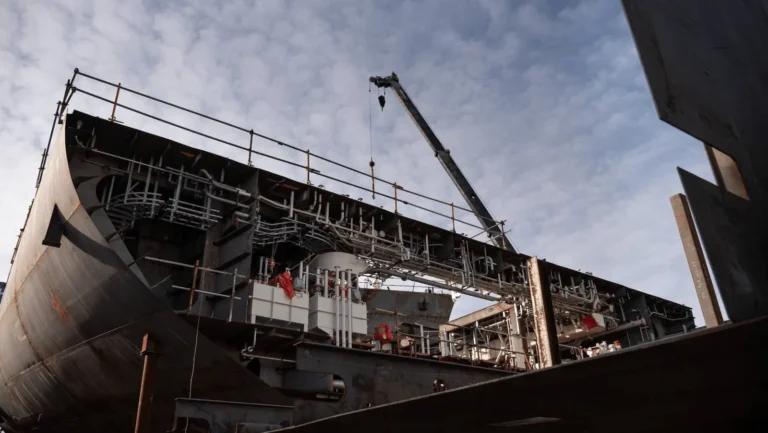
Shipbuilding involves thousands of metal components that must be cut, fitted, welded and assembled into a complete vessel. While large steel plates remain essential for hull construction, shipyards also rely heavily on round tubes, square tubes, rectangular tubes and structural profiles for piping systems, supports, frames, handrails and other marine structures.
Tube laser cutting can prepare many of these tubular and profile components directly from digital drawings. Holes, slots, notches, miters, connection profiles and bevels can be produced before welding and assembly, reducing separate drilling, coping and manual fitting operations.
In shipbuilding, tube laser cutting is therefore most valuable where the component requires both accurate cutting and preparation for the next fabrication process.
Where Tube Laser Cutting Fits in Shipbuilding
A ship is assembled from many different types of tubular and structural components.
Depending on the vessel and production area, laser-cut tubes and profiles can be used for:
Piping Systems · Pipe Supports · Structural Frames · Reinforcements · Handrails · Ladders · Platforms · Brackets · Cabin Structures · Equipment Supports
Industry solutions for shipbuilding also identify piping systems, hull ribs and beams, reinforcements, decks, bulkheads, handrails, grilles and cabin partitions among the types of components that can benefit from laser tube and profile processing.
This makes tube laser cutting relevant not only to the hull itself, but also to the large amount of secondary fabrication that takes place throughout a shipyard.
Pipe Systems and Pipe Supports
Piping is one of the most natural applications for tube laser cutting in shipbuilding.
Marine piping systems require numerous pipe sections, supports, brackets and connection components. A support tube may need holes for mounting, while a pipe component may require an angled end or a shaped opening for a branch connection.
Instead of cutting the pipe and carrying it through several separate machining operations, a tube laser can produce many of these features in one setup.
This can simplify the workflow:
Tube Loading → Laser Cutting → Fit-Up → Welding → Installation
For shipyards processing large numbers of similar support components, repeatable CNC positioning can also reduce manual marking and drilling work.
Structural Frames and Reinforcements
Not every tubular component in a ship carries fluid.
Ships also contain extensive structural systems used to support equipment, decks, access areas, machinery and internal installations. These structures can incorporate round and square tubes as well as larger structural profiles.
Typical components include:
- Structural frames
- Equipment supports
- Reinforcement members
- Tubular brackets
- Access structures
- Machinery support frames
- Platform components
For these parts, the important features are often holes, slots and connection profiles that allow the tubes to be assembled accurately with other structural members.
A tube laser can create these features directly from the engineering drawing, making the component easier to position and weld.
Hull Ribs, Beams and Other Tubular Structures
Large vessels contain numerous stiffening and reinforcement members that must be positioned accurately during assembly.
For suitable tubular structures, laser cutting can create the openings and connection geometry required before the component reaches the fabrication or welding area.
The benefit becomes more noticeable when one part contains several features that would otherwise require different machines.
Instead of:
Sawing → Marking → Drilling → Notching → Grinding
the component can be prepared through a more integrated process:
Laser Cutting → Fit-Up → Welding
This principle is widely promoted in modern tube-laser fabrication because producing a more complete component in one machining step can reduce handling and the number of separate operations.
Ship Handrails, Ladders and Access Structures
Ship interiors and exterior decks contain extensive access and safety structures.
Handrails, guardrails, ladders, walkways and platform structures commonly use tubular components that need:
- Repeated mounting holes
- Connection slots
- Angled tube ends
- Notches
- Tube intersections
- Cut-to-length sections
These are well suited to CNC tube processing because the same component geometry may need to be repeated many times throughout a vessel.
For handrails and similar assemblies, accurate tube-end geometry can also reduce the amount of adjustment required during welding.
Shipbuilding industry applications specifically include handrails, railings, grilles and other interior or outfitting structures among the tubular components suitable for laser processing.
Marine Equipment Supports and Brackets
Ships contain a large amount of equipment that must be securely mounted to the vessel structure.
Equipment supports and brackets may use tubular sections with multiple holes, slots or connection points. The exact geometry often changes depending on the equipment being installed.
This is where digitally programmed tube cutting becomes useful.
A new equipment layout can require a different mounting-hole pattern or support geometry. Instead of manufacturing a new punching die or creating a new drilling fixture, the cutting program can be changed to match the updated design.
That makes tube laser cutting suitable for both repeat shipbuilding production and project-based fabrication.
Shaped Tube Ends Improve Welding Fit-Up
One of the most useful tube-laser capabilities in shipbuilding is the ability to cut the connection geometry, rather than simply cutting a tube straight across.
When two tubes meet at an angle, a conventional straight cut may leave a gap that must be manually corrected before welding.
A tube laser can instead produce a contoured end or cope that follows the mating tube.
For fabricated marine structures, this can help:
Improve fit-up → Reduce manual grinding → Reduce positioning work → Prepare components for welding
Modern Lasertube systems are specifically promoted for creating joints and tube connections directly during laser processing, including geometries designed to simplify assembly.
For shipyards, where large numbers of welded components must be assembled accurately, this can be more important than raw cutting speed.
Bevel Cutting for Marine Fabrication
Some shipbuilding components require bevel preparation before welding.
When beveling is performed separately, the fabrication sequence may involve an additional machine or manual preparation process. A bevel tube laser can integrate the two operations.
For example:
Tube Cutting + Bevel Preparation → Fit-Up → Welding
LONX’s LX-T35-3 supports ±45° bevel cutting for round and square tubes from Ø40–350 mm, with three-chuck clamping and support for tube lengths up to 12,000 mm. It is designed for long and heavy tube fabrication, and shipbuilding is one of the heavy-industry applications supported by LONX’s structural/profile systems.
For larger pipe joints and thick-wall structural components where weld preparation is part of the process, bevel capability can reduce downstream preparation work.
Large and Heavy Tubes Require Stable Handling
Shipbuilding introduces another challenge that is less important for small fabricated products: workpiece size and weight.
Large tubes and structural sections can be several meters long and may weigh hundreds of kilograms or more. During rotation, unsupported workpieces can sag or vibrate, affecting cutting stability.
This is why large tube laser systems commonly use multiple chucks and servo-controlled support systems.
그리고 LX-T52 III, for example, uses a triple-chuck configuration with dynamic servo support and handles round and square tubes from Ø80–500 mm, with tube lengths up to 12,000 mm. It can also process channel steel, equal angle steel, I-beams and H-beams, extending the system beyond conventional round and square tube cutting.
For large shipbuilding structures, this broader profile capability can be valuable when a fabrication line handles different structural sections rather than one pipe diameter.
Automation Matters in Shipyard Production
Shipbuilding is a high-volume manufacturing environment, but it is not always a low-mix environment. Different vessels and different areas of the same vessel can require different component geometries.
Automatic loading and unloading can reduce manual handling of long and heavy tubes and keep the cutting system supplied with material.
The LX-T52 III supports customizable automatic loading and unloading for tube lengths up to 12 m, designed specifically for the handling requirements of large and heavy tubes.
For medium-sized components, the LX-K24 provides a more compact alternative, processing round and square tubes up to Φ230 mm and tube lengths up to 6700 mm. LONX specifically positions the K24 for heavy fabrication and shipbuilding projects.
The appropriate level of automation depends on whether the shipyard is producing repeat components, project-specific structures, or a mixture of both.
Tube and Structural Profile Processing
One advantage of using a capable tube laser system in a shipyard is the ability to process more than one profile type.
Depending on the machine configuration, production can include:
Round Tubes · Square Tubes · Rectangular Tubes · Channel Steel · Angle Steel · I-Beams · H-Beams
This is particularly relevant to shipbuilding because structural and outfitting work often involves more than conventional round and square pipes.
LONX’s profile laser systems extend this concept into large structural sections. The LX-H65, for example, processes round and square sections from 100–650 mm and also supports channel steel, equal angle steel, I-beams and H-beams. Shipbuilding is explicitly listed among its target applications.
For very large structural profiles, the LX-H100 extends processing to profiles up to approximately 1000 mm and uses 3D five-axis RTCP processing with automatic recognition of TEKLA-based structural models. Shipbuilding is also listed as an application.
Recommended LONX Laser Cutting Machines for Shipbuilding
The appropriate machine depends heavily on whether the shipyard is processing conventional tubes, heavy pipes or large structural profiles.
LX-K24 — For Medium Tube and Pipe Components
그리고 LX-K24 processes round and square tubes up to Φ230 mm, with tube lengths up to 6700 mm and a maximum tube load of 300 kg. LONX specifically positions it for heavy pipe fabrication and shipbuilding applications.
Suitable for: pipe supports, tubular frames, brackets, equipment supports and medium-sized shipbuilding components.
LX-T35-3 — For Large Tube Fabrication and Bevel Cutting
그리고 LX-T35-3 processes Ø40–350 mm round tubes and square tubes up to 350 × 350 mm, with tube lengths up to 12,000 mm. Its three-chuck configuration provides additional support for long workpieces, while ±45° bevel cutting can combine tube profiling with weld preparation.
Suitable for: large pipe components, structural tubes, heavy supports and welded marine structures.
LX-T52 III — For Large-Diameter and Heavy Shipbuilding Components
For larger tubular components, the LX-T52 III processes round and square tubes from Ø80–500 mm, with lengths up to 12,000 mm. It also supports channel steel, angle steel, I-beams and H-beams, with triple-chuck clamping, dynamic servo support and one-step 45° full bevel cutting.
Suitable for: large-diameter pipe components, heavy structural tubes, complex joints and components requiring integrated bevel preparation.
LX-H65 / LX-H100 — For Large Structural Profiles
When shipbuilding work moves beyond conventional pipe into heavy structural sections, LONX’s profile laser systems become more relevant.
그리고 LX-H65 handles profiles from 100–650 mm, while the LX-H100 extends the range into the very large profile segment. Both support 3D five-axis processing and list shipbuilding among their applications.
Suitable for: H-beams, I-beams, channel steel and large structural members used in shipyard fabrication.
Tube Laser Cutting in the Shipbuilding Workflow
For many tubular shipbuilding components, the process can be simplified to:
Engineering Drawing → Tube/Profile Loading → Laser Cutting → Fit-Up → Welding → Surface Treatment → Installation
The laser-cut component can already contain the holes, slots, connection profiles and other geometry required by the downstream fabrication process.
This is particularly useful when the shipyard wants to produce more complete parts rather than sending partially processed tubes between multiple machines.
At the same time, tube laser cutting should be integrated with the shipyard’s existing engineering, welding and inspection procedures. The machine produces the required geometry; project-specific welding procedures, material certification, inspection and marine standards remain separate parts of the manufacturing process.
A More Integrated Approach to Shipbuilding Fabrication
For shipbuilding, the value of tube laser cutting comes from processing a component according to its final fabrication requirements, not simply cutting raw pipe into shorter pieces.
A pipe support can be cut with its mounting holes already in place. A structural tube can receive a shaped end for a welded intersection. A large pipe can be cut and beveled in the same process. A structural profile can receive the holes and connection geometry required for assembly.
This reduces manual preparation and helps move more work upstream into a controlled CNC process.
From medium pipe supports to large structural sections, LONX offers tube and profile laser cutting systems for different levels of shipyard fabrication.