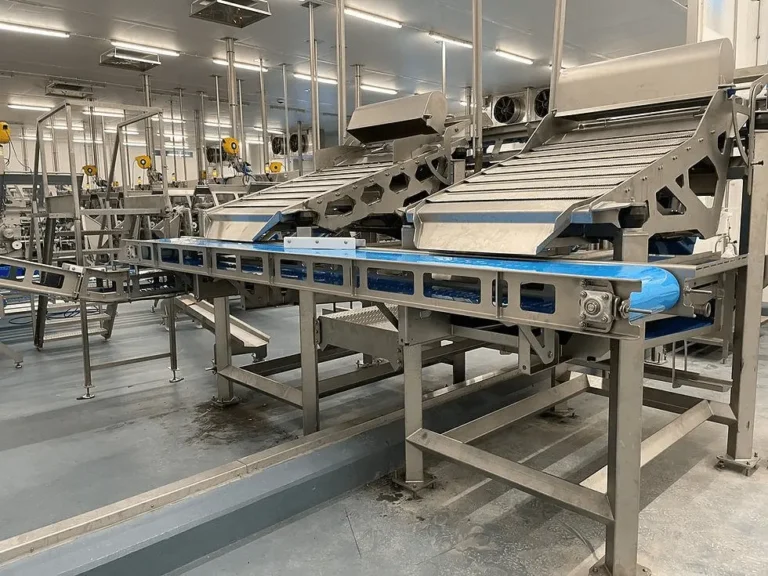
Food processing equipment manufacturers need metal components that fit accurately, withstand demanding operating conditions, and support efficient cleaning and maintenance. From conveyor housings and feed hoppers to sorting screens, machine guards, and mounting plates, sheet metal parts play an important role in the construction of food production lines.
The challenge is not simply cutting stainless steel into the required shape. Components must fit together during bending and welding, accommodate sensors and other installed equipment, and meet the surface and construction requirements of their intended use. When designs change or production involves multiple equipment configurations, manufacturers also need a flexible way to produce different parts without excessive tooling and setup costs.
Fiber laser cutting provides a programmable method for producing flat sheet metal components with defined contours, holes, slots, and openings. For suitable parts, it can reduce the need for dedicated cutting tools and simplify the production of customized components.
However, laser cutting is only one stage of equipment manufacturing. Forming, welding, surface finishing, cleaning, and final inspection all influence the finished component. The best results come from coordinating the cutting process with the complete manufacturing workflow.
Where Food Processing Equipment Manufacturers Face Production Challenges
1. Complex Cutouts Increase Setup and Rework
Food processing machinery often contains conveyor side panels, sensor mounting plates, guide plates, access covers, and components with multiple openings. These features must match the equipment layout and accommodate the hardware installed during assembly.
When parts require repeated manual marking, drilling, or separate positioning operations, preparation time can increase. Design changes may also require adjustments to existing tooling or cutting procedures.
How fiber laser cutting helps
CNC fiber laser cutting can produce suitable profiles and openings directly from programmed drawings. Different contours, mounting holes, and slots can be incorporated into the same cutting program, reducing the need for separate marking and positioning operations.
When an equipment design changes, the cutting file can be revised without manufacturing a dedicated cutting die for every new contour. This is particularly useful for customized production lines, replacement parts, and equipment manufactured in different configurations.
The actual benefit depends on part geometry and production volume. For simple, repetitive features produced in large quantities, punching or other dedicated processes may still be more economical.
2. Stainless Steel Edges Require Careful Finishing
Stainless steel is widely used in food processing equipment because suitable grades can provide corrosion resistance and withstand repeated cleaning. However, the finished component must still meet the requirements of its intended application.
Burrs, sharp edges, surface scratches, cutting residue, and unsuitable finishes can create additional work. On components exposed to food or frequent washdown, the design and condition of the finished surface also influence cleanability.
How fiber laser cutting helps
With suitable material and process parameters, laser cutting can produce controlled contours and openings that may reduce finishing work on appropriate components.
Nevertheless, laser cutting does not guarantee a burr-free edge, a polished surface, or hygienic performance. Results depend on the material grade, thickness, cutting conditions, handling, and specified finish.
Manufacturers should consider the complete process, including deburring, grinding, polishing, passivation where required, and protection against surface contamination. Representative samples should be inspected before production is released.
3. Sheet Metal Parts Must Fit During Welding and Assembly
Food processing equipment often combines flat panels, formed sections, brackets, hoppers, chutes, and supporting structures. These components must fit together before welding, fastening, or final installation.
If a panel’s dimensions or mounting features are incorrect, the result may be gaps, alignment problems, additional grinding, or rework during assembly. These issues can become more costly when several components must fit together within a larger production line.
How fiber laser cutting helps
Programmed cutting can produce flat blanks with defined external dimensions, mounting features, and connection points. Coordinating the cutting layout with the approved forming and assembly drawings helps reduce avoidable mismatches.
For components that require bending, the flat pattern must account for the intended bend geometry and manufacturing process. Parts should be checked after forming because bending can affect final dimensions and feature positions.
For welded equipment, the complete joint design and finishing process also matter. Laser cutting does not replace dimensional inspection or the welding procedures required for the finished assembly.
4. Equipment Modifications Make Dedicated Tooling Less Flexible
Food processing equipment is often customized to suit different products, line layouts, capacities, or installation conditions. A manufacturer may need to modify conveyor widths, hopper openings, access panels, sensor positions, or mounting arrangements between projects.
Dedicated cutting tools can become expensive when parts vary frequently or when individual configurations are produced in relatively small quantities.
How fiber laser cutting helps
Programmable cutting allows suitable components to be produced from revised digital files. Manufacturers can accommodate different panel sizes and opening layouts without requiring a dedicated cutting die for every contour.
This flexibility is useful for customized equipment, engineering prototypes, replacement components, and production lines with changing specifications.
For standardized components manufactured in very large quantities, dedicated tooling may provide a lower overall cost. The economic advantage of laser cutting depends on the part mix, production volume, programming requirements, and downstream operations.
5. Material Waste and Secondary Processing Increase Costs
Food processing equipment can contain parts of many different sizes, from small mounting brackets to large conveyor housings and hopper panels. Poorly planned sheet layouts can leave unused material between components.
Additional handling, deburring, bending, welding, and polishing can also increase the cost of each finished part.
How fiber laser cutting helps
Nesting software can arrange different components on a sheet to improve material utilization. Manufacturers can evaluate alternative layouts before cutting, particularly when an order includes several part sizes or customized shapes.
Laser cutting can also combine many programmed contours and openings into a single cutting operation, reducing the need for some separate marking or cutting steps.
Actual savings depend on sheet dimensions, part geometry, spacing constraints, production quantities, and the remaining finishing work. Material utilization and total production cost should be evaluated using real component drawings rather than assumed from the cutting process alone.
Which Food Processing Equipment Components Can Be Laser Cut?
Conveyor Side Panels and Machine Covers
Food processing lines use conveyor housings, side panels, machine covers, access doors, and protective guards to support equipment operation and maintenance.
These components may require mounting holes, access openings, sensor cutouts, or customized external dimensions. Laser cutting can produce suitable flat blanks before the parts are bent, welded, or assembled.
Where panels are exposed to washdown or food residues, the finished design should also consider cleanability, drainage, surface condition, and access for maintenance. The cutting process alone does not establish the hygienic performance of the complete equipment.
Hoppers, Chutes, and Guide Plates
Feed hoppers, transfer chutes, and guide plates direct ingredients or processed materials through production equipment. Their designs may involve angled panels, irregular outlines, mounting features, and connections to adjoining components.
Laser cutting can produce the flat patterns required before these parts are formed and welded.
For components that contact food, material selection, internal corner geometry, weld quality, and the finished surface must follow the applicable design and hygiene requirements. Sharp internal corners, inaccessible crevices, or poorly finished joints may make cleaning more difficult.
A successful cutting operation is therefore only the starting point. The formed and assembled component must be assessed as a complete part of the processing system.

Filtration Screens and Perforated Components
Sorting and filtration equipment may incorporate panels with repeated openings, customized cutouts, or specific hole patterns.
Laser cutting can be useful when the pattern includes irregular shapes, varying opening sizes, or customized layouts that are difficult to produce economically with dedicated tooling.
For standardized perforation in large production quantities, punching or other dedicated processes may be more efficient. The appropriate method depends on the opening geometry, sheet thickness, required pattern, production volume, and finishing requirements.
Where openings affect product separation or filtration performance, their dimensions and arrangement must be verified against the equipment’s actual operating requirements.
Mounting Brackets and Sensor Plates
Food processing equipment may require brackets and mounting plates for sensors, motors, guards, guides, and other installed components.
These parts often contain multiple holes or slots that must align with the equipment frame and the hardware being installed.
Laser cutting can produce customized profiles and mounting features from programmed drawings, making it useful for equipment modifications and varied production runs.
The finished parts may still require bending, welding, or other forming operations. Critical mounting dimensions should be verified against the actual components before the equipment is assembled.
Stainless Steel Machine Enclosures
Control enclosures, machine covers, access panels, and protective housings are used throughout food production facilities.
These components may need openings for displays, switches, cable entries, ventilation, and service access. Laser cutting can produce the required flat profiles before bending and assembly.
The final enclosure should be designed for its intended environment. Surfaces exposed to washdown, food splashes, or frequent cleaning may require suitable corrosion resistance, smooth finishes, accessible joints, and protection against water or residue accumulation.
The appropriate design depends on the enclosure’s function and location. A control cabinet outside the food-contact zone does not necessarily have the same requirements as a component that directly contacts food.
How Fiber Laser Cutting Supports Food Equipment Production
Produce Complex Profiles From Digital Drawings
Equipment manufacturers often need parts with different contours, holes, slots, and mounting features. Programmable laser cutting can produce many of these features directly from approved digital drawings.
When a design changes, the cutting program can be updated rather than creating a new dedicated cutting die for every contour. This can simplify customized production and reduce tooling dependence for suitable components.
Prepare Components for Bending and Welding
Many food machinery parts begin as flat sheets and become three-dimensional components through bending, forming, or welding.
Cutting programs should be coordinated with the approved flat patterns, bend locations, joint designs, and mounting interfaces. This helps reduce avoidable rework when the components proceed to the next manufacturing stage.
For food-contact equipment, welding and finishing require particular attention because the finished joints and surfaces can affect cleanability. Laser cutting does not eliminate the need for appropriate welding procedures, joint finishing, or inspection.
Improve Material Utilization Through Nesting
Nesting software can arrange several parts on one sheet and help reduce unused material. This can be useful when a production order includes different panel sizes, brackets, and customized components.
The most efficient layout depends on the shape and size of each part, minimum spacing requirements, sheet dimensions, and the planned production quantity.
Nesting should be evaluated alongside the time required to separate, handle, and finish the parts. A layout that uses material efficiently is not necessarily the fastest overall production route.
Reduce Unnecessary Handling and Separate Operations
Combining multiple contours and openings within one programmed cutting operation can reduce some manual marking and separate cutting steps.
This may help when producing customized panels, sensor plates, brackets, and other components that require several different features.
The complete workflow still matters. Loading, unloading, deburring, bending, welding, polishing, and assembly may remain necessary. The objective is to reduce avoidable work without compromising the quality of the finished component.
Laser Cutting vs. Punching for Food Equipment Components
Laser cutting and punching can both be effective in food processing equipment manufacturing. The appropriate choice depends on the component design and production requirements.
Fiber laser cutting is worth considering when:
- Parts have complex contours or customized openings.
- Product designs change frequently.
- Production includes multiple component variants or smaller batches.
- Dedicated cutting tooling would be difficult to justify.
Punching is worth considering when:
- Components use standardized, repetitive hole patterns.
- Production volumes are high and predictable.
- Dedicated punching tools can be used efficiently over long production runs.
- The required geometry is well suited to the available punching equipment.
Neither method is universally superior. Tooling costs, cutting or punching time, material utilization, edge quality, setup requirements, and downstream processing all influence the total cost.
For some production lines, a combination of processes may be the most practical approach: laser cutting for customized profiles and changing designs, with punching for repetitive high-volume features.
Is Fiber Laser Cutting the Right Choice for Food Processing Equipment?
Fiber laser cutting is worth considering when food machinery manufacturing involves customized stainless steel panels, conveyor housings, hopper blanks, mounting brackets, or other components with complex contours and openings.
It can be particularly useful when designs change frequently or when manufacturers need to produce different component configurations without dedicated cutting tools for every part.
However, standardized perforated components may be more economical to punch, while the manufacture of complete hoppers, conveyors, and processing systems still requires forming, welding, finishing, assembly, and inspection.
The right production route depends on the component design, material, thickness, production quantity, surface requirements, and subsequent manufacturing operations.
If you are evaluating laser cutting for your food processing equipment components, review the available sheet metal laser cutting machines against your actual drawings and production requirements.
Często zadawane pytania
Can fiber laser cutting process stainless steel for food processing equipment?
Yes. Fiber laser cutting can process suitable stainless steel sheet metal components, including conveyor panels, machine covers, mounting plates, and hopper blanks. The appropriate material grade, thickness, and cutting conditions depend on the component’s requirements.
Can laser cutting improve the fit of conveyor panels and hoppers?
Programmed cutting can help produce the specified flat profiles and openings. The final fit also depends on the accuracy of the flat pattern, bending, welding, assembly tolerances, and the design of adjoining components.
Is laser cutting better than punching for perforated components?
Not always. Laser cutting is useful for customized or complex patterns, while punching may be more economical for repetitive, high-volume hole patterns. The best choice depends on geometry, material thickness, production volume, and tooling costs.
Does laser cutting guarantee food-contact safety or hygienic surfaces?
No. Food-contact suitability depends on material selection, surface finish, weld quality, equipment design, cleaning procedures, and applicable requirements. Laser cutting is only one manufacturing operation and does not certify a component as hygienic or suitable for direct food contact.
Can laser-cut stainless steel parts be used in washdown environments?
They can be used where the material, design, finishing, and completed assembly are suitable for the intended environment. Corrosion resistance, seams, joints, drainage, electrical protection, and cleaning requirements should be considered for the complete equipment.