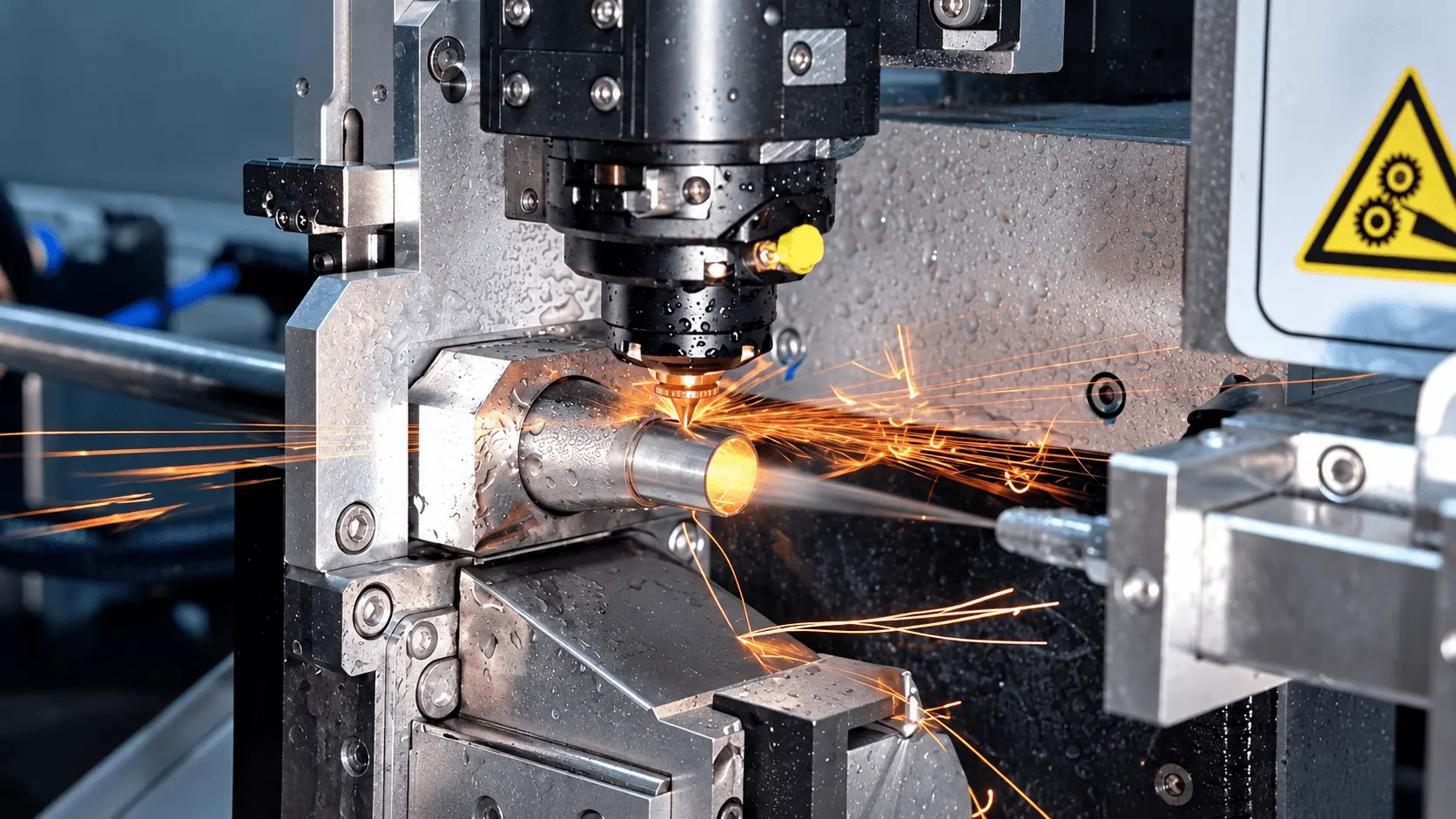
Laser tube cutting can produce precise cuts at high speed, but the quality of a finished part depends on more than what is visible from the outside.
When molten metal is not fully expelled during cutting, some of it may resolidify and adhere to the cut edge or the inside wall of the tube. This residue, commonly called dross, can increase cleaning and deburring requirements. In applications where internal cleanliness matters, it may also affect downstream welding, assembly, or fluid-system performance.
For manufacturers processing thin-walled tubing, small-diameter tubes, or complex holes and notches, controlling internal dross can be particularly challenging.
Optimizing laser parameters and assist gas conditions is an important starting point. However, some applications may benefit from additional residue-control measures, including water-spray-assisted laser tube cutting.
How does this approach work? What problems can it help address? And when is it worth considering?
This guide explains the causes of internal dross, the available approaches to managing it, and the practical considerations manufacturers should evaluate before choosing a water-spray-assisted cutting system.
What Is Dross in Laser Tube Cutting?
Dross is molten material that remains attached to a cut edge or another surface after it cools and solidifies. During laser tube cutting, it can accumulate around the opening, along the inner edge of a cut, or on the opposite inner wall of the tube.
Because a tube is hollow, cutting through one side can expose the opposite wall to hot particles and molten material ejected from the cutting zone. Depending on the material, wall thickness, tube diameter, and cutting geometry, these particles may adhere to the internal surface or cause localized heat damage.
Three terms are particularly useful when discussing tube-cutting quality:
- Dross: Resolidified molten material attached to a cut edge or surface.
- Spatter: Droplets of molten material ejected during cutting that may land on nearby surfaces.
- Burrs: Unwanted raised edges or projections along a cut that may require deburring.
These defects are related, but they are not interchangeable. A process that produces a clean outer edge may still leave internal dross, burrs around a hole, or heat damage to the opposite wall.
For this reason, evaluating laser tube cutting quality sometimes requires inspecting the inside of the workpiece rather than judging the result solely from its external appearance.
Why Does Dross Build Up Inside Laser-Cut Tubes?
Laser cutting melts material along a programmed path. Assist gas helps expel molten metal from the cutting zone, while the laser settings, nozzle condition, and cutting geometry influence the resulting cut quality.
If molten material is not expelled effectively, some may resolidify on the cut edge or accumulate elsewhere inside the tube.
Several factors can contribute to this problem.
1. Cutting parameters and assist gas conditions
Laser power, cutting speed, focal position, nozzle condition, and assist gas pressure and flow all influence how material melts and leaves the cut.
An unsuitable combination can produce excessive residue, rough edges, or inconsistent results. Reviewing and optimizing these parameters should therefore be the first step when troubleshooting dross.
However, parameter optimization alone may not address every challenge, particularly when the tube geometry makes residue difficult to control.
2. Tube geometry and internal surfaces
Unlike flat-sheet cutting, tube cutting involves a curved workpiece with an internal wall that may be exposed to ejected material.
Hot particles can strike the opposite wall, while residue may remain near the cut opening. The resulting defects depend on the tube diameter, wall thickness, material, cutting trajectory, and process conditions.
The problem can be particularly demanding when working with small-diameter tubing, where the internal space is limited and the opposite wall is relatively close to the cutting zone.
3. Complex holes and notches
Straight cut-offs and relatively small holes may be easier to process than large openings or intersecting profiles.
Consider a saddle-shaped cut in a metal tube. The cutting path passes through regions with different surface heights and orientations. The cutting head must follow the geometry accurately while maintaining suitable cutting conditions.
At the same time, manufacturers may need to control several defects:
- Burrs at the bottom of the cut.
- Dross adhering to the internal wall.
- Heat damage on the opposite side of the tube.
These are related but distinct quality requirements. A process that controls one defect does not necessarily eliminate the others.
The key point is that internal dross depends on both the cutting process and the geometry of the workpiece. The most appropriate solution depends on the actual part and its quality requirements.
Why Does Internal Dross Matter in Manufacturing?
The importance of internal dross depends on how the tube will be used and what happens after cutting.
For some components, a small amount of residue may be acceptable. For others, it can create additional processing requirements or affect product performance.
Additional cleaning and deburring
When residue remains inside a tube, operators may need to remove it manually or use a secondary cleaning process.
The difficulty depends on the tube diameter, part length, internal geometry, and accessibility of the affected area. Small or complex components can be especially difficult to clean consistently.
Even when cleaning is technically straightforward, the additional operation consumes labor and production time.
Welding and assembly consistency
Internal dross may interfere with component fit-up, contact between mating parts, or subsequent welding operations.
Whether it causes a functional problem depends on the part design and manufacturing tolerances. Nevertheless, manufacturers producing components with demanding assembly requirements should evaluate internal residue rather than judging cut quality from the outside alone.
Fluid passages and internal cleanliness
For tubes carrying liquids or gases, internal particles may be unacceptable when they can enter downstream components, interfere with flow, or violate cleanliness specifications.
The consequences depend on the system. In some applications, a validated cleaning process can remove residual particles. In others, preventing or reducing residue at the cutting stage may simplify subsequent processing.
This makes internal residue control especially relevant when the finished component has defined cleanliness requirements.
Production time and post-processing costs
Even when dross does not cause a rejected part, removing it takes time.
For repetitive production, the cumulative cost of cleaning, inspection, and rework can be significant. A cutting process that reduces secondary operations may improve overall productivity, provided the improvement is demonstrated under realistic production conditions.
How Do Manufacturers Reduce Dross in Laser Tube Cutting?
There is no single solution for every material, tube geometry, and cutting requirement. Manufacturers can consider several approaches depending on the cause of the residue and the required finished-part quality.
1. Optimize the cutting process
Review laser power, cutting speed, focal position, assist gas settings, and nozzle condition.
Correcting an unsuitable combination of parameters may improve cut quality and reduce dross without introducing additional equipment or maintenance requirements.
2. Use residue protection and collection systems
Mechanical catchers, internal protection devices, and extraction systems can help manage spatter and cutting residue in suitable applications.
Their effectiveness depends on the part geometry, accessibility, and the design of the collection system.
These approaches may be appropriate when the main requirement is to prevent ejected material from damaging a surface or to collect residue before it accumulates.
3. Evaluate water-based anti-spatter methods
Some cutting processes use water-based anti-spatter media or protective coatings to reduce residue adhesion.
These approaches should not automatically be treated as equivalent to a system that actively sprays water during cutting. Their mechanisms, application methods, and maintenance requirements may differ.
4. Consider water-assisted cutting approaches
Water can play different roles in laser processing, including cooling and helping to remove debris under appropriate process conditions.
However, not every water-assisted process works in the same way.
A water-spray-assisted tube-cutting system, a wet-cutting process that introduces water into the tube, and a water-guided laser system have different configurations. Understanding these differences is important when evaluating equipment and expected results.
How Does Water-Spray-Assisted Laser Tube Cutting Work?
Water-spray-assisted laser tube cutting integrates a water spray system into the cutting equipment to help manage residue generated during processing.
The laser remains responsible for cutting the metal. Water serves as an auxiliary part of the process rather than as a medium for guiding the laser beam.
Depending on the system design, water may help cool particles, reduce their tendency to adhere to surfaces, or assist in carrying residue away. The precise mechanism depends on the spray arrangement and how water interacts with the cutting zone.
It is therefore important to distinguish the general principles of water-assisted processing from the specific working mechanism of an individual machine.
Why does the spray system design matter?
Integrating water into a laser cutting process involves more than adding a nozzle.
The system must deliver water where it is needed while maintaining stable cutting conditions. Water and splash must also be controlled to protect sensitive components, including the cutting head’s protective optics and capacitive height-sensing system.
This becomes particularly important when cutting complex profiles. The cutting head must follow changes in the workpiece geometry while maintaining a suitable distance from the surface.
If water reaches sensitive components or interferes with height sensing, it can compromise cutting stability and increase maintenance requirements.
An effective design must therefore balance residue control, cutting-head protection, and reliable motion and height control.
[Video placement: Insert a close-up video of the water-spray system operating during tube cutting. Add labels for the chuck, spray location, cutting head, and workpiece where these are visible.]
What can water-spray-assisted cutting help achieve?
The potential benefits should be evaluated against the actual production requirements.
Depending on the application, a suitable system may help:
- Reduce internal dross or residue adhesion.
- Improve the condition of the opposite inner wall.
- Reduce the time required for secondary cleaning.
- Improve the consistency of finished parts under suitable cutting conditions.
These are potential process benefits, not guaranteed outcomes for every material or geometry.
A successful test on a simple cut-off does not establish that the same result will be achieved on a large hole, a complex saddle cut, or a different wall thickness.
Water delivery is only part of the solution
More water does not automatically guarantee better results.
The spray arrangement must suit the cutting conditions, and the equipment must be designed to withstand water exposure. Tube diameter, wall thickness, material, cut geometry, and cutting parameters can all influence the outcome.
The cutting head also needs appropriate protection against water splash and mist. Where protection is inadequate, contamination of optical components, sensor problems, and residue or moisture reaching nearby machine components may become operational concerns.
A water-spray system should therefore be evaluated as part of the complete cutting machine, not as an isolated nozzle.
Water-Spray-Assisted Cutting vs. Water-Guided Laser Cutting
The terms can sound similar, but they describe different approaches.
| Funkcja | Water-spray-assisted laser tube cutting | Water-guided laser cutting |
|---|---|---|
| How the metal is cut | A conventional laser beam cuts the metal | A laser beam is coupled into a water jet that guides its transmission |
| Role of water | An auxiliary part of the cutting process for residue control | A light-guiding medium that also influences the processing environment |
| Main focus | Internal dross, spatter, and downstream cleaning | Water-guided laser processing and specialized cutting applications |
| Main evaluation criteria | Residue control, cutting stability, finished-part quality, and post-processing | Beam delivery, precision, material interaction, and process suitability |
Water-spray-assisted tube cutting should also be distinguished from wet laser tube cutting, in which water is deliberately introduced into the tube as part of the cutting process.
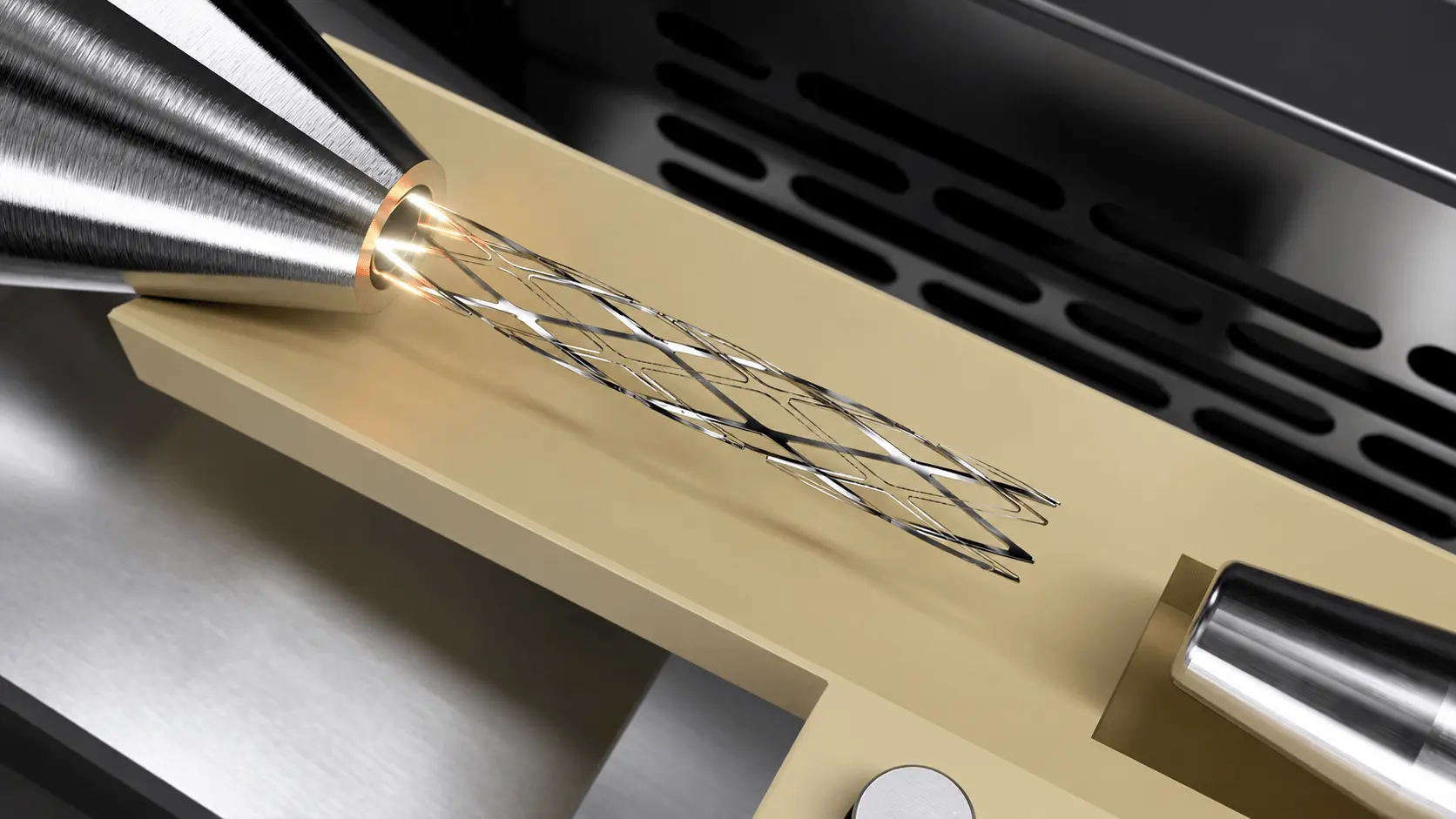
A relevant example is the peer-reviewed study Comparison of dry and wet fibre laser profile cutting of thin 316L stainless steel tubes for medical device applications. The researchers compared dry cutting with a process using water flow inside thin stainless-steel tubes. Under the tested conditions, wet cutting improved several cutting-quality measures, including dross deposition and protection against damage to the opposite wall.
However, this was a specific wet-cutting process for very small, thin-walled tubes. Its results should not be treated as direct proof of the performance of a commercial water-spray-assisted tube-cutting system.
For a different technology that uses water to guide the laser beam, see our guide to water jet laser cutting machines.
Which Industries Could Benefit from Better Internal Residue Control?
The potential value of water-spray-assisted cutting depends less on the industry name than on the workpiece, the downstream process, and the consequences of internal residue.
The following applications may warrant evaluation, although suitability must be established for each specific part.
Automotive and industrial fluid-carrying components
Fuel lines, coolant tubes, hydraulic lines, and other fluid-carrying components may have strict requirements for internal cleanliness.
If cutting residue remains inside the component, it may become a concern when particles can travel downstream, affect valves or other components, or violate cleanliness specifications.
Reducing residue at the cutting stage may help simplify subsequent processing. However, the final component must still meet its applicable cleanliness, pressure, and safety requirements.
Medical devices and precision tubing
Small, thin-walled tubes used in medical-device manufacturing can present demanding cutting challenges because of their geometry and surface-quality requirements.
Research on wet laser cutting of thin 316L stainless-steel tubes for coronary stent applications demonstrates that water-assisted processing can improve selected quality measures under specific experimental conditions.
This is a useful example of why internal residue and opposite-wall damage matter in precision manufacturing.
It does not mean that a general-purpose water-spray-assisted tube-cutting machine is automatically suitable for producing stents, catheters, or other medical devices. Such applications require appropriate process validation, material controls, cleaning procedures, and compliance with applicable requirements.
Battery thermal management and new-energy systems
Battery cooling circuits and other thermal-management assemblies may use tubular components where internal cleanliness and reliable fluid flow matter.
Residue can be a concern if it remains in a passage where particles may affect downstream components or conflict with the system’s cleanliness specification.
Water-spray-assisted cutting may be worth evaluating when it can reduce residue without introducing unacceptable moisture, corrosion, or contamination risks.
The suitability of the approach depends on the material, tube design, downstream cleaning process, and system requirements.
Hydraulic and pneumatic systems
Hydraulic and pneumatic components may contain precision passages, valves, and sealing interfaces.
Where internal particles can affect flow, contaminate a fluid circuit, or interfere with component operation, residue control is an important manufacturing consideration.
The appropriate solution may involve cutting-parameter optimization, mechanical residue collection, cleaning, or a water-assisted process. The decision should be based on the required cleanliness level and the effectiveness of the complete manufacturing process.
Home appliances, sanitary products, and food-processing equipment
Tubular components used in appliances, sanitary products, and food-processing equipment may have internal-surface, cleaning, or fluid-contact requirements.
For example, residue inside a tube may create additional cleaning work or complicate quality inspection. In fluid-contact applications, the finished component must meet the relevant hygiene and cleanliness requirements.
Water-spray-assisted cutting should be considered only as one possible step in the manufacturing process. It does not replace validated cleaning or sanitation procedures.
High-purity tubing for semiconductor and chemical systems
High-purity gas and chemical delivery systems can have particularly demanding requirements for particles, moisture, and contamination.
Reducing cutting residue at its source may be beneficial in principle, but water spray can also introduce moisture or contaminants if the process is not appropriately controlled.
For this reason, water-spray-assisted cutting should not be assumed suitable for ultra-high-purity tubing without process validation. Depending on the material and cleanliness specification, a different cutting method or a tightly controlled downstream cleaning process may be more appropriate.
When Might Water-Spray-Assisted Cutting Not Be the Right Choice?
A balanced equipment decision should consider not only the potential benefits, but also the situations in which a water-spray system may add unnecessary complexity.
When downstream cleaning already removes the residue
If a component routinely undergoes a validated cleaning, pickling, or other finishing process that reliably removes the relevant residue, adding a water-spray system may not produce enough additional value to justify its cost.
The decision should be based on the actual cleaning process, production time, quality requirements, and operating costs.
When the material or coating is sensitive to moisture
Some materials and surface treatments may be vulnerable to corrosion, staining, or moisture-related damage.
Water exposure may require additional drying, rust prevention, or process controls. Components with sensitive internal coatings also need to be evaluated for compatibility.
These requirements may reduce or outweigh the benefit of a water-assisted approach in certain applications.
When contamination control is especially demanding
In high-purity or moisture-sensitive applications, introducing water may create additional process-control requirements.
Manufacturers should assess water quality, filtration, potential residues, drying, and any contamination introduced by the system. If these requirements cannot be validated, a different approach may be more appropriate.
When maintenance costs outweigh the production benefit
A water-spray system adds components and operating considerations that must be managed over time.
Potential requirements include water supply, filtration, collection, recirculation where applicable, cleaning, corrosion prevention, and inspection of protective components.
The relevant question is not simply whether the system reduces dross. It is whether the improvement in quality or post-processing efficiency justifies the complete cost of operation.
What Should You Check Before Choosing a Water-Spray-Assisted Tube Laser?
Before investing in a new machine, manufacturers should compare results under conditions that reflect their actual production requirements.
Step 1: Select representative workpieces
Choose the materials, tube diameters, wall thicknesses, and cut geometries that are most important to your production.
Include difficult features, such as large holes or saddle-shaped cuts, if they are part of your regular workload.
Step 2: Inspect the actual cutting results
Where practical, compare conventional cutting with the proposed water-spray-assisted process using equivalent workpieces and controlled cutting conditions.
Inspect the outer cut, internal wall, opposite wall, and areas where residue is likely to accumulate.
Do not rely on a single photograph of the outside surface to determine whether the process has solved the internal-residue problem.
Step 3: Measure post-processing requirements
Record the time required for cleaning, deburring, and inspection. Check whether additional operations remain necessary and whether the finished parts meet the required acceptance criteria.
Step 4: Evaluate water management and machine protection
Ask the manufacturer about:
- Water consumption and supply requirements.
- Filtration, collection, and recirculation arrangements.
- Protection of optical components and height sensors.
- Moisture control around machine components.
- Drying and corrosion prevention for the processed material.
- Routine maintenance and consumable replacement.
The answers will help establish whether the machine is practical for the intended production environment.
Step 5: Check repeatability and total production cost
A successful sample is a useful starting point, but production equipment must also deliver consistent results over repeated cycles.
Run enough representative parts to assess stability. Then compare cycle time, cleaning time, maintenance, water-related costs, and reject or rework rates where reliable data are available.
This provides a more useful basis for investment decisions than relying on a general claim of slag-free cutting.
Recommended Water-Spray-Assisted Laser Tube Cutting Machines
The right machine depends on the workpiece, required accuracy, cutting geometry, material-handling arrangement, and the quality criteria for the finished part.
LONX offers different water-spray-assisted laser tube cutting configurations for manufacturers to evaluate.
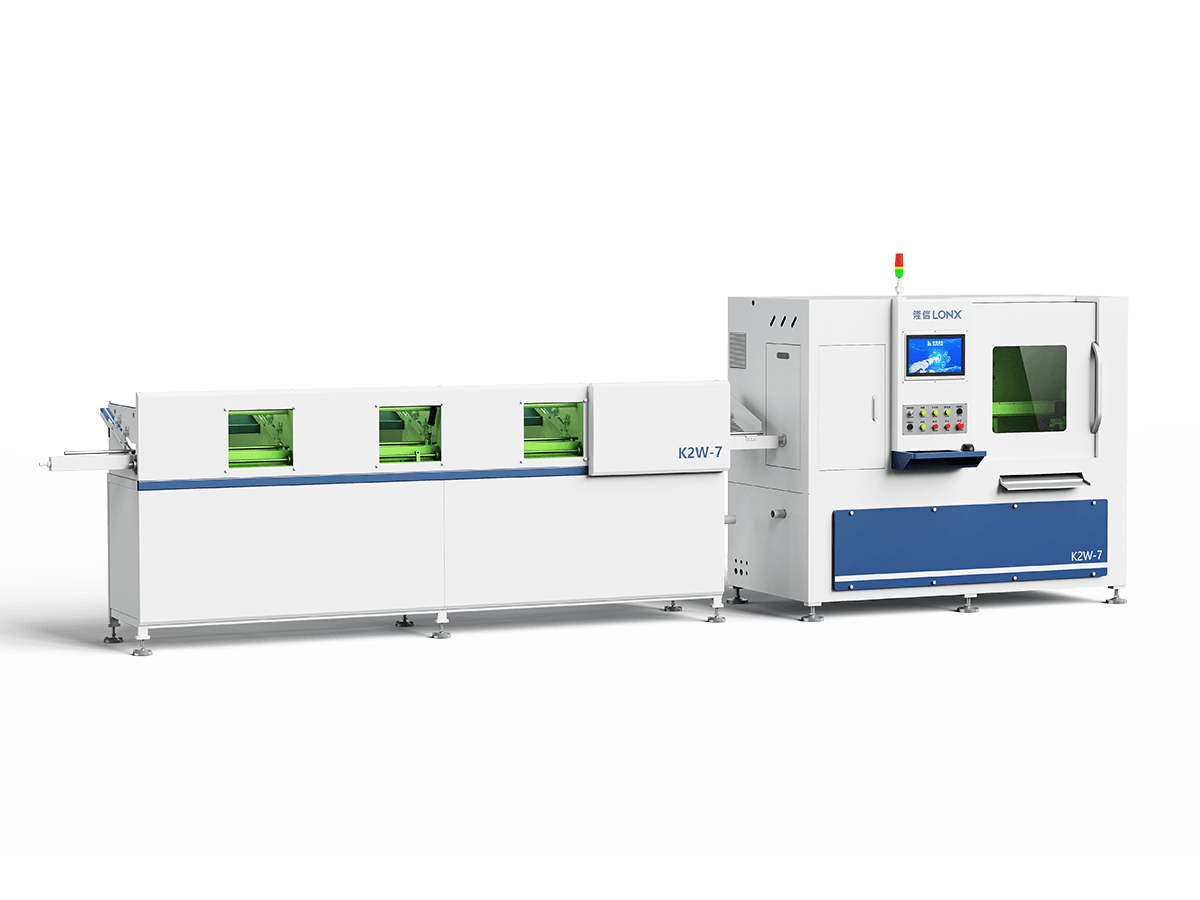
K2W: For Precision Small-Tube Processing
The LONX K2W series is designed for precision small-tube processing. Its water-spray arrangement is positioned in front of the chuck.
When evaluating the K2W, manufacturers should consider the required tube dimensions, dimensional tolerances, cut geometry, loading method, and the level of internal residue control needed.
It may be worth considering when precision small-tube processing is central to the production task.
K4W: An Alternative Water-Spray Configuration
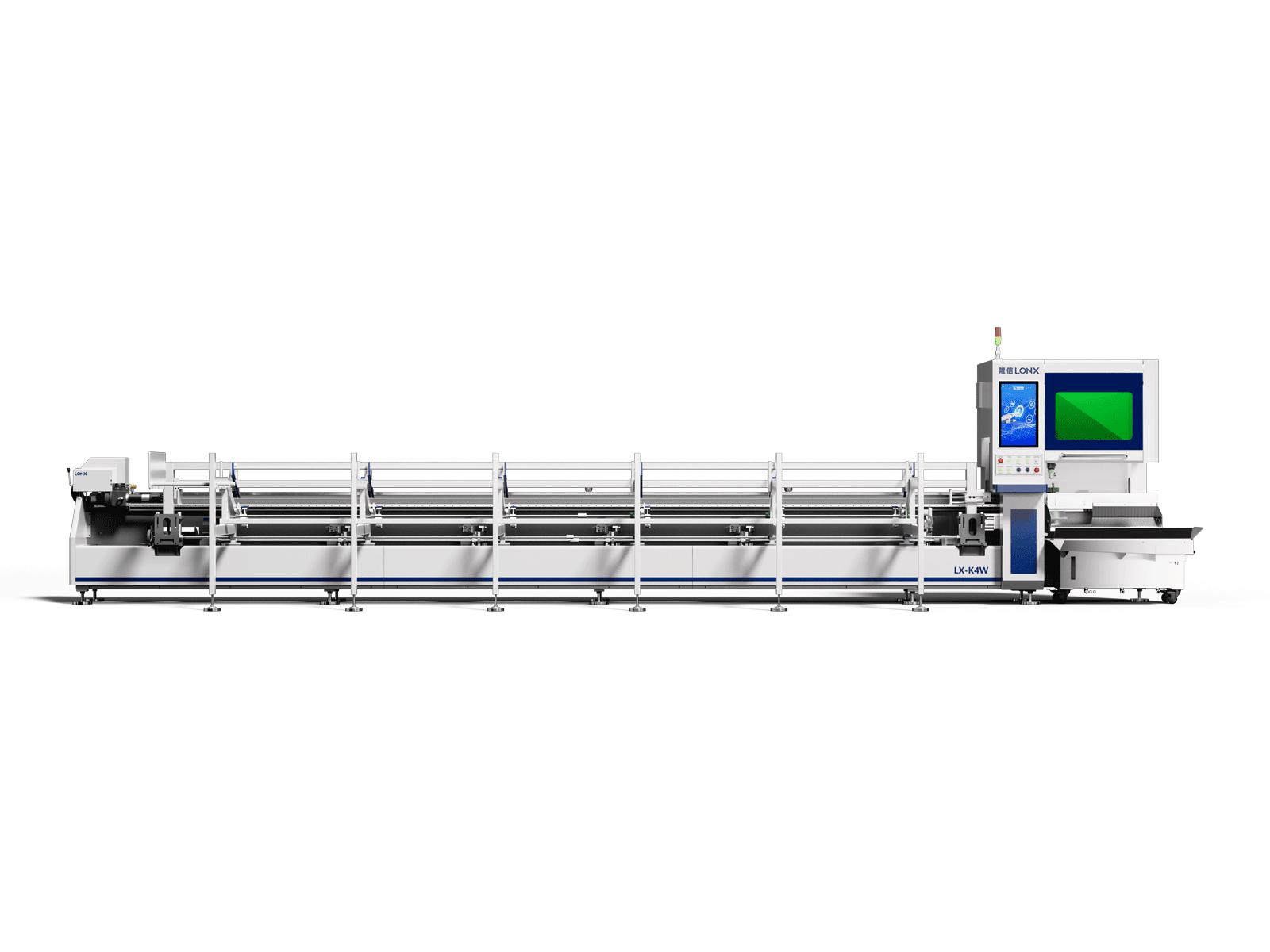
The LONX K4W uses a water-spray arrangement positioned behind the chuck, differing from the K2W layout.
The two machines should be evaluated according to their actual configurations and the requirements of the workpiece. Spray position alone does not guarantee a particular level of dross reduction or finished-part quality.
Before selecting the K4W, confirm its current processing range, achievable accuracy, loading and unloading requirements, and suitability for the intended material and cut geometry with LONX.
For either machine, a representative cutting test is the most useful way to assess internal residue, opposite-wall condition, dimensional accuracy, repeatability, and post-processing requirements.
Learn more about the LONX K4W laser tube cutting machine or contact LONX to discuss your application and arrange a cutting test.
Wnioski
Internal dross is an often-overlooked issue in laser tube cutting. Although it may not always be visible from the outside, it can increase cleaning requirements and affect downstream manufacturing operations.
Optimizing conventional cutting parameters remains important, but some applications may benefit from additional residue-control measures.
Water-spray-assisted laser tube cutting is one approach worth evaluating when internal residue, complex cut geometry, or post-processing requirements are significant concerns. Its value depends on the workpiece, the machine design, the required finished-part quality, and the overall cost of production.
It is not a universal solution, and it does not replace necessary cleaning, inspection, or process validation. The most reliable way to determine whether it is suitable is to test representative parts, measure the results, and compare the complete production process.
For manufacturers seeking to reduce internal dross, the starting point is simple: understand where the residue forms, identify why it matters to the finished component, and choose a cutting process based on measurable results rather than assumptions.
Często zadawane pytania
What causes dross inside laser-cut tubes?
Dross forms when molten material is not fully expelled during cutting and subsequently resolidifies on a cut edge or another surface. Cutting parameters, assist gas conditions, material, wall thickness, and tube geometry can all influence residue formation.
How can I reduce dross during laser tube cutting?
Start by reviewing cutting speed, laser power, focal position, nozzle condition, and assist gas settings. Depending on the application, residue protection, collection systems, or water-assisted approaches may also be worth evaluating.
Can water spray prevent dross from sticking to the tube wall?
Water-spray-assisted systems are designed to help control residue during cutting. Their effectiveness depends on the system design and operating conditions, so results should be verified using representative workpieces.
Is water-spray-assisted cutting the same as water-guided laser cutting?
No. In water-spray-assisted cutting, a conventional laser beam cuts the metal and water serves as an auxiliary part of the process. In water-guided laser cutting, a water jet guides the laser beam.
Does water-spray-assisted cutting eliminate deburring?
Not necessarily. It may reduce residue or secondary cleaning requirements in suitable applications, but the need for deburring depends on the material, geometry, cutting conditions, and required finished-part quality.
Is water-spray-assisted cutting suitable for medical or high-purity tubing?
Not automatically. These applications may have stringent requirements for internal cleanliness, moisture, contamination, and process validation. The cutting process must be assessed as part of the complete manufacturing and cleaning workflow.
What maintenance does a water-spray-assisted tube laser require?
Requirements depend on the machine design. Manufacturers should ask about water supply, filtration, collection or recirculation, protection of optical components and sensors, corrosion prevention, drying, and routine maintenance.