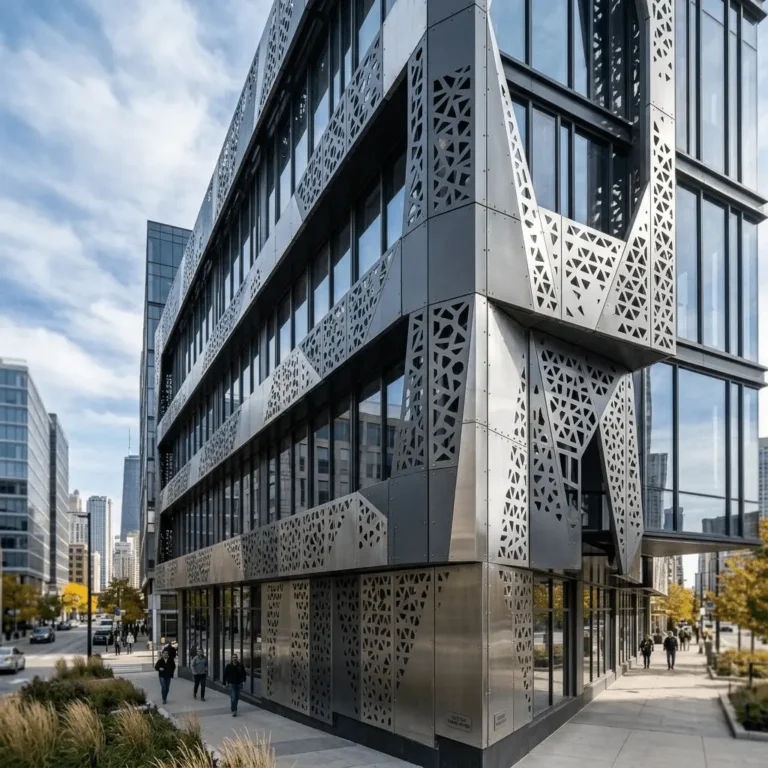
Architectural metalwork often involves more than cutting a sheet to size. Fabricators may need to produce intricate decorative patterns, custom facade panels, metal screens, partitions, and other components that must match architectural drawings and fit together during installation.
Every project can bring different dimensions, patterns, materials, and finishing requirements. When production relies heavily on manual marking, drilling, or tooling designed for a limited range of patterns, changing designs and maintaining consistency across multiple panels can become difficult.
Fiber laser cutting provides a programmable way to produce complex contours, openings, and decorative patterns directly from digital designs. For architectural metal fabricators, the main benefit is greater flexibility in turning customized drawings into repeatable sheet metal components.
The value of laser cutting, however, depends on the complete process. Material selection, panel dimensions, cutting quality, surface finishing, and installation tolerances all influence the final result.
The Production Challenges Behind Architectural Metalwork
1. Custom Patterns Make Traditional Production Difficult to Scale
Decorative screens, privacy panels, facade elements, and interior partitions may feature geometric patterns, repeated openings, logos, or custom-designed cutouts.
Producing different patterns through manual marking and drilling can require substantial preparation. Dedicated tooling may also become less economical when a project contains many unique designs or relatively small quantities.
How fiber laser cutting helps
A CNC fiber laser cutting machine can follow programmed cutting paths to produce a wide variety of contours and openings. Changing the design generally involves updating the cutting program rather than manufacturing a new dedicated cutting tool for every pattern.
This makes laser cutting worth considering for project-based manufacturing, customized architectural panels, and product lines with frequent design variations.
For extremely simple patterns produced in very large quantities, punching or dedicated tooling may still be more economical. The best process depends on pattern complexity, order volume, and tooling costs.
2. Repeated Panels Need Consistent Patterns and Dimensions
Architectural projects may require dozens or hundreds of panels with similar designs. If the pattern, opening positions, or external dimensions vary between parts, alignment can become difficult during installation.
Small dimensional differences can be particularly noticeable when panels are arranged in continuous rows or when decorative patterns must align across adjoining sections.
How fiber laser cutting helps
Once a cutting program has been validated, it can be reused for repeated parts. CNC-controlled cutting helps reproduce the programmed geometry across a production batch, reducing dependence on repeated manual marking and positioning.
However, programmed consistency does not guarantee perfect installation alignment. Material variation, thermal effects, panel handling, forming, and installation tolerances can all influence the final result.
For projects with demanding alignment requirements, establish critical dimensions in advance and inspect representative parts before producing the full batch.
3. Complex Designs Can Increase Material Waste
Decorative panels often contain many internal cutouts. Depending on the pattern and panel dimensions, the remaining material between openings may be difficult to use efficiently.
Poorly planned layouts can increase scrap, particularly when a project contains multiple panel sizes, irregular shapes, or small production batches.
How fiber laser cutting helps
Nesting software can arrange multiple components on a sheet and help optimize material utilization. Manufacturers can evaluate different layouts before cutting and adjust the arrangement according to part geometry, spacing requirements, and production priorities.
Laser cutting also avoids the need for a dedicated cutting die for every custom contour.
Actual material savings depend on the design, sheet dimensions, nesting strategy, and cutting constraints. Intricate patterns do not automatically produce better material utilization, so layouts should be evaluated using real project drawings.
4. Visible Edges and Surfaces Affect the Finished Appearance
Decorative metal screens and facade panels are often visible architectural elements. Rough edges, dross, discoloration, scratches, or inconsistent finishing can affect their appearance and create additional work before installation.
The challenge can be more significant when processing stainless steel, aluminum, coated sheet metal, or materials intended for a specific decorative finish.
How fiber laser cutting helps
With suitable material selection and cutting parameters, fiber laser cutting can produce controlled contours and detailed openings. The process can be useful for designs that require intricate patterns or clearly defined edges.
It does not automatically eliminate deburring, polishing, coating, or other finishing operations. Edge quality and surface condition depend on material, thickness, cutting parameters, protective film compatibility, and the required finish.
For visible architectural components, evaluate the complete finishing process using representative samples rather than judging the cutting result alone.
5. Panels Must Fit the Actual Installation Layout
Architectural panels are rarely installed in isolation. They may need to align with frames, fixing points, adjacent panels, openings, or building interfaces.
A panel can match its nominal drawing dimensions and still create installation difficulties if mounting holes, joint clearances, or surrounding structures have not been considered together.
How fiber laser cutting helps
Digital cutting programs make it possible to position holes, slots, and contours according to the supplied drawings. Manufacturers can incorporate specified mounting features and panel boundaries into the cutting layout before production.
For custom projects, it is important to coordinate the cutting drawing with the installation design. Critical dimensions, fixing points, joint gaps, and any required forming operations should be reviewed before the cutting program is finalized.
Laser cutting improves control over the programmed part geometry; it does not replace engineering review or site measurement where these are required.

Architectural Components That Can Benefit From Laser Cutting
Decorative Metal Screens and Privacy Panels
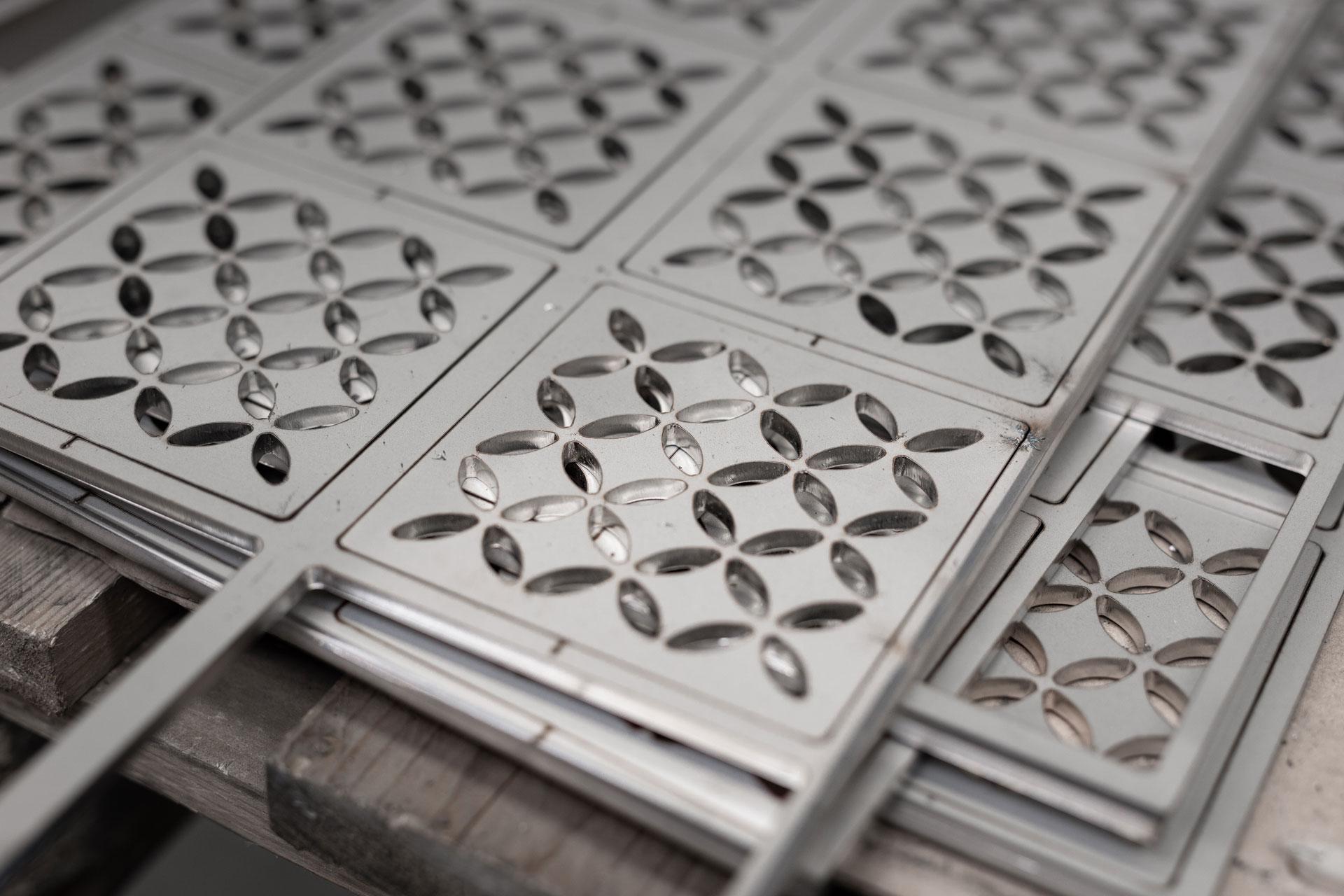
Decorative screens are used in interior partitions, building entrances, privacy dividers, and selected exterior applications. Designs may include repeated geometric patterns, organic shapes, or custom motifs.
Laser cutting is particularly relevant when the design contains intricate openings or varies between projects. Manufacturers should also consider the remaining material around each opening, panel rigidity, edge finishing, and the intended installation method.
For exterior screens, the material and finish must be suitable for the exposure conditions and maintenance requirements.
Facade Panels and Building Cladding Elements
Architectural metal panels may be used as decorative facade elements, soffit panels, or other building envelope components.
These parts can require precise external dimensions, mounting holes, ventilation openings, or decorative cutouts. Laser cutting can produce the flat profiles and features required before any subsequent forming or finishing.
The finished facade system may require additional engineering for wind loads, structural support, weather resistance, drainage, and fire performance. These requirements cannot be guaranteed by the cutting process alone and must be addressed through the appropriate design and validation procedures.
Interior Wall Panels and Decorative Partitions
Interior architectural projects may use metal wall panels, decorative partitions, ceiling features, and custom room dividers.
These applications often involve design variation and visible patterns, making programmable cutting useful for producing customized parts without creating dedicated tooling for every design.
For adjoining panels, manufacturers should check pattern alignment, edge clearances, mounting points, and the dimensions of the supporting frame.
Signage and Custom Architectural Features
Metal signage, decorative logos, lettering panels, and bespoke architectural details may require complex outlines or small internal cutouts.
Laser cutting can reproduce many of these features from digital artwork converted into a suitable cutting file. The achievable detail depends on material thickness, feature size, spacing, and cutting conditions.
Very small openings or narrow bridges between cutouts may be unsuitable for certain material thicknesses. Review the design before production and test critical features where necessary.
Perforated Panels, Screens, and Ventilation Features
Some architectural and interior components use repeated openings to provide a particular appearance or allow airflow through a panel.
Laser cutting can create customized opening patterns and contours, but the appropriate method depends on the number of holes, pattern complexity, sheet thickness, and production volume.
For standardized high-volume perforation, dedicated punching equipment may offer a more economical approach. Laser cutting is worth evaluating when design flexibility or changing patterns are important to the project.
How to Turn an Architectural Design Into a Finished Metal Panel
A successful production workflow begins with the installation requirements, not just the cutting drawing.
01. Review the Design and Installation Requirements
Confirm panel dimensions, material specifications, opening patterns, mounting points, joint gaps, and any required bends. Check that the drawing reflects the intended installation arrangement.
02. Prepare the Cutting File and Nesting Layout
Convert the approved design into a suitable cutting file. Review the minimum feature sizes, spacing between openings, sheet dimensions, and nesting arrangement before releasing the program.
03. Cut Representative Samples
For intricate patterns or visible surfaces, produce sample parts to assess edge condition, dimensional accuracy, feature quality, and any thermal effects. Confirm that the result meets the project’s requirements before proceeding with the full batch.
04. Complete Forming and Surface Finishing
Depending on the design, panels may require bending, deburring, brushing, polishing, coating, or other finishing operations. Protect finished surfaces during handling and storage.
05. Inspect and Prepare for Installation
Check critical dimensions, mounting points, pattern alignment, and edge condition. Organize components by project or installation area so that the correct panels can be identified and assembled efficiently.
How to Evaluate Laser Cutting for Architectural Projects
Before choosing a cutting process, consider the actual project requirements.
Pattern Complexity and Feature Size
Review the most detailed patterns and smallest openings in the design. Very narrow features, small holes, or thin bridges between cutouts may be affected by material thickness and cutting conditions.
Representative sample cutting can help confirm whether the proposed design is practical.
Material and Surface Finish
Identify whether the panels use carbon steel, stainless steel, aluminum, or another sheet material. Consider the required appearance, corrosion resistance, coating system, and exposure conditions.
For visible components, assess edge quality and surface handling requirements alongside cutting capability.
Panel Dimensions and Production Quantity
Determine the largest panel dimensions and the number of different designs in the project. Consider whether production involves a small number of unique panels or a large batch of repeated parts.
These factors influence the required working area, nesting strategy, loading method, and suitability of laser cutting compared with alternative processes.
Dimensional Tolerances and Installation Interfaces
Identify the critical dimensions, fixing holes, panel gaps, and alignment requirements. The required tolerance should be defined by the project design rather than assumed from a general machine specification.
For complex assemblies, coordinate the cutting drawing with the supporting structure and installation plan.
Total Manufacturing Cost
Compare the full production process, including programming, cutting, material utilization, deburring, surface finishing, handling, and installation preparation.
Laser cutting can reduce tooling dependence and improve flexibility for complex designs, but the total cost advantage depends on the actual project. For simple, repetitive parts, conventional processes may remain competitive.
Is Fiber Laser Cutting the Right Choice for Your Project?
Fiber laser cutting is worth evaluating when architectural metalwork involves intricate patterns, customized panel designs, multiple part variations, or repeated components that require consistent programmed geometry.
It may be less advantageous when the design contains only simple straight cuts or standardized perforations that can be produced more economically using shearing or dedicated punching processes.
The best decision depends on the design, material, thickness, production quantity, finishing requirements, and installation tolerances.
If you are considering laser cutting for architectural panels, review the available sheet metal laser cutting machines against your actual panel dimensions and production requirements.
Sıkça Sorulan Sorular
Can a fiber laser cutting machine produce intricate decorative metal patterns?
Yes. Fiber laser cutting can produce many detailed contours, holes, and decorative openings from a programmed design. The practical level of detail depends on the material, thickness, feature dimensions, spacing, and cutting parameters.
Is laser cutting suitable for exterior facade panels?
Laser cutting can produce suitable flat metal facade components, including panels with custom contours and mounting holes. The complete facade system must also meet the relevant structural, weather-resistance, fire-performance, and installation requirements.
How can manufacturers maintain consistent patterns across multiple panels?
Use an approved cutting program, maintain consistent material and process conditions, and inspect critical dimensions. Where panels must align across a larger installation, verify the pattern positions, mounting features, and joint clearances against the installation drawings.
Can laser cutting reduce material waste for decorative panels?
Nesting software can help arrange parts and improve material utilization. Actual results depend on the panel design, opening pattern, sheet dimensions, spacing requirements, and production layout.
Do laser-cut decorative panels require additional finishing?
They may. Depending on the material and required appearance, panels can require deburring, polishing, brushing, coating, or other surface treatments. The finishing process should be evaluated using representative samples.