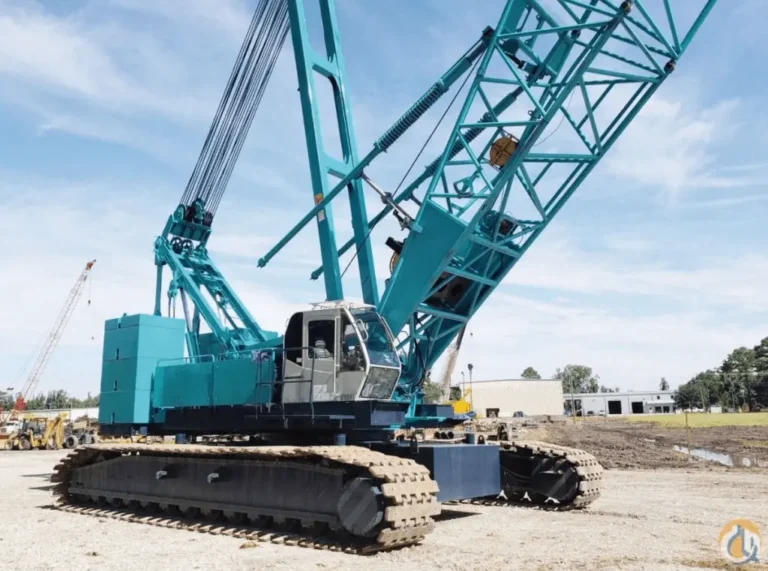
Heavy equipment manufacturers use large and heavy steel tubes and structural profiles for frames, chassis, booms, support structures, guards, and other load-bearing components. These parts often require accurately positioned holes, slots, notches, intersecting joints, and angled cuts before welding and assembly.
For manufacturers processing these components, the challenge is not simply cutting a heavy tube to length. Long and heavy workpieces need stable support during cutting, while complex structural joints may require several operations that would otherwise involve sawing, drilling, profiling, and grinding. Tube laser cutting combines many of these operations in a CNC-controlled process and can be configured for large-diameter tubes and structural profiles.
Tube Laser Cutting Applications in Heavy Equipment
Tube laser cutting is mainly used for structural and fabricated components rather than complete heavy equipment machines.
Tipik uygulamalar şunları içerir:
- Heavy equipment frames and chassis
- Boom and arm components
- Structural supports and reinforcement members
- Protective guards and roll-over structures
- Mounting brackets and support assemblies
- Access steps, platforms, and handrail structures
- Tubular components for mining, material-handling, and industrial equipment
Loaders, dozers, mining equipment, forklifts, and other heavy machines can contain substantial amounts of structural tubing. Chassis rails, boom sections, protective structures, stabilizers, and support tubes all require accurate cutting and reliable welded connections.
The required processing varies by component. A support member may only need length cutting and mounting holes, while a boom or frame component may require multiple intersecting cuts and precisely prepared tube ends.
Complex Tube Joints for Heavy Equipment Frames
Many heavy equipment structures are assembled by welding tubes and profiles at different angles. A straight 90-degree cut is often not enough to create the required joint.
A tube laser can produce holes, slots, notches, coped ends, and intersecting contours directly from the programmed geometry. This allows structural members to be prepared for their actual connection rather than being cut to length and manually modified afterward.
For example, when one structural tube intersects another member at an angle, the end of the tube can be profiled to match the adjoining component. This can reduce manual fitting and grinding before welding and make repeated frame assemblies more consistent. CNC tube laser systems are increasingly used for these kinds of structural joints because the cutting path can be generated directly from CAD geometry.
Where the joint requires weld preparation, a suitable bevel or 3D tube cutting configuration can also produce the required angled geometry during the cutting process.
Processing Large and Heavy Tubes
Large-diameter tubes create different requirements from the small and medium tubes used in industries such as furniture or automotive parts.
As tube diameter, wall thickness, length, and weight increase, workpiece stability becomes more important. A long tube can sag during processing, while an improperly supported heavy tube can vibrate or shift as it rotates.
A suitable heavy-duty tube laser therefore needs more than a large cutting diameter. Chuck configuration, workpiece support, loading capacity, and material handling all affect the stability of the cutting process.
For example, LONX’s LX-K26 uses a servo follow-up support system to support long and heavy tubes during cutting, while its loading capacity reaches 300 kg per tube. The LX-K35-3 uses three chucks and follow-up support for tubes up to Ø350 mm, with a single-tube load capacity of up to 1,000 kg and tube lengths up to 12,000 mm.
This type of machine configuration is particularly relevant when manufacturers process heavy structural members that cannot be treated like standard light-gauge tubing.
From Sawing and Drilling to Integrated Tube Processing
Heavy equipment fabrication traditionally involves several stages for preparing structural tubes:
Sawing → Marking → Drilling → Notching → Grinding → Welding
Each additional operation means moving and repositioning a heavy workpiece.
Tube laser cutting can combine many of these operations in one setup. Holes and slots can be cut according to the production drawing, while tube ends and connection contours can be processed at the same time.
For manufacturers producing different equipment models or customized structural assemblies, digital programming also makes it easier to change tube dimensions and cutting patterns without creating dedicated mechanical tooling for every component.
The result is not simply a faster cutting operation. It can simplify the flow of heavy structural components into welding and assembly by reducing manual preparation and repeated positioning.
Tube and Structural Profile Cutting for Heavy Equipment
Heavy equipment production can involve both closed-section tubes and open structural profiles.
Common closed sections include:
- Yuvarlak borular
- Square tubes
- Rectangular tubes
Larger structural equipment may also use:
- Angle steel
- Channel steel
- I-beams
- H-beams
The processing requirements are different for each type of section. A conventional tube laser can be appropriate for round, square, and rectangular tubes, while projects using large structural profiles may require a dedicated profile laser cutting system.
LONX’s LX-K26 supports round and square tubes as well as channel steel, angle steel, I-beams, and H-beams within its processing range. For substantially larger structural members, the LX-H100 is designed for round tubes up to Ø1,000 mm, square tubes up to 850 × 850 mm, and profiles including H-beams, I-beams, channels, and angle steel. Its five-axis 3D cutting system is designed for heavy industry and engineering machinery applications.
Choosing a Tube Laser Cutting Machine for Heavy Equipment
For heavy equipment components, machine selection should begin with the largest and heaviest workpiece that needs to be processed.
The key factors are:
Tube or profile size
Determine the maximum round, square, rectangular, or structural profile dimensions.
Wall thickness and material
Laser power should be matched to the material and thickness that will actually be produced.
Tube length and weight
Long and heavy tubes require sufficient loading capacity and continuous support during cutting.
Joint geometry
If the components require notches, intersecting joints, angled cuts, or weld preparation, confirm that the machine supports the required 3D or bevel cutting functions.
Üretim hacmi
For repeated production, automatic loading, multi-chuck clamping, short-tailing cutting, and material handling can have a significant effect on the overall production process.
Recommended LONX Tube Laser Cutting Machines
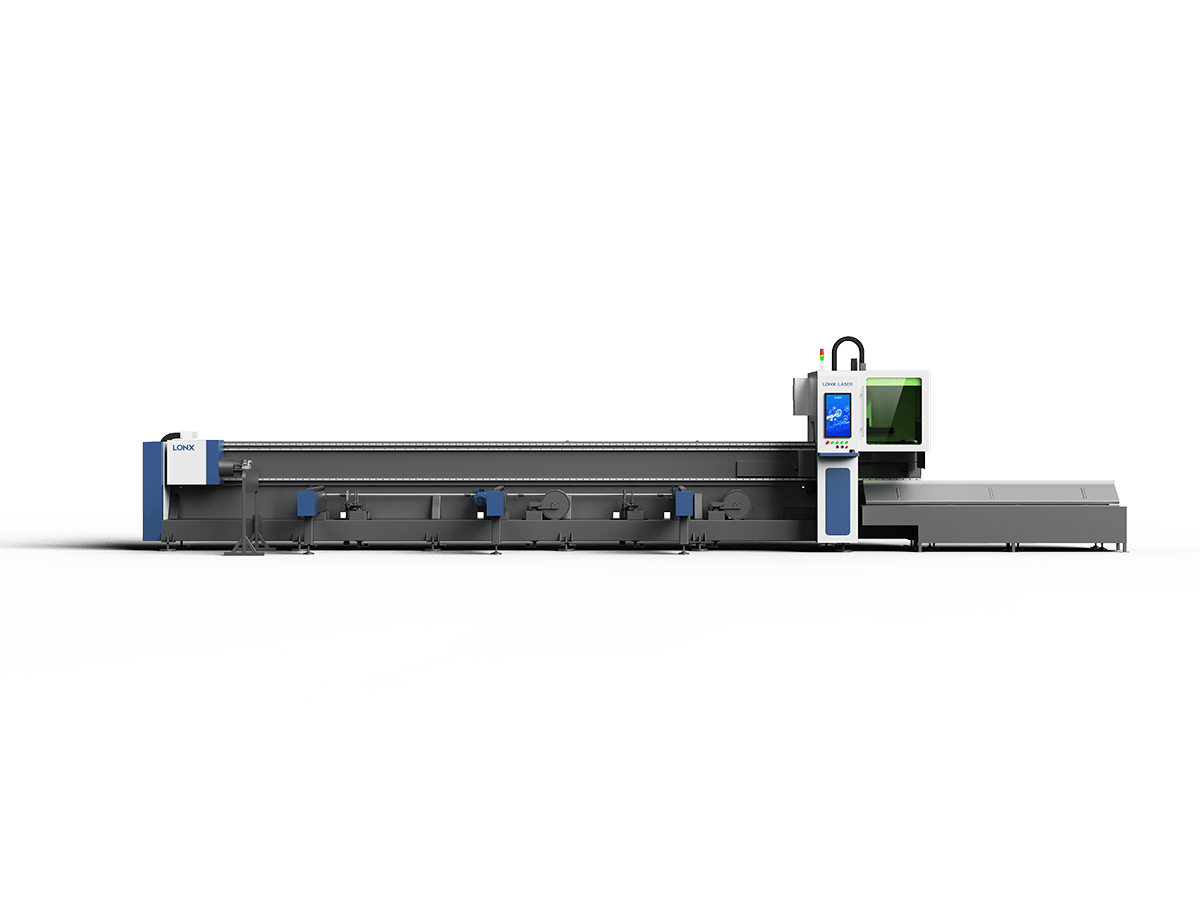
LX-K26
Designed for large-diameter tubes and structural profiles up to Ø250 mm, with a 300 kg loading capacity. It processes round and square tubes, channel steel, angle steel, I-beams, and H-beams, making it suitable for medium-to-large heavy equipment components.

LX-K35-3
A three-chuck heavy-duty tube laser for Ø40–350 mm round tubes and 40×40–350×350 mm square tubes. It supports tube lengths up to 12,000 mm and single-tube loads up to 1,000 kg, making it suitable for large, heavy structural components used in heavy equipment.
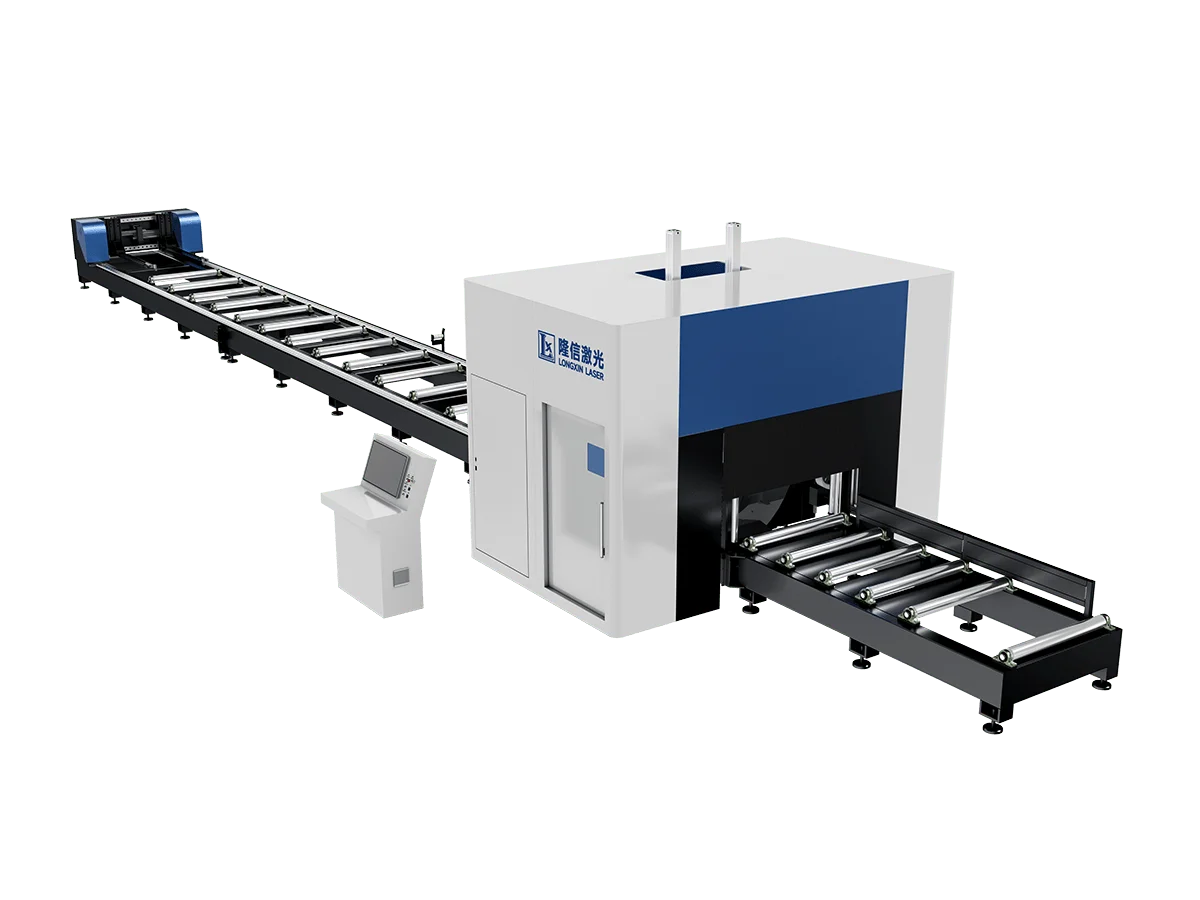
LX-H100
For very large tubular and structural sections, the LX-H100 processes round tubes from Ø150–1,000 mm and square tubes from 150×150 to 850×850 mm. It also processes H-beams, I-beams, channel steel, and angle steel and provides five-axis 3D cutting for large structural components. LONX lists heavy industry and engineering machinery among its target applications.