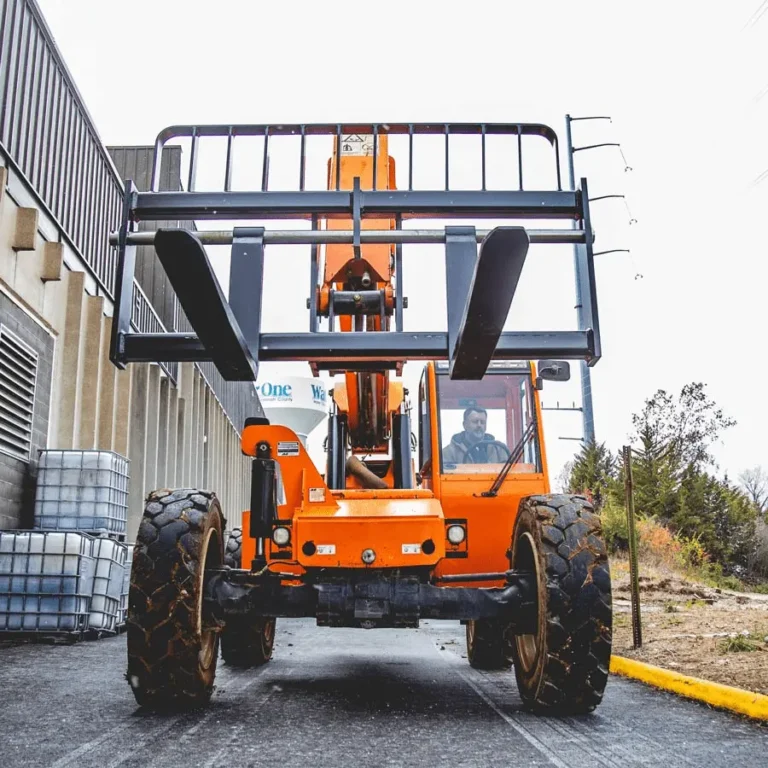
Industrial vehicles are built for work rather than conventional road transportation. Forklifts, warehouse vehicles, utility vehicles, industrial transporters, and other specialized vehicles often use welded tube and profile structures for their chassis, frames, operator protection systems, supports, and working equipment.
Unlike high-volume automotive production, industrial vehicle manufacturing often involves different models, customized configurations, and smaller production batches. This makes production flexibility just as important as cutting speed. Tube laser cutting allows manufacturers to change from one component to another through digital programs while producing holes, slots, joints, and other features together with the basic tube cut. BLM identifies production flexibility, streamlined processing, and the ability to handle different profiles and materials as key reasons for using tube laser systems in industrial vehicle manufacturing.
Tube Laser Cutting Applications in Industrial Vehicles
Tube and profile components are used throughout different types of industrial vehicles.
Tipik uygulamalar şunları içerir:
- Forklift frames and protective structures
- Chassis and support frames for industrial transport vehicles
- Warehouse and material-handling vehicles
- Utility and maintenance vehicle structures
- Operator guards and protective frames
- Mounting structures for equipment and accessories
- Tubular body and interior components
Forklift frames and similar material-handling equipment are particularly relevant because their structural components often need accurately positioned mounting holes, supports, and welded joints. Larger industrial vehicles may also require long chassis members and heavier structural tubes. BLM specifically identifies chassis parts, exhaust pipes, tubular body components, equipment, accessories, and interiors among industrial vehicle tube-laser applications.
Small-Batch Production Requires Flexible Tube Processing
Industrial vehicles are often built in smaller batches than passenger vehicles. Some models may also be customized according to the end user’s requirements.
That changes the economics of tube fabrication. Dedicated fixtures and tooling can become inefficient when dimensions or component designs change frequently.
Tube laser cutting allows a new part to be programmed digitally and put into production without mechanical tool changes. This makes it easier to produce different chassis members, supports, brackets, or protective structures within the same production environment.
For manufacturers producing custom industrial vehicles or made-to-order equipment, this flexibility can be particularly useful. BLM reports that a tube and profile laser system reduced the processing time of one industrial-vehicle component from 67 minutes using traditional machining and multiple handling steps to 8 minutes 20 seconds, with a reported 25% reduction in part cost in that specific example.
Chassis Components Need More Than Simple Tube Cutting
Industrial vehicle chassis components can be exposed to significant bending and torsional loads. As a result, their tube and profile joints need to be prepared accurately before welding.
A laser tube cutter can produce the features required to connect structural members, including:
- Mounting holes
- Bolt and rivet holes
- Slots
- Notches
- Intersecting contours
- Angled tube ends
- Weld-preparation cuts
Instead of cutting a chassis member to length and sending it to separate drilling and profiling operations, manufacturers can produce many of these features during the same CNC-controlled process.
This is particularly useful when several tubes come together to form a frame. Consistent joint geometry makes positioning and welding easier and reduces manual fitting.
One Setup Can Replace Several Tube-Processing Operations
A conventional workflow for an industrial vehicle component may involve:
Sawing → Marking → Drilling → Notching → Deburring → Welding Preparation
Tube laser cutting can combine many of these operations into one programmed process.
Holes and slots can be cut directly from the part drawing, while tube ends and joint contours can be processed at the same time. Some advanced tube-processing systems also integrate drilling, tapping, or flow-drilling operations for components that require threaded connections.
The advantage is especially relevant for heavy components, where every additional setup means moving and repositioning material.
Long Chassis Members Need Accurate Positioning
Many industrial vehicles use long chassis members. As the tube becomes longer, maintaining the position of holes and other features along its entire length becomes more difficult.
The handling system therefore matters as much as the laser itself.
Multiple chucks can control the tube at different positions during rotation and movement, while follow-up supports help stabilize longer workpieces. This is important when producing chassis members where hole locations and joint geometry must remain consistent from one end of the component to the other.
BLM notes that multi-chuck systems for large tubes can grip and control the workpiece during the cutting process without repeatedly releasing and repositioning it, improving accuracy and cycle time.
For industrial vehicle manufacturers, this can be particularly useful when processing long chassis sections or other structural members.
Different Vehicles, Different Materials and Profiles
Industrial vehicles do not all use the same structural design.
Depending on the vehicle and its working environment, manufacturers may process:
- Yuvarlak borular
- Square tubes
- Rectangular tubes
- C-shaped and U-shaped profiles
- Other structural sections
Carbon steel is common for chassis and structural components, while stainless steel and aluminum may be used for specific parts where corrosion resistance or weight reduction is required. BLM also highlights the ability to process different tube sections and materials as an important requirement for industrial vehicle manufacturing.
This is why the machine should be selected according to the actual mix of industrial vehicle components rather than simply based on laser power.
Choosing a Tube Laser Cutting Machine for Industrial Vehicles
For manufacturers of forklifts, warehouse vehicles, utility vehicles, and other industrial vehicles, several machine characteristics deserve attention.
Tube size and profile
Determine the smallest and largest tubes or profiles used in the chassis and other structural components.
Tüp uzunluğu
Long chassis members require sufficient processing length and a stable support system.
Ağırlık kapasitesi
Heavy structural tubes need suitable chuck capacity, loading equipment, and workpiece support.
Joint requirements
If components require notches, intersecting joints, angled ends, or weld preparation, the machine should provide the appropriate 3D or bevel cutting capability.
Production model
For mixed or customized production, quick program changes and automatic loading can be more valuable than maximum cutting speed alone.
Additional machining
If components also require tapping, drilling, or marking, an integrated tube-processing system may reduce the need for separate operations.
Recommended LONX Tube Laser Cutting Machines
LX-K28-3
A three-chuck tube laser for round tubes from Ø20–280 mm and square tubes from 20×20–280×280 mm, with tube lengths up to 12,000 mm. Its servo follow-up support and automatic loading configuration make it suitable for forklift frames, material-handling equipment, utility vehicle structures, and other medium-to-large tubular components.
LX-K35
A heavy-duty system for Ø40–350 mm round tubes and 40×40–350×350 mm square tubes, with a single-tube load capacity of up to 1,000 kg. It is suited to larger industrial vehicle chassis and heavy structural components where workpiece size and weight are major considerations.
LX-K19
For smaller and medium-sized industrial vehicle components, the LX-K19 covers round and square tubes from Ø15–180 mm and combines automatic loading with 1.5G acceleration and ±0.05 mm repeat positioning accuracy. It is suitable when the production mix includes a broad range of relatively compact tubular components.