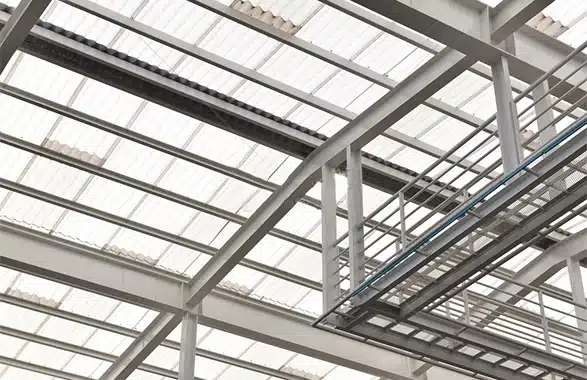
Building trusses are made from multiple tubes or structural profiles that must be cut to specific lengths and joined at different angles. Roof trusses, space frames, stadium structures, exhibition halls, and other large-span structures may contain hundreds or thousands of individual members.
For truss manufacturers, the challenge is not simply cutting tubes to length. Many members need holes, slots, notches, angled ends, or shaped joints before welding or bolting. Tube laser cutting can produce these features directly from digital designs, reducing the amount of manual layout and secondary processing required.
Why Tube Processing Matters in Truss Fabrication
A typical tube truss consists of chords, diagonal braces, vertical members, and connection components. Each member may have a different length or require a different joint geometry.
Traditional fabrication can involve several separate operations: sawing tubes to length, marking hole positions, drilling, coping tube ends, and preparing edges for welding. Every additional operation requires handling and repositioning the material.
Tube laser cutting brings many of these operations into one CNC-controlled process. The machine can cut the member to length while producing the holes, slots, contours, and joint features required for assembly.
This is particularly useful when a truss project contains many different components. Designs can be changed digitally without manufacturing a dedicated tool for every new tube geometry.
Cutting Tube Joints for Better Truss Assembly
The connection between truss members is one of the most important parts of the fabrication process.
Diagonal braces often meet the main chord at an angle rather than at a simple 90-degree joint. If the end of the brace is only cut straight, additional fitting and cutting may be required before it can be welded to the chord.
Tube laser cutting can produce profiled or notched tube ends that match the geometry of the adjoining member. This is commonly known as coping or tube end profiling.
For example, a square or round tube can be cut with a shaped end designed to fit against another round tube. The resulting joint can require less manual fitting and reduce the amount of weld filling and grinding needed during assembly. Tube laser systems are specifically used for these types of truss coping operations in structural fabrication.
Where welding preparation is required, bevel cutting can also be used to create the required edge geometry directly during tube processing.
Round Tubes, Square Tubes and Structural Profiles
Building trusses are not limited to one type of section.
Round tubes are widely used for tubular trusses and space-frame structures, while square and rectangular tubes are commonly used for frames and structural assemblies. Larger steel structures may also incorporate open or structural profiles such as angle steel, channel steel, I-beams, and H-beams.
The appropriate laser cutting system therefore depends on the profiles used in the project.
For standard pipe trusses, the main considerations are tube diameter, wall thickness, length, and the required joint geometry. For larger steel structures, the ability to process structural profiles and perform 3D cutting becomes more important.
LONX systems cover both conventional round and square tubes and larger structural profiles. Its product range includes dedicated systems for H-beam, C-channel, angle steel, and other structural sections.
Handling Long and Heavy Truss Members
Large trusses often require long structural members, and some projects use tubes several meters in length.
Long workpieces create a practical machining problem: the tube can sag or move during rotation and cutting. If the material is not properly supported, this can affect cutting stability and dimensional accuracy.
For this reason, manufacturers processing large truss members should pay attention to the machine’s loading capacity, chuck configuration, and follow-up support system.
Three-chuck systems and servo follow-up supports can improve stability when processing long or heavy tubes. LONX’s LX-K35-3, for example, supports tubes up to 12 meters in loading and unloading length, with a single-tube load capacity of up to 1,000 kg.
Material utilization is another consideration. Long structural tubes can generate significant scrap when poorly planned, so nesting and short-tail or zero-tail cutting capabilities can help manufacturers make better use of each raw tube.
Reduce Sawing, Drilling and Manual Fitting
For truss fabrication, one of the main benefits of tube laser cutting is the ability to replace several individual preparation steps with a single CNC process.
Instead of:
Sawing → Marking → Drilling → Notching → Grinding → Welding Preparation
many of these operations can be integrated into:
Tube Laser Cutting → Welding / Assembly
The exact operations depend on the machine configuration and the truss design, but combining tube cutting and joint preparation can reduce material handling and make the overall workflow easier to manage.
It also helps when a project contains a large number of unique components. Each member can be programmed according to its own length and joint geometry without creating separate mechanical tooling.
Choosing a Tube Laser Cutting Machine for Building Truss
The right machine depends on the type of truss and the profiles being processed.
For standard pipe trusses, focus on:
-
Tube diameter and wall thickness
-
Round, square, or rectangular tube
-
Maximum tube length
-
Required holes, slots, and joint profiles
-
Required bevel or 3D cutting capability
For large structural trusses, also consider:
-
Maximum tube or profile size
-
Single-tube weight
-
Long-tube support
-
Automatic loading and unloading
-
Structural-profile compatibility
-
Material utilization and tailing
If the production involves both tubular trusses and large structural profiles, a profile laser cutting system may provide a wider processing range than a conventional tube cutter.
Recommended LONX Tube and Profile Laser Cutting Machines
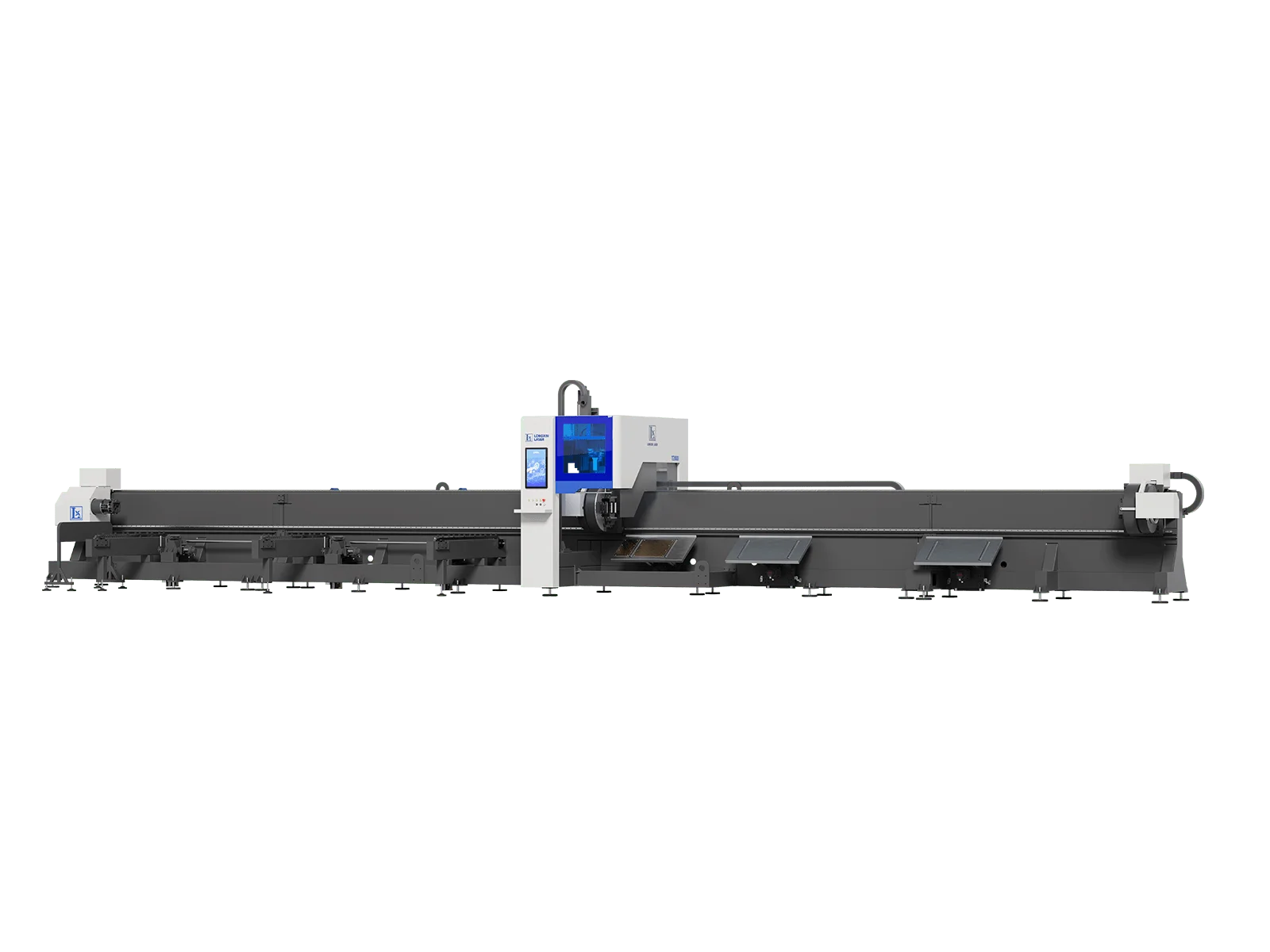
LX-K24-3
A three-chuck tube laser cutting machine for round and square tubes from Ø15–230 mm and up to 12,000 mm in tube length. It is suitable for standard and medium-size tubular trusses that require accurate joint features and long-tube processing.

LX-K35-3
Designed for larger and heavier truss members, the LX-K35-3 processes round and square tubes from Ø40–350 mm, supports tubes up to 12 meters, and handles individual tubes up to 1,000 kg. Its three-chuck structure and follow-up support are suited to heavy structural tube fabrication.
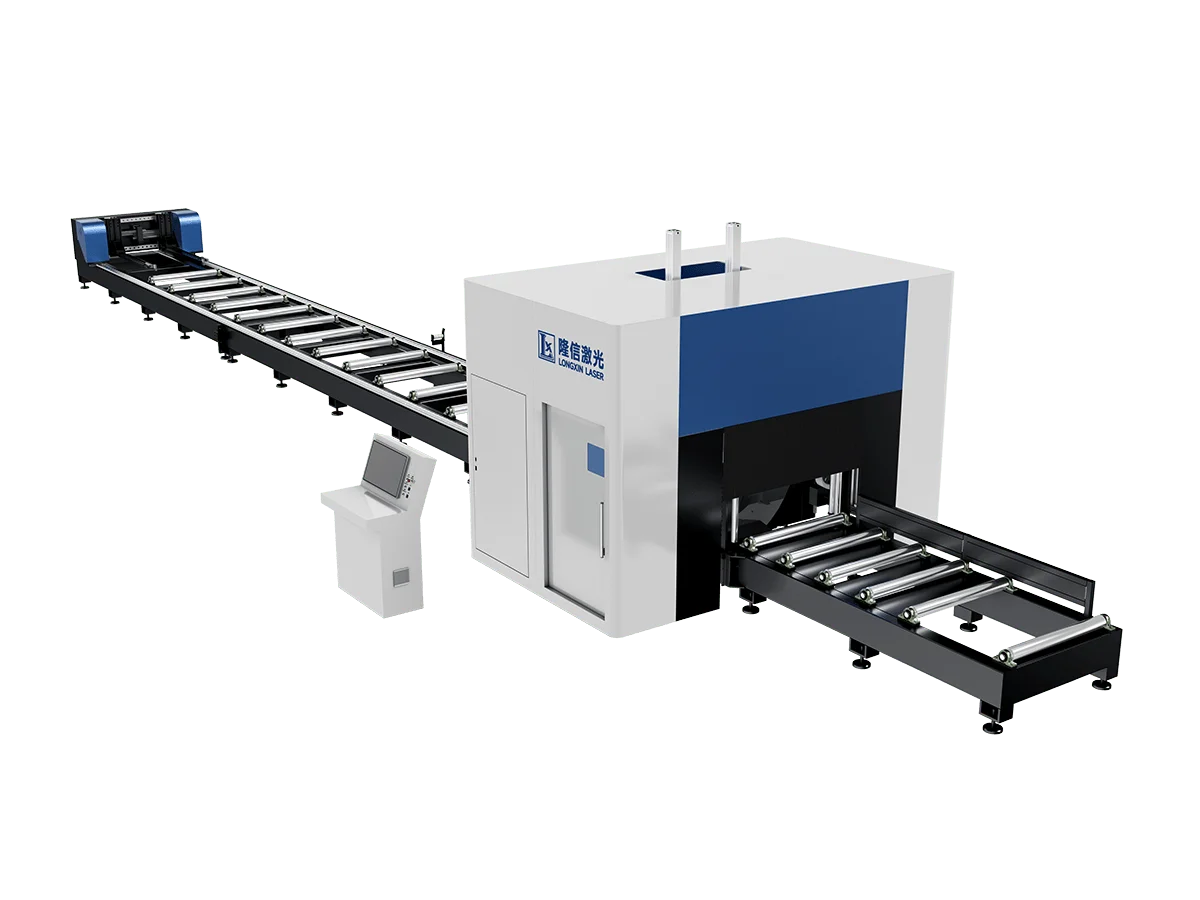
LX-H100
For projects using very large tubes and structural profiles, the LX-H100 processes round tubes from Ø150–1,000 mm and square tubes from 150×150 to 850×850 mm. It also supports channel steel, angle steel, I-beams, and H-beams, with 3D five-axis cutting for large structural components.