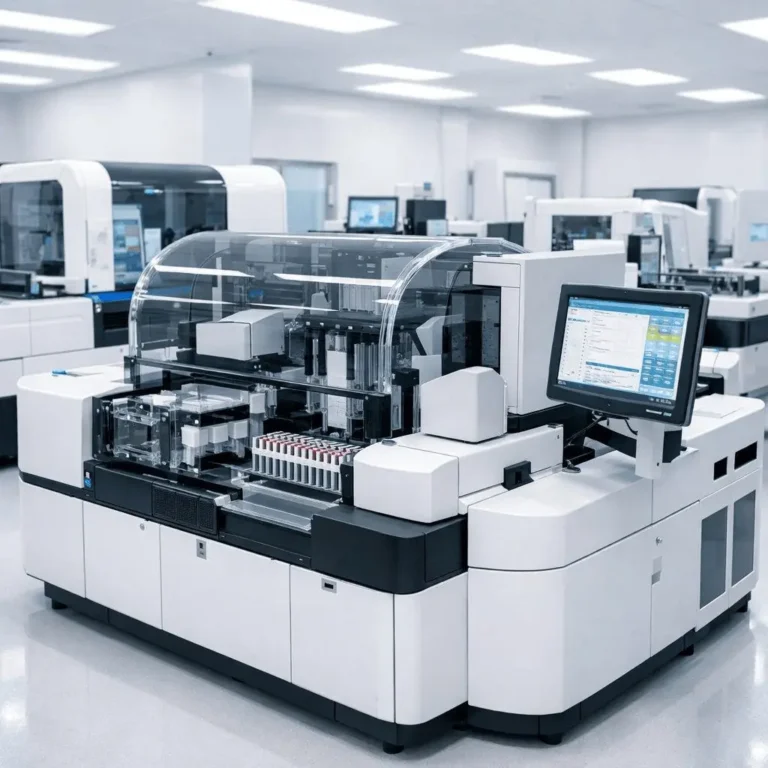
Medical and laboratory equipment manufacturers need metal components that fit accurately, maintain a consistent appearance, and support reliable assembly. From diagnostic equipment housings and laboratory analyzer cabinets to instrument carts, stainless steel trays, and mounting brackets, these components must meet the requirements of the finished equipment.
The challenge is that equipment designs often change between models. A new display, connector, control panel, or internal component can require different openings and mounting features. At the same time, visible surfaces may need careful finishing, and repeated production runs must maintain consistent dimensions.
Fiber laser cutting provides a programmable way to produce flat sheet metal components with defined contours, holes, slots, and mounting features. For suitable parts, it can reduce dependence on dedicated cutting tools and make design changes easier to accommodate.
However, cutting is only one stage of medical and laboratory equipment manufacturing. Bending, welding, hardware installation, surface finishing, cleaning requirements, and final inspection all influence the finished component. The objective is to make the cutting process support the complete production workflow.
Where Medical and Laboratory Equipment Manufacturers Face Production Challenges
1. Frequent Design Changes Create Rework and Setup Costs
Medical and laboratory equipment may contain displays, control interfaces, connectors, ventilation openings, removable covers, and internal mounting plates. When the equipment design changes, the surrounding sheet metal components may need to change as well.
For manufacturers producing multiple equipment models or customized configurations, repeated tooling changes and manual modifications can add cost and delay production.
How fiber laser cutting helps
CNC fiber laser cutting uses programmed cutting paths to produce suitable panel geometries and openings. When the design changes, the cutting file can be revised without requiring a dedicated cutting die for every new contour.
This is useful for prototype housings, customized equipment panels, lower-volume production, and product lines with frequent revisions.
The benefit depends on the part and production quantity. For simple components manufactured in very large volumes, punching or dedicated tooling may remain more economical.
2. Display, Connector, and Control Panel Openings Must Fit Precisely
Equipment housings often require openings for screens, buttons, switches, connectors, cable glands, and other installed components.
If an opening is incorrectly positioned or sized, the panel may not fit the hardware. Correcting the problem after bending, coating, or assembly can be more expensive than identifying it earlier.
How fiber laser cutting helps
Programmed cutting allows multiple openings and external contours to be defined in the same digital part layout. This reduces the need for separate manual marking and positioning operations for suitable components.
Before production, manufacturers should verify the opening dimensions against the actual hardware drawings. Connector clearance, mounting arrangements, cable routing, and access for installation must all be considered.
A correctly cut flat panel does not automatically guarantee a correctly assembled enclosure. Bending tolerances, hardware dimensions, and the geometry of adjoining components also matter.
3. Visible Surfaces Require Consistent Finishing
Medical and laboratory equipment may use stainless steel, brushed metal, or powder-coated panels. These surfaces can be visible to operators, laboratory personnel, and service technicians.
Scratches, burrs, cutting residue, uneven welds, or inconsistent coating can lead to additional finishing work and affect the appearance of the finished equipment.
How fiber laser cutting helps
A suitable laser cutting process can produce controlled profiles and openings without the mechanical cutting contact associated with some conventional methods.
However, laser cutting does not guarantee a scratch-free surface, eliminate all burrs, or provide a finished cosmetic appearance by itself. The result depends on the material, thickness, cutting parameters, handling, and specified finish.
For visible components, manufacturers should evaluate edge quality and surface condition using representative samples. Protective film management, deburring, brushing, welding, and coating may still be required.
4. Bending and Assembly Can Introduce Fit Problems
A flat enclosure panel may contain mounting holes, tabs, slots, and openings positioned close to bend lines. If these features are not coordinated with the forming process, holes can deform, flanges may interfere with adjacent parts, or mounting hardware may become difficult to install.
Such problems can lead to repeated adjustments during assembly.
How fiber laser cutting helps
Cutting programs can be prepared from approved flat-pattern drawings that account for the intended bends, mounting features, and mating components.
Reviewing the cutting layout together with the forming sequence helps identify potential problems before the parts are produced. This is particularly useful for multi-panel housings, removable covers, and equipment frames with several mounting interfaces.
The flat pattern must still be engineered correctly, and the completed part should be checked after forming. Laser cutting does not replace bending process control or assembly inspection.
5. Small Production Batches Make Tooling Investment Difficult to Justify
Medical and laboratory equipment manufacturers may produce different models in relatively small batches, particularly during product development, specialized equipment production, or the introduction of new configurations.
Investing in dedicated cutting tooling for every variation can be difficult to justify when designs change or demand remains uncertain.
How fiber laser cutting helps
Programmable cutting can produce suitable parts from revised digital files without dedicated cutting dies for every contour. This supports prototypes, pilot production, customized equipment, and repeat orders with changing quantities.
Once a design is approved, the cutting program can be reused for subsequent production runs.
For high-volume, stable designs, manufacturers should still compare laser cutting with punching or stamping. The best process depends on the complete cost of tooling, programming, production, and downstream operations.
Which Medical and Laboratory Equipment Components Can Be Laser Cut?
The following applications focus on sheet metal components that can be cut flat before bending, welding, finishing, or assembly.
Diagnostic Equipment Housings and Covers
Diagnostic and analytical equipment may require metal housings, removable covers, access panels, mounting plates, and internal supports.
These parts can contain openings for displays, connectors, ventilation, service access, and fastening hardware. Laser cutting can produce suitable flat blanks according to the approved equipment design.
For visible surfaces, manufacturers should consider handling, edge condition, and the requirements of subsequent coating or finishing. The final enclosure must also accommodate internal components and provide the required access for maintenance.
Laboratory Analyzer Cabinets and Instrument Panels
Laboratory analyzers and other benchtop or floor-standing instruments may use sheet metal cabinets, control panels, internal mounting plates, and protective covers.
Different equipment models may have different interface layouts, even when they share a similar enclosure structure.
Programmable cutting can accommodate these variations without requiring dedicated cutting tooling for every external contour. Critical display openings, connector locations, and mounting points should be checked against the actual components before production.
Medical Equipment Carts and Mobile Workstations
Mobile equipment may use formed sheet metal shelves, equipment mounting plates, side panels, drawers, and brackets.
These parts must fit with the cart frame, handles, wheels, and installed equipment. Incorrect hole positions or inconsistent panel dimensions can complicate assembly and create unnecessary adjustment work.
Laser cutting can produce suitable flat components with programmed mounting features before they are bent, welded, or assembled.
The stability, load capacity, mobility, and safety of the finished cart depend on the complete mechanical design and validation process, not on cutting accuracy alone.

Stainless Steel Trays and Shelves
Laboratory and healthcare environments may use stainless steel trays, shelves, covers, and equipment support components.
Laser cutting can produce flat blanks with customized outlines, slots, and openings. Depending on the design, these parts may then be bent, formed, polished, or assembled.
Material selection and finishing should follow the intended use and specified cleaning requirements. A stainless steel component is not automatically suitable for every cleaning, sterilization, or chemical exposure condition.
Mounting Brackets and Internal Structural Components
Equipment housings may contain brackets, supports, gussets, and mounting plates that hold internal components in position.
These parts can require several holes, slots, or irregular profiles. Laser cutting can prepare suitable blanks according to the equipment drawings, while subsequent forming and joining create the required three-dimensional structure.
Where components carry loads or support safety-critical equipment, material specifications, joining methods, structural design, and inspection must be evaluated separately.
How to Improve the Complete Sheet Metal Manufacturing Workflow
Laser cutting provides the greatest value when it is coordinated with the processes that follow it.
01. Review the Approved Equipment Drawings
Identify the material, thickness, external dimensions, display openings, connector positions, mounting holes, and critical interfaces. Confirm that the drawing reflects the actual hardware and equipment layout.
02. Prepare the Cutting Program
Create the cutting file from the approved flat pattern. Check the positions of holes, slots, bend reliefs, and other features that could affect subsequent forming and assembly.
03. Validate Representative Parts
Cut sample components using the intended material and thickness. Inspect critical dimensions, opening positions, edge quality, and any visible surface requirements before committing to a production batch.
04. Complete Forming and Hardware Installation
Bend the blanks into the required panels, covers, brackets, and housings. Install hardware according to the design and verify that holes, fasteners, and adjoining components fit correctly.
05. Finish and Inspect the Components
Complete the specified deburring, welding, surface finishing, coating, cleaning, and inspection operations. The exact requirements depend on the component and its intended use.
For regulated medical equipment, the manufacturer’s quality system and applicable requirements govern material traceability, process documentation, cleaning, validation, and final acceptance.
How to Choose a Laser Cutting Process for Medical Equipment
Before selecting a machine or changing an established process, evaluate the parts that create the greatest manufacturing difficulties.
Materiale e spessore
Identify the materials used in the actual equipment, such as stainless steel, carbon steel, or aluminum. Confirm the required thickness range, material grade, and surface condition.
Material selection should follow the component’s mechanical, corrosion-resistance, cleaning, and appearance requirements rather than assuming one material suits every medical or laboratory application.
Critical Dimensions and Hardware Interfaces
Identify the dimensions that affect assembly, including display openings, connector cutouts, mounting holes, and bend locations.
Evaluate representative components using the actual hardware and approved drawings. Where a feature requires tighter control than the normal process can reliably achieve, establish the appropriate inspection and manufacturing method before production.
Surface Finish and Cleaning Requirements
Determine whether components require brushed stainless steel, powder coating, smooth visible surfaces, or other specified finishes.
Consider the entire process, including cutting, deburring, welding, polishing, coating, and handling. The required cleaning or sterilization compatibility must be determined by the finished component’s intended use and the manufacturer’s validated requirements.
Production Volume and Design Stability
For prototypes and frequently changing designs, programmable laser cutting can reduce reliance on dedicated cutting tools. For stable, high-volume components with repetitive features, punching or other production methods may be more economical.
Compare the expected lifetime quantity, tooling cost, programming time, and downstream operations before choosing the process.
Documentation and Quality Requirements
Medical equipment manufacturers may require material documentation, revision control, dimensional inspection, and traceability from suppliers.
These requirements should be defined before production. Laser cutting does not itself establish regulatory compliance or medical quality certification; the relevant responsibilities depend on the component, supplier scope, and manufacturer’s quality system.
Is Fiber Laser Cutting the Right Choice for Medical and Laboratory Equipment?
Fiber laser cutting is worth evaluating when equipment manufacturing involves customized sheet metal housings, changing panel designs, multiple openings, mounting brackets, or lower-volume production.
It may be less economical for simple, highly repetitive components that can be produced efficiently with dedicated tooling or punching processes.
The right manufacturing route depends on material, thickness, component geometry, production volume, finishing requirements, and the processes needed to complete the assembly.
If you are evaluating laser cutting for your medical or laboratory equipment components, review the available sheet metal laser cutting machines against your actual drawings and production requirements.
Domande frequenti
Can fiber laser cutting be used for medical equipment housings?
Yes. It can produce suitable sheet metal panels, covers, mounting plates, brackets, and enclosure components with programmed contours and openings. The appropriate process depends on material, thickness, geometry, and required tolerances.
Can laser cutting improve the fit of display and connector openings?
A validated CNC cutting program can help maintain the programmed positions and dimensions of these features. The finished fit must still be verified against actual hardware, bending tolerances, and assembly requirements.
Which materials are commonly used for medical equipment sheet metal components?
Depending on the application, manufacturers may specify stainless steel, carbon steel, or aluminum. The appropriate material depends on structural requirements, corrosion exposure, cleaning procedures, surface finish, and cost.
Does laser cutting make a component medical-grade or sterile?
No. Laser cutting is a manufacturing process, not a medical certification or sterilization process. Suitability depends on the component design, material, finishing, cleaning, validation, and applicable regulatory requirements.
Is laser cutting suitable for small production batches?
It can be useful for prototypes, customized configurations, and lower-volume parts because suitable contours can be produced from revised cutting files without dedicated cutting dies for every design. The economics still depend on part complexity and production requirements.