












1. Introduction: The Rise of Coil Laser Cutting Technology
The metalworking industry is undergoing profound change driven by high product variability, just-in-time (JIT) inventory demands, and strict requirements for material efficiency. In this context, traditional metal sheet cutting methods—especially those that rely on loading individual sheets—are increasingly becoming operational bottlenecks.
1.1 Analyzing the Limitations of Traditional Metal Cutting
Traditional sheet-cutting workflows suffer from several weaknesses that directly affect production efficiency and cost control.
First, logistics and labor efficiency are low. Traditional methods require operators to load single sheets manually, which consumes labor and creates process bottlenecks that lead to significant machine idle time and the need for physical inventory buffers—pre-cut sheet stock. Heavy reliance on manual labor and time-consuming changeovers significantly reduce a factory’s responsiveness to market demand.
Second, material utilization and flexibility are limited. Shearing, punching, or plasma cutting struggle with complex profiles and freeform contours. Inefficient nesting further increases material waste. For large-volume parts, stamping requires expensive, dedicated tooling. These tooling costs and long lead times constrain design flexibility and delay time to market.
1.2 The Shift to Continuous, Coil-Fed Automation
To overcome these challenges, manufacturers are shifting toward fully automated, continuous production flows that eliminate manual handling and inventory inefficiencies. At the core of this transformation is the coil laser cutting machine (also called a laser blanking line or coil-fed laser cutting system). This solution combines the cost advantages of coil stock with the flexibility and mold-free nature of laser cutting, enabling continuous cutting of parts directly from large metal coils.
2. What Is a Coil Laser Cutting Machine?
A coil laser cutting machine is a highly integrated manufacturing ecosystem that handles the entire process from uncoiling raw material to stacking finished parts in a continuous, fully automated operation. It represents a fundamental shift away from feeding individual sheets.
2.1 Definition and Core Architectural Components
Also known as a coil-fed laser cutting machine, coil laser cutting line, or laser blanking line, the system is composed of five synchronized subsystems that work together to deliver continuous material handling and cutting:
-
Decoiler / Unwinding Machine: Handles heavy metal coils and smoothly releases material from the roll.
-
Leveler / Straightener: Eliminates the coil’s natural curvature and internal residual stress (coil memory).
-
Servo Feeder and Roller Conveyor: Precisely controls material speed and positioning to ensure stable feeding during continuous cutting.
-
Fiber Laser Cutting System: The cutting core, often mounted on linear drives to enable complex cutting on moving strip material.
-
Unloading / Stacking System: Automatically separates finished parts from skeleton scrap and stacks them for downstream operations.
2.2 Distinction: Coil-Fed vs. Traditional Sheet-Fed Systems
The key difference between coil-fed and sheet-fed systems lies in material supply and logistics. Sheet-fed systems require an inventory buffer of pre-cut sheets and periodic stops for manual sheet changes. Coil-fed systems perform true continuous processing: the laser can cut while the strip is moving, eliminating manual intervention and maximizing uptime.
Purchasing coil stock is often cheaper per unit weight than buying pre-cut sheets because it avoids supplier cutting and handling fees. Combining lower input cost with optimized nesting on long strip material provides a dual economic advantage: cheaper raw material and higher material utilization. This cost-effectiveness is a primary driver of ROI.
3. How Does the Coil Laser Cutting Process Work?
The coil laser cutting process is a highly synchronized collaboration of mechanical engineering, optics, and servo control to ensure continuous, high-precision output.
3.1 Uncoiling and Precision Feeding
The process begins with the decoiler gradually paying out the coil. High-precision sensors and automated arc-compensation systems maintain stable, continuous material feed to balance leveling and cutting speeds.
3.2 Critical Step: Advanced Leveling (Stress Relief)
Leveling is one of the most critical steps for achieving high-precision parts. Steel and alloys retain “coil memory”—internal stresses and curvature introduced during rolling and coiling. These hidden stresses can be released during cutting or forming, causing part distortion or dimensional change. Therefore, leveling is essential before laser cutting.
Modern levelers apply repeated bending over multiple roll sets to plastically yield the material and neutralize internal stresses. Multi-point adjustments across the working width compensate for center bulges or edge waves, delivering perfectly flat, stress-relieved material to the laser. The leveler is the key technology that ensures the nominal laser precision translates into real part accuracy, distinguishing a true laser blanking line from a simple decoiler with a cutting head.
3.3 Continuous Laser Cutting and Nesting Optimization
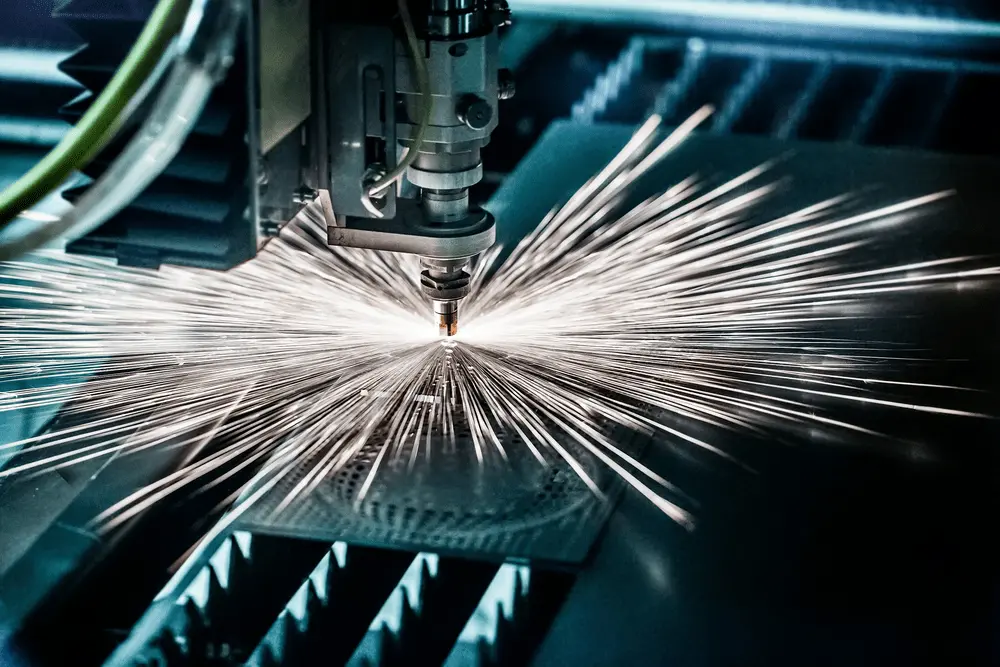
After leveling, the continuous strip enters the cutting zone. Advanced fiber lasers (power ranges from several kW up to tens of kW) mounted on linear drive systems enable high-speed, complex shape cutting while the material moves. CAD/CAM nesting optimizes layouts in real time to maximize yield and supports mixed-part production runs.
Some systems use tensioned-span cutting where the strip is clamped and supported across opposing fixtures and cut while suspended, eliminating support slats and reducing the need for periodic cleaning.
3.4 Automatic Stacking or Recoiling
Once parts are cut, scrap falls away while conveyors capture released parts. Automated stacking systems handle finished parts gently and precisely, preparing them for downstream bending, welding, or assembly.
4. Key Advantages of Coil Laser Cutting Machines
Coil-fed laser cutting machines deliver transformative operational and financial advantages that align with JIT production and lean manufacturing goals.
4.1 Superior Material Utilization Rate (Optimizing Raw Material Cost)
Unlike sheet-fed systems constrained by standard sheet sizes, coil processing enables continuous, highly optimized nesting, significantly reducing scrap. Material cost savings for specific part families commonly reach double-digit percentages compared with conventional sheet processing.
4.2 Continuous, Unmanned Cutting Without Manual Loading
Full automation drastically reduces labor dependency. A single large coil can provide thousands of meters of material; the end-to-end process—from coil load to finished-part stack—is continuous, enabling lights-out manufacturing and greatly increased throughput.
4.3 High Speed, High Precision, and High Flexibility Cutting
High-power fiber lasers combined with linear motion systems deliver fast processing and excellent cut quality. Laser cutting can consistently meet tight tolerances and produce superior edge quality. Compared with stamping, laser blanking is ideal for small-to-medium batch sizes and mixed-variant production because it avoids costly, long-lead-time tooling.
4.4 Fast Return on Investment (ROI)
ROI arises from multiple sources:
-
Lower labor and operating expenses.
-
Significant material savings.
-
High electrical efficiency of modern fiber lasers and reduced energy consumption.
-
Elimination of expensive tooling for flexible geometries.
By combining the raw material cost advantages of coil stock with the flexibility of laser cutting, coil-fed laser blanking occupies a cost-effective middle ground suitable for high-volume, high-mix industries such as automotive.
5. Applications Across Industries
The high throughput, flexibility, and precision of automatic coil laser cutting make it indispensable in capital-intensive sectors.
5.1 Automotive Parts Manufacturing
The automotive industry uses coil laser blanking for safety-critical components where material integrity and dimensional precision are essential:
-
Structural panels and formed components (e.g., B-pillars, door rings).
-
Battery trays, heater housings, and HVAC components produced from various materials including low-carbon steel, galvanized steel, and aluminum.
-
High-speed production of kits for rapid assembly-line integration.
5.2 Sheet Metal Fabrication and Construction
For fabricators producing large panels and complex housings, coil-fed laser lines deliver major efficiency gains:
-
Elevator interior and exterior panels requiring high surface quality and dimensional accuracy.
-
Electrical cabinets, HVAC panels, and protective enclosures.
5.3 Appliances, Consumer Goods, and Specialized Materials
Coil laser cutting also serves industries requiring fine contours and special material handling:
-
Kitchenware and white goods components requiring clean profiles.
-
Electrical steel laminations where laser parameters can be tuned to meet or exceed stamping performance while offering design freedom.
6. Coil Laser Cutting vs. Traditional Sheet Cutting
A direct comparison highlights the logistical and economic advantages of converting from discrete, manual sheet-fed workflows to integrated, continuous coil-fed laser blanking lines.
Operational comparison
| 特徴 | Coil Laser Cutting (Coil-Fed Line) | Traditional Sheet Cutting (Sheet-Fed Laser) |
|---|---|---|
| Material feeding | Continuous from coil | Manual loading of sheets |
| Material purchase | Uses economical coil stock | Requires purchase of ready-sized sheets |
| 効率性 | High — continuous cutting, minimal idle time | Medium — frequent manual sheet changes |
| Material waste / nesting | Minimal — superior nesting optimization | Higher — constrained by sheet margins |
| Labor cost | Low — supports unmanned operation | High — requires operator involvement |
| Automation level | Fully integrated (decoiling to stacking) | Partial — logistics are manual |
6.1 Strategic Impact on Inventory Management
Sheet-fed workflows require both coil (or bulk) raw material and pre-cut sheet buffers. Coil-fed systems eliminate the need for pre-cut sheet buffers, converting raw coil directly to finished blanks. This reduces storage space, lowers inventory carrying costs, and supports JIT strategies—improving cash flow and enabling leaner operations.
7. Choosing the Right Coil Laser Cutting Machine
Selecting the optimal solution requires matching system specifications to expected throughput, material types, and part geometry.
7.1 Determining Required Laser Power
Laser power determines cutting speed and maximum thickness. Because coil systems typically run continuously, selecting sufficient power is essential to achieve desired throughput.
Recommended fiber laser power vs. material thickness (approximate guidance for carbon steel):
| Material | Thickness (mm) | Typical recommended power (kW) | Approximate speed (m/min) |
|---|---|---|---|
| Thin sheets | 0.5 – 2.0 | 1.5 – 3.0 | 5 – 15 |
| Medium gauge | 3.0 – 8.0 | 4.0 – 8.0 | 2 – 7 |
| Heavy gauge | 10.0 – 20.0 | 12.0 – 20.0 | 0.5 – 3 |
| Industrial heavy duty | 20.0 – 30.0+ | 30.0+ | 0.4 – 1.5 |
Note: stainless steels and highly reflective alloys typically require higher power. Power selection must consider material width and targeted cutting speed.
7.2 System Capacity Assessment
Manufacturers should evaluate the system’s maximum material specifications:
-
Coil weight and size: Industrial lines are built for heavy coils; decoilers commonly support tens of tonnes.
-
Coil width: Standard capacities range up to widths used for automotive or construction panels.
-
Thickness range: Many lines focus on thin-to-medium gauges but heavy-duty models exist for much thicker materials.
7.3 Importance of Line Integration and Service Support
Beyond hardware specs, supplier expertise in coil handling, leveling technology, and advanced automation software is critical to ensure reliable uptime and maximize benefits.
8. Future Trends in Coil Laser Cutting: The Industry 4.0 Ecosystem
Modern coil laser cutting lines are central to smart factories: they rely on data connectivity, predictive intelligence, and systems integration to maximize uptime and efficiency.
8.1 High-Power Density and Advanced Laser Sources
Laser sources continue to evolve toward higher power and greater reliability, enabling faster cutting of thicker materials and improving processing of reflective materials such as aluminum. These advances expand the range of coil-fed applications.
8.2 Integration of AI and Machine Learning
AI and ML are raising machine intelligence beyond fixed recipes:
-
Process optimization: AI selects optimal cutting paths, speeds, and power settings for each job, reducing cycle times and energy consumption.
-
Quality control: Real-time edge-quality assessment and parameter adjustments ensure consistent performance in long continuous runs.
-
Smart nesting: ML improves nesting algorithms to further boost yield and lower raw material cost.
8.3 MES/ERP Connectivity for Smart Manufacturing
To function effectively in Industry 4.0, coil laser lines must integrate with MES/ERP systems for true transparency and unmanned control. This integration enables real-time tracking of machine status, quality, material flow, and enables traceability of parts to specific coil batches and process parameters—critical for auditability and quality assurance.
Data benefits include: real-time processing tracking, optimized scheduling, inventory visibility, automated invoicing, and complete traceability for each finished part.
8.4 Unmanned Production and Cloud Monitoring
IoT and cloud platforms enable remote diagnostics, predictive maintenance, and 24/7 autonomous operation—core capabilities for modern smart manufacturing and Industry 4.0 implementations.
9. Conclusion
Combining advanced fiber laser technology with fully automated coil handling marks a clear direction toward high-throughput, flexible metal processing. A coil laser cutting machine is more than an equipment upgrade—it is a strategic asset that addresses modern manufacturing challenges: rising labor costs, limited material yield, and the need for mold-free, flexible production.
By eliminating manual material handling, removing internal stresses through precision leveling, and leveraging AI for process optimization, coil-fed laser blanking lines deliver outstanding throughput, repeatable precision, and substantial material savings. For manufacturers pursuing Industry 4.0 efficiency and JIT delivery, investing in high-capacity coil laser cutting is a strategic necessity.
To begin optimizing your production and realizing the ROI of continuous processing, contact us for coil laser cutting solutions tailored to your industrial requirements.
References
-
Traditional Metal Sheet Cutting Method Pain Points and Trends
-
Processing Rolled-Up Sheets: Productivity Benefits of Laser Coil Processing
-
DIMECO Coil-Fed Laser Cutting System: Continuous Unmanned Production
-
Steel Leveling Machine Solutions: Eliminating Coil Memory and Stress
-
Why Coil to Laser cutting systems allow you to save up to 25% of raw material
-
How AI and IoT are Transforming Laser Cutting Machines for Smart Factories