











In the world of high-precision manufacturing, heat has always been the biggest enemy.
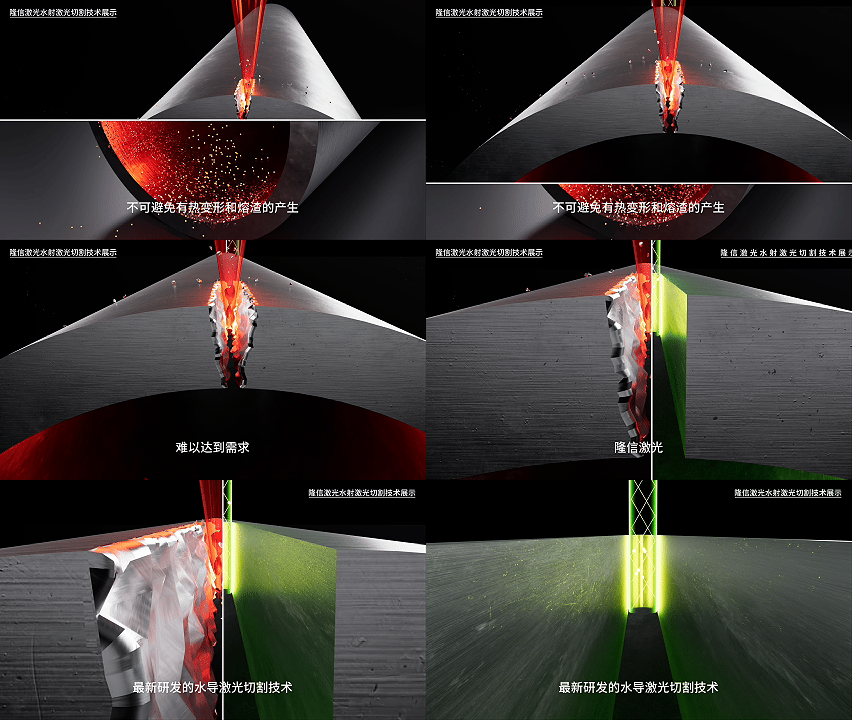
From warping in thin-walled stainless steel parts, oxidation on highly reflective metals like copper and aluminum, to hardness loss at the cutting edge of heat-treated tool steels — these long-standing quality issues all stem from one core limitation of conventional dry laser cutting: unavoidable thermal impact.
Manufacturers are often forced into a difficult compromise:
sacrifice efficiency for quality, or increase costs through secondary processing.
When working with advanced materials such as silicon carbide or ceramics, the weaknesses of traditional laser cutting become even more evident — edge chipping and micro-cracks can quickly lead to high scrap rates.
Longxin Laser’s water-guided laser technology offers a fundamentally different answer.
Liquid Light: The Core Technology Behind Water-Guided Lasers
Water-guided laser technology uses a high-pressure water jet (30–80 μm in diameter) — comparable to the thickness of a human hair — as a “liquid optical fiber”.
Through total internal reflection at the water-air interface, the laser beam is precisely guided to the workpiece.
In this system, water serves two roles simultaneously:
-
a laser transmission medium
-
an instant cooling agent that removes heat between laser pulses
Achieving stable water-laser coupling requires extreme precision in fluid control, optical alignment, and mechanical stability.
Once regarded as a highly restricted technology dominated by Switzerland, this advanced process has now been fully mastered and industrialized by Longxin Laser, enabling reliable, efficient, and repeatable performance in real-world production environments.

Three Key Advantages That Redefine Precision Machining Standards
1. True Cold Processing — No More “Thermal Violence”
Unlike conventional laser cutting, which relies on intense heat, water-guided laser processing cools the cutting zone instantly.
This dramatically reduces the heat-affected zone (HAZ).
-
In carbon fiber composite machining, studies show over 90% reduction in HAZ
-
In magnetic materials, effective cutting thickness increases from 4 mm to up to 20 mm
-
Cutting force is reduced to approximately 0.1 N, minimizing mechanical stress and deformation
The result: stable material properties, no annealing effects, and superior edge quality.
2. Vertical Cuts Without Taper
Traditional laser cutting suffers from beam divergence when processing thick materials, leading to V-shaped kerfs and taper.
Water-guided lasers, however, do not require focal compensation.
-
Near-zero taper cutting
-
Aspect ratio up to 100:1
-
Minimum kerf width of 30 μm
This makes the technology especially suitable for deep, narrow slot machining and high aspect-ratio structures.
3. Clean Cutting — Finished Parts Right After Processing
The high-pressure water jet removes molten material instantly during cutting, resulting in completely slag-free edges.
This is particularly critical for:
-
medical devices
-
precision fluid channels
-
high-cleanliness industrial components
In many cases, parts can be used directly after cutting, eliminating secondary cleaning processes.
Water-guided laser technology demonstrates excellent adaptability across a wide range of difficult-to-machine materials — from aerospace alloys and silicon carbide wafers to medical implants.
Application Scenarios Where Water-Guided Lasers Excel
Water-guided laser cutting is not designed to replace all cutting methods — but in specific high-value applications, it is irreplaceable.
-
Thin-walled metal parts
Titanium and stainless steel components with minimal thermal deformation and higher yield rates -
Deep holes and narrow channels
Mold cooling channels completed in one-third the time of wire EDM -
Precision tool edge finishing
Reduced chipping on carbide drills and cutting tools, extending service life -
Advanced material processing
Seamless transition from metals to ceramics, silicon carbide, and diamond materials without changing the overall process system
This technology is not about showing technical sophistication — it is about solving problems that conventional metal processing has struggled with for decades.
Conclusion: A New Balance Between Speed, Accuracy, and Quality
Water-guided laser technology successfully resolves the long-standing contradiction between speed, precision, and surface quality in high-end manufacturing.
As industries such as aerospace, semiconductors, and medical devices continue to demand higher processing standards, water-guided lasers are becoming a key enabling technology for the future of precision manufacturing.
As one of the first companies in China to achieve full industrialization of water-guided laser technology, Longxin Laser focuses on delivering customized process solutions, making this advanced technology more accessible and cost-effective for global manufacturers.
Are you seeking a breakthrough in precision and quality for your products?
Contact us to explore how water-guided laser technology can be applied in your industry — and apply for free sample cutting tests on key components.
Let’s use this “cool beam of light” to cut through the toughest manufacturing challenges together.