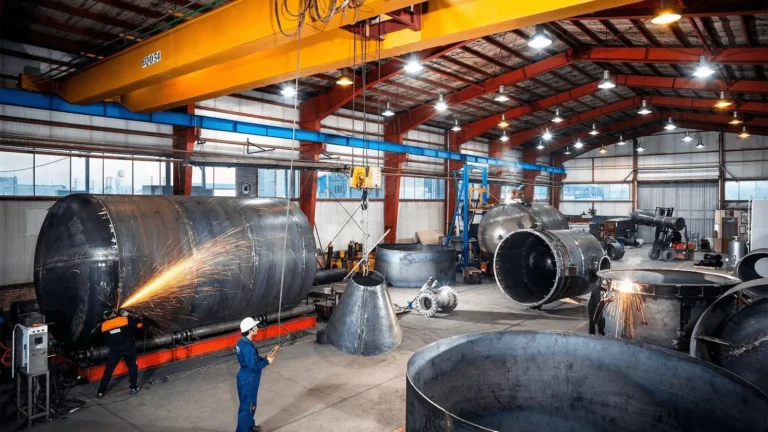
Pressure vessel manufacturing requires accurate fabrication of cylindrical sections, nozzles, penetrations, supports and other components before welding and assembly. Depending on the vessel design, these parts may involve heavy-wall steel pipe or tube that needs holes, branch openings, shaped ends or weld-preparation features.
Tube laser cutting can produce many of these geometries directly from digital drawings, reducing separate layout, drilling, coping and beveling operations for suitable components.
In pressure vessel fabrication, the strongest application is therefore not simply cutting pipe to length. It is preparing tubular components and vessel connection features for accurate fit-up and welding.
Where Tube Laser Cutting Fits in Pressure Vessel Manufacturing
A pressure vessel may include:
Shell Sections · Nozzles · Branch Connections · Penetrations · Pipe Fittings · Supports · Saddles · Manway Structures
The manufacturing route varies according to the vessel design. Large cylindrical shells and vessel heads are often produced from plate through forming and welding, while tube laser cutting is more relevant to tubular components and openings associated with the vessel. Industry fabricators currently use large-diameter tube lasers for nozzle ports, penetrations, shell sections, supports and other heavy-wall vessel components.
This distinction matters when selecting the right laser process.
Nozzle and Penetration Cutting
Nozzle openings are one of the most relevant tube-laser applications in pressure vessel fabrication.
A vessel may require several nozzles or branch connections for:
- Process piping
- Instrument connections
- Drainage
- Venting
- Inlet and outlet connections
- Auxiliary equipment
The opening geometry depends on the nozzle size, vessel diameter and connection angle. A simple drilled hole is therefore often not enough.
For tubular nozzle components, the laser can cut the required end profile, while for suitable large-diameter pipe work it can also create the geometry needed for penetration and branch connections.
This allows the nozzle component to arrive at the welding station with a more accurate mating profile, reducing manual layout and grinding before fit-up. Modern pressure-vessel tube fabrication systems specifically use laser profiling for nozzle and penetration cuts because the curved joint geometry can be generated directly from the engineering model.
Branch Connections and Saddle Cuts
A branch connection between two pipes or between a nozzle and a cylindrical shell creates a curved intersection.
If the branch pipe is only cut straight, the fabricator may need to manually mark and grind the end to obtain a suitable fit.
Tube laser cutting can instead create a saddle or fish-mouth profile that follows the mating surface.
That can improve the initial fit-up between components and reduce manual adjustment before welding.
For pressure-vessel fabrication, this is particularly useful when multiple nozzles or branch pipes need to be produced with different diameters and intersection angles.
The digital cutting program can be changed for each geometry without manufacturing a separate mechanical cutting tool.
Weld Preparation and Bevel Cutting
Pressure-vessel components often require controlled weld preparation.
When tube cutting and beveling are separate operations, a tubular component may need to move from the cutting machine to another station before welding.
A bevel-capable tube laser can combine:
Profile Cutting → Hole / Opening Cutting → Bevel Preparation
in a single programmed process where the geometry is supported by the machine and approved by the engineering specification.
LONX’s LX-T52 III integrates one-step 45° full bevel cutting for round, square, rectangular and compatible special-shaped sections. LONX explicitly identifies pressure vessel manufacturing as an application for this capability.
For heavy-wall tube components, this can reduce secondary milling, grinding and manual bevel preparation.
The exact bevel geometry, however, should always come from the approved vessel and welding design. A machine’s maximum bevel angle does not by itself determine the correct weld preparation for a pressure boundary. Current industry guidance emphasizes that the drawing, project specification, welding procedure and pressure-boundary design must define the required opening and bevel geometry.
Heavy-Wall Pipe and Tube Components
Pressure vessels often involve heavier materials than the small and medium tubing used in general fabrication.
This places greater demands on:
Clamping Stability · Workpiece Support · Laser Power · Tube Rotation · Material Handling
A long, heavy pipe must remain stable while it rotates through the cutting process. If the workpiece sags or moves, the position of holes and connection profiles can be affected.
Three-chuck tube laser systems provide additional support along the workpiece and are particularly useful for long and heavy tubular components.
LONX’s heavy-duty systems are designed around this production requirement, with three-chuck configurations, servo follow-up support and automated material handling options for long tubes.
Supports, Saddles and Structural Attachments
Pressure vessels also require structural components to hold the vessel, connect it to surrounding equipment or support attached piping.
These can include:
- Vessel support tubes
- Pipe-support structures
- 支架
- Saddles
- Equipment supports
- Maintenance structures
Depending on the component design, laser cutting can add holes, slots, notches and tube-end profiles before the parts are welded or assembled.
This allows the same tube laser system to support not only pressure-boundary-related components, but also the structural fabrication surrounding the vessel.
Industry pressure-vessel fabricators commonly group saddles, legs, supports and manway structures alongside nozzle and shell components in their fabrication workflows.
Heat Exchanger and Process Equipment Components
Pressure vessels are closely related to other process equipment such as heat exchangers, reactors and storage vessels.
Tubular components may be used for supports, piping connections and other fabricated assemblies around the main vessel.
In some designs, larger cylindrical shell sections also require accurately positioned openings and penetrations. A suitable large-diameter tube laser can process cylindrical workpieces and produce these openings according to the engineering drawing, while plate and head components continue through their own dedicated fabrication processes.
This makes tube laser cutting one part of a larger manufacturing chain rather than a replacement for plate cutting, forming or welding.
From CAD Drawing to Weld-Ready Components
Pressure-vessel fabrication can involve many different pipe and nozzle configurations.
A digital workflow allows the cutting geometry to be created directly from the engineering model.
A typical process is:
Engineering Drawing / 3D Model → Tube or Pipe Loading → Laser Profiling → Fit-Up → Welding → Inspection
The laser-cut component can already include the required nozzle profile, branch geometry, holes or weld-preparation features.
This reduces the need to transfer dimensions manually from drawings to the workshop floor.
For complex nozzle-to-shell or pipe-to-pipe intersections, offline programming can also simulate the cutting geometry before the physical workpiece is processed. Recent pressure-vessel tube-cutting solutions specifically emphasize CAD-based programming of saddle cuts and nozzle intersections to improve fit-up before welding.
Reducing Secondary Fabrication
Traditional heavy-pipe fabrication may require several separate operations:
Saw Cutting → Layout → Drilling → Coping → Grinding → Beveling → Fit-Up
For suitable components, tube laser cutting can consolidate much of this work:
Laser Cutting → Fit-Up → Welding
Holes and openings can be cut directly into the pipe. Branch ends can be profiled for the mating component. Bevels can be produced during the same operation when the machine configuration supports them.
The main benefit is therefore not simply a faster cutting cycle. It is the reduction of secondary fabrication and manual fitting between the raw pipe and the welding station.
Material Utilization for Large Vessel Components
Heavy-wall pipe can represent a significant portion of the raw-material cost in pressure-vessel fabrication.
Long components also make the tail section of each raw tube important. A machine that can reposition its chucks during cutting can use more of the available tube length and reduce unusable remnants.
LONX’s triple-chuck systems use independently controlled chucks and movable chuck positioning to improve material utilization. The LX-T52 III is specifically designed around zero-scrap tube processing for applicable parts while maintaining stable clamping of long and heavy tubes.
Actual material savings depend on the part geometry, cutting layout and raw material dimensions, so production nesting should be evaluated using the customer’s actual components.
Recommended LONX Tube Laser Cutting Machines for Pressure Vessel Manufacturing
Pressure-vessel components vary considerably in size, so the appropriate machine depends on the pipe diameter, wall thickness, length, joint geometry and bevel requirements.
LX-T35-3 — For Large Tube Components and Bevel Preparation
選擇 LX-T35-3 processes round tubes from Ø40–350 mm and square tubes up to 350 × 350 mm, with lengths up to 12,000 mm. Its three-chuck configuration is designed for long workpieces, while 45° bevel cutting allows cutting and weld preparation to be integrated for supported applications.
Suitable for: large tubular components, branch pipes, supports and pressure-vessel fabrication where bevel preparation is required.
LX-K35-3 — For Large and Heavy Tube Processing
選擇 LX-K35-3 is designed for larger tubular workpieces, covering round and square tubes up to approximately 350 mm and supporting long, heavy tube processing.
It is more appropriate where the main requirement is stable processing of large tube sections and connection features rather than integrated bevel cutting.
Suitable for: heavy pipe components, vessel supports, large tubular structures and fabricated pressure-equipment components.
LX-T52 III — For Large-Diameter Pressure Vessel Components
For larger pressure-vessel components, the LX-T52 III extends the working range to Ø80–500 mm round tubes 以及 80 × 80–500 × 500 mm square tubes, with tube lengths up to 12,000 mm and laser power from 3–12 kW.
Its triple-chuck system, dynamic servo support and one-step 45° full bevel cutting make it particularly suited to large-diameter tube fabrication. LONX explicitly lists pressure vessel manufacturing among the applications for this machine.
Suitable for: large nozzle components, heavy tubular sections, complex pipe joints and pressure-vessel parts requiring integrated bevel preparation.
How to Choose a Tube Laser for Pressure Vessel Fabrication
The machine should be selected from the actual component drawings rather than from the pressure-vessel category alone.
The key parameters are:
Tube / pipe diameter → Wall thickness → Material → Length → Nozzle or branch geometry → Bevel requirements → Workpiece weight → Production volume
It is also important to distinguish between a pressure-boundary component and a non-pressure structural or support component.
For a pressure-boundary component, the laser-cut geometry must follow the approved engineering design and applicable welding and inspection requirements. A clean laser cut does not, by itself, establish pressure-vessel code compliance or qualify a welded joint. Current pressure-vessel fabrication guidance similarly treats cutting, welding, inspection and traceability as separate but connected manufacturing requirements.
Tube Laser Cutting as Part of the Pressure Vessel Workflow
For suitable tubular components, the laser can move a significant amount of fabrication work upstream.
A nozzle can be profiled before welding. A branch pipe can receive its saddle cut. A heavy tube can be cut and beveled in one setup. A support structure can receive its mounting holes before assembly.
That means the laser becomes part of the broader production chain:
Engineering → Cutting / Profiling → Fit-Up → Welding → Inspection → Final Assembly
The goal is not to replace every pressure-vessel manufacturing process. It is to produce more complete and accurately prepared tubular components before welding and assembly.
For manufacturers of pressure vessels, tanks, heat-transfer equipment and related heavy fabrication, LONX provides tube laser systems for different tube diameters, lengths and processing requirements.