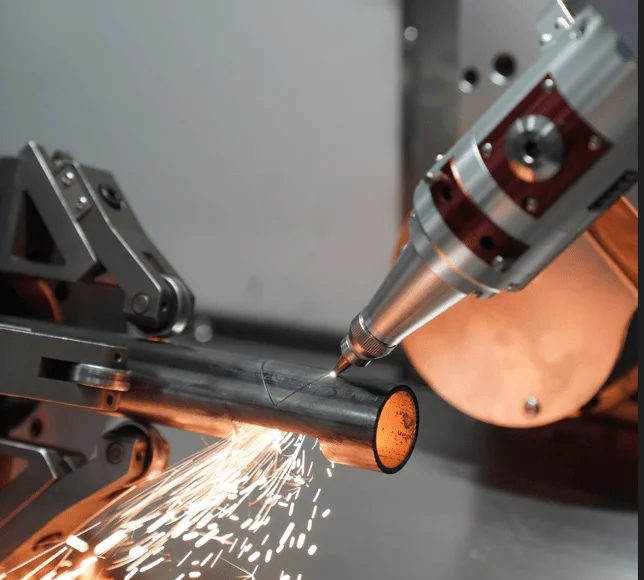
El consumo de energía de una cortadora de tubos láser es un tema que merece atención. Este artículo analizará los costos operativos diarios de usar una máquina cortadora de tubos láser, así como los factores que influyen en estos costos. Esto le ayudará a seleccionar mejor el equipo de corte de tubos láser adecuado.
Costo de Referencia de Operar una Cortadora de Tubos Láser
Costos totales del consumo de energía
Usando la cortadora de tubos láser LX-GL40 como ejemplo, la potencia de salida de la fuente láser es de 4kW, la potencia del motor de la máquina herramienta es de 1.95kW y la potencia del enfriador es de 3kW, con una potencia nominal total de salida de la máquina de 8.95kW. Sin embargo, la máquina generalmente opera al 60% de su capacidad total, lo cual es suficiente. Por lo tanto, el consumo de energía real es de 8.95 x 60% = 5.37kWh por hora. Calculando a un precio de electricidad de $0.1 5por kWh, el costo operativo por hora es de $0.8.
| Elemento | Potencia nominal(KW) | Potencia total
(KW) |
Consumo total de energía
(Factor de ajuste: 60%) |
Consumo por hora
(tome 0.1 USD /kWh como ejemplo) |
| Potencia de entrada del láser | 4 | 8.95 | 95 x 60% =
37KWh / hora |
37x 0.15 USD / kWh ≈ 0.8USD / hora |
| Potencia del motor de la bancada | 1.95 | |||
| Enfriador | 3 |
Costo del aire de corte
Los gases auxiliares como el aire son gratuitos, por lo que podemos considerar ese costo como 0. Sin embargo, si se utilizan otros gases, habrá costos adicionales.
| Gas auxiliar | Requisitos | Tubería | Precio del gas
(precio de referencia) |
Costo por hora (USD) |
| Aire | Aire comprimido | SS/CS | 0.00 | 0.00 |
Otros consumibles
La lente protectora y la boquilla de corte son las principales piezas consumibles de la máquina cortadora de tubos láser. Si la máquina opera diariamente, su vida útil normal es de alrededor de 3 a 5 meses. Calculado por hora, el costo de estos consumibles es de aproximadamente $0.1.
| Elemento | Consumo por hora | Observaciones |
| Lente protectora | 05 USD | Excelente entorno de trabajo y mayor tiempo de uso (3-5meses) |
| Boquilla de corte | 05USD | |
| Total | 10 USD |
Costos operativos totales(USD)
El costo operativo total por hora de una máquina cortadora de tubos láser es de aproximadamente $0.9. Este costo no es alto.
| No. | Elemento | Aire |
| 1 | Consumo de energía | 8 USD |
| 2 | Consumo de aire | 0 |
| 3 | Otros consumibles | 10 USD |
| Total | 9 USD | |
Factores que Influyen en el Consumo de Energía
Fuente de Láser y Potencia de Salida:
El tipo de fuente de láser y su potencia de salida influyen significativamente en el consumo de energía. Las cortadoras de tubo por láser típicamente emplean láseres de CO2 o láseres de fibra, siendo los primeros más intensivos en energía debido a la necesidad de sistemas de gas y enfriamiento.
Propiedades del Material:
Las propiedades del material que se corta, como el grosor, la densidad y la conductividad térmica, afectan directamente la cantidad de energía requerida para fundir y vaporizar el material. Los materiales más gruesos y densos generalmente demandan una mayor potencia de salida, lo que conduce a un mayor consumo de energía.
Velocidad de Corte y Aceleración:
La velocidad a la que se mueve el haz de láser y las tasas de aceleración del sistema de control de movimiento juegan un papel en el consumo de energía. Las velocidades de corte más altas y la aceleración rápida pueden aumentar la demanda de energía, particularmente para los componentes de control de movimiento.
Sistemas Auxiliares:
Las cortadoras de tubo por láser requieren varios sistemas auxiliares, como sistemas de enfriamiento, sistemas de extracción y unidades de control por computadora. El consumo de energía de estos componentes de soporte puede variar según su diseño y eficiencia.
Ciclo de Trabajo:
El ciclo de trabajo, o el porcentaje de tiempo que el láser está cortando activamente, influye en el consumo de energía. Un ciclo de trabajo más alto generalmente se traduce en un mayor consumo de energía, ya que la fuente de láser y los sistemas auxiliares operan durante períodos más largos.
Equipo Periférico y su Impacto
Sistema de Extracción
Un sistema de extracción en una cortadora de tubo por láser juega un papel crucial en la eliminación de humos y residuos generados durante el proceso de corte. Asegura un entorno de trabajo limpio y ayuda a mantener la eficiencia de la máquina al prevenir obstrucciones.
Unidades de Enfriamiento
Las unidades de enfriamiento, otro equipo periférico esencial, son responsables de mantener el tubo de láser a una temperatura óptima durante la operación. Al disipar el calor de manera efectiva, contribuyen a la longevidad de la máquina y aseguran un rendimiento de corte consistente.
Optimización del Uso de Energía
Para optimizar el consumo de energía, es vital integrar equipos suplementarios como sistemas de extracción y unidades de enfriamiento. Estas adiciones no solo mejoran la funcionalidad general de la cortadora de tubo por láser, sino que también contribuyen a la eficiencia energética. Al asegurar que estos periféricos estén bien mantenidos y operen de manera eficiente, los usuarios pueden reducir el desperdicio innecesario de energía.
Reflexiones finales
En última instancia, la elección de una cortadora de tubo por láser debe guiarse por una evaluación holística de sus requisitos específicos de aplicación, volúmenes de producción, necesidades de procesamiento de materiales y costos operativos a largo plazo. Al considerar el consumo de energía como un factor clave en su proceso de toma de decisiones, no solo puede optimizar su uso de energía y reducir los costos operativos, sino también contribuir a un ecosistema de fabricación más sostenible y responsable con el medio ambiente.