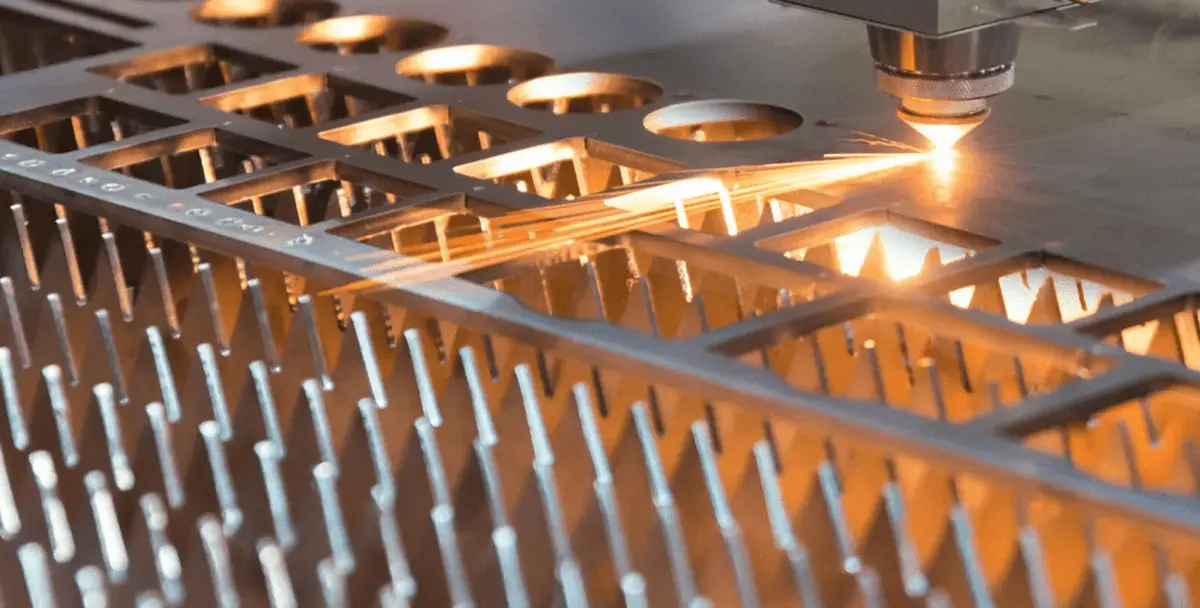
A 1500W fiber laser can cut different metal thicknesses depending on the material, assist gas, cutting parameters, machine configuration, and required edge quality. There is no single maximum thickness that applies to every 1500W laser cutting machine.
For industrial buyers, the key question is not simply whether a laser can cut through a plate. It is whether the machine can produce clean, repeatable cuts at an acceptable speed and cost for your actual production requirements.
What Thickness Can a 1500W Fiber Laser Cut?
The cutting capacity of a 1500W fiber laser varies by material and process conditions. Carbon steel, stainless steel, and aluminum require different cutting parameters, so a single thickness figure cannot accurately describe every application.
The following carbon steel values are examples from LONX Laser reference cutting data. They are preliminary reference values, not guaranteed production results.
| Materiale | Thickness | Gas ausiliario | Focus Condition | Reference Cutting Speed |
|---|---|---|---|---|
| Acciaio al carbonio | 5 mm | Oxygen | Positive focus | 1.8–2.0 m/min |
| Acciaio al carbonio | 8 mm | Oxygen | Positive focus | 1.0–1.2 m/min |
Actual results depend on material grade, surface condition, gas pressure and purity, nozzle configuration, focus position, and the required cutting quality. These reference values should not be treated as a universal cutting chart or a guarantee for every 1500W machine.
Before selecting equipment for a specific thickness, request a cutting test using your actual material and production requirements. For a broader comparison across laser power levels, see our fiber laser cutting thickness chart.
Why Does Cutting Thickness Vary Between Machines?
Two machines using a nominally identical 1500W laser source may achieve different cutting speeds, edge quality, and maximum usable thickness. Laser power is important, but it is only one part of the complete cutting system.
- Material grade and condition: Alloy composition, coatings, surface condition, and actual thickness can affect the cutting process.
- Assist gas: Oxygen, nitrogen, and compressed air produce different cutting behavior and edge conditions.
- Cutting speed: Excessive speed can cause incomplete separation, while unsuitable speed settings can increase heat input or reduce edge quality.
- Cutting head and nozzle: Nozzle geometry, alignment, and gas delivery affect process stability.
- Focus position: The focal position influences how laser energy is distributed through the material.
- Piercing settings: Piercing power, duration, and sequence affect the start of the cutting process, especially on thicker material.
- Machine configuration: The laser source, optics, motion system, and process-control capabilities all contribute to the result.
This is why maximum-thickness claims should be evaluated alongside the complete process conditions and the quality of the finished cut.
Cut-Through Thickness vs. Clean-Cut Thickness
A machine that separates a plate under specific conditions does not necessarily produce an edge that is ready for production.
A cutting limit may describe the maximum thickness that can be separated under particular conditions. A clean-cut limit may refer to a more demanding result with acceptable edge quality and less secondary processing. Manufacturers may define these terms differently, so the test conditions matter.
When comparing machines, ask the supplier to clarify what its published thickness figure means.
| Evaluation Item | What to Confirm |
|---|---|
| Cut-through capability | Can the laser completely separate the specified material? |
| Edge quality | Is the cut suitable for the intended application? |
| Dross and burrs | How much secondary cleaning is required? |
| Velocità di taglio | Can the result meet your production target? |
| Repeatability | Can the same result be achieved consistently? |
| Post-elaborazione | Are grinding, deburring, or other operations required? |
For production planning, clean and repeatable results are generally more useful than a maximum-thickness claim without supporting process conditions.
How Does Assist Gas Affect Cutting Thickness?
Assist gas influences cutting behavior, edge oxidation, process stability, and operating cost. The appropriate choice depends on the material, thickness, machine configuration, and required finish.
Oxygen Cutting
Oxygen is commonly used for carbon steel because the oxidation reaction contributes heat to the cutting process. This can support the processing of thicker carbon steel, although the resulting edge is oxidized and may require additional processing.
The appropriate gas pressure, nozzle, focus position, and cutting speed must be established for the particular machine and application.
Nitrogen Cutting
Nitrogen is commonly used when a clean, non-oxidized edge is important, particularly for stainless steel. The process may require a high-pressure gas supply, and gas consumption can be a significant operating cost.
Required pressure and flow depend on the material, thickness, nozzle, and cutting conditions. Do not assume that a nitrogen parameter set can be transferred directly to another gas.
Compressed-Air Cutting
Properly filtered and dried compressed air may be suitable for certain materials and applications. Its suitability depends on the machine configuration, available pressure, air quality, and required edge condition.
Compressed air should not be assumed to replace nitrogen or oxygen under all conditions. Validate the process using the intended material and acceptance criteria.
How to Choose the Right 1500W Cutting Parameters
A published cutting chart should be treated as a starting reference for a specific combination of machine, material, and process settings.
- Identify the material and thickness. Match the material grade, thickness, and surface condition as closely as possible.
- Confirm the laser source. Check that the reference applies to the specified laser type and power.
- Check the cutting head and nozzle. Confirm that the optical and nozzle configuration is compatible with the intended application.
- Specify the assist gas. Confirm gas type, purity, pressure, and flow requirements.
- Set the focus position. Use the process settings appropriate for the material and thickness.
- Evaluate cutting speed. Assess speed together with edge quality, dimensional accuracy, and production requirements.
- Confirm piercing settings. Check that piercing is reliable for the specified material and thickness.
- Define acceptance criteria. Specify acceptable edge condition, dross level, dimensional tolerance, and required post-processing.
Do not transfer a parameter table from one machine to another without confirming compatibility. A setting that works for one material or machine configuration may not produce the same result elsewhere.
How to Validate Cutting Performance Before Buying
For an industrial purchase, a sample test is more informative than a headline thickness specification alone.
1. Define Your Production Requirements
List the materials you process, their normal and maximum thicknesses, part geometry, required edge quality, and expected production volume. Include both frequently processed thin materials and thicker plates.
2. Request the Full Parameter Record
Ask the supplier to document the material, thickness, cutting speed, assist gas, pressure, nozzle, focus position, piercing settings, and quality criteria used in the test.
A statement such as “cuts up to 10 mm” is insufficient for a meaningful equipment comparison without these details.
3. Test Representative Workpieces
Where possible, provide material matching your actual production grade, thickness, and surface condition. Test representative features such as holes, slots, corners, and external contours. A straight-line cutting demonstration alone may not reveal every limitation relevant to your finished parts.
4. Evaluate the Finished Cut
Inspect the cut for complete separation, dross, burrs, heat effects, and dimensional accuracy. Record cutting time and any required secondary processing.
5. Confirm Repeatability
Repeat the test under representative operating conditions. Check whether the process remains stable and consistently achieves the required quality. A successful single test should not automatically be treated as proof of sustained production capability.
When Should You Consider a Higher-Power Laser?
A higher-power fiber laser may be worth considering when your production requires thicker materials, higher cutting speeds, greater throughput, or a wider range of materials and thicknesses.
However, laser power alone does not determine productivity. Consider your actual material mix, cycle times, edge-quality requirements, gas costs, and expected production volume.
Explore LONX Laser sheet metal laser cutting machines to review available equipment categories, or read our metal laser cutting guide for additional process-selection considerations.
What Information Should You Provide When Requesting a Quote?
To evaluate a suitable laser cutting configuration, prepare the following information:
- Material names and grades
- Normal and maximum material thicknesses
- Representative drawings or sample parts
- Required edge quality and dimensional tolerances
- Target cutting speed or production volume
- Available oxygen, nitrogen, or compressed-air supply
- Sheet dimensions and loading requirements
- Expected operating schedule
- Required automation, training, and after-sales service
The more accurately these requirements are defined, the easier it is to assess whether a 1500W machine is suitable or whether another configuration should be considered.
Contact LONX Laser with your material specifications and sample-part requirements to discuss a suitable sheet metal laser cutting configuration and quotation.
Conclusione
A 1500W fiber laser’s cutting thickness depends on the material, assist gas, cutting parameters, machine configuration, and required edge quality. Reference tables can help establish an initial process window, but they should not be treated as universal guarantees.
For a reliable purchasing decision, compare complete process conditions and validate the materials and workpieces used in your production. When the required result is close to a published cutting limit, request a sample test and confirm repeatable quality before finalizing the machine selection.