











1. Introduction: The Challenge of Perfect Pipelines
Constructing underground pipelines—especially gravity-flow systems—presents a fundamental engineering challenge: maintaining a perfectly consistent slope, commonly referred to as “grade.” In applications such as sewer lines and stormwater drainage, gravity is the only force that moves fluids through the system. Even minor deviations, such as subtle high points or low points, can interrupt flow, leading to sediment buildup, blockages, and premature system failure.
Traditionally, crews relied on stakes, string lines, and manual levels to control alignment and grade. While effective to a degree, these methods are time-consuming and prone to cumulative human error. Today, this critical task is handled far more accurately and efficiently with a pipe laser—a specialized alignment tool designed specifically for underground pipe installation.
This guide explains what a pipe laser is, how it works, and why it has become an essential tool in modern pipeline construction.
2. What Is a Pipe Laser?
A pipe laser is a precision construction instrument that projects a highly accurate laser beam to serve as a reference line for pipe alignment and slope. Its primary purpose is to ensure that each section of pipe is installed at the exact grade, direction, and elevation specified in the project design.
Designed for harsh underground environments, pipe lasers feature rugged, dust-tight housings, with many professional models offering high levels of water and dust protection for use in wet trenches and confined spaces. By providing a constant, visible reference, a pipe laser allows installation crews to achieve consistent results with far greater accuracy than traditional methods.

3. Where Pipe Lasers Are Used
Pipe lasers are widely used in underground and low-visibility construction environments where precision alignment is critical. Common applications include:
- Sewer and wastewater pipeline installation
- Stormwater drainage systems
- Underground utility pipelines (water, gas, electrical conduits, and communication ducts)
- Trenchless construction and pipe jacking projects
- Pipeline rehabilitation and replacement
- Tunneling and mining-related alignment tasks
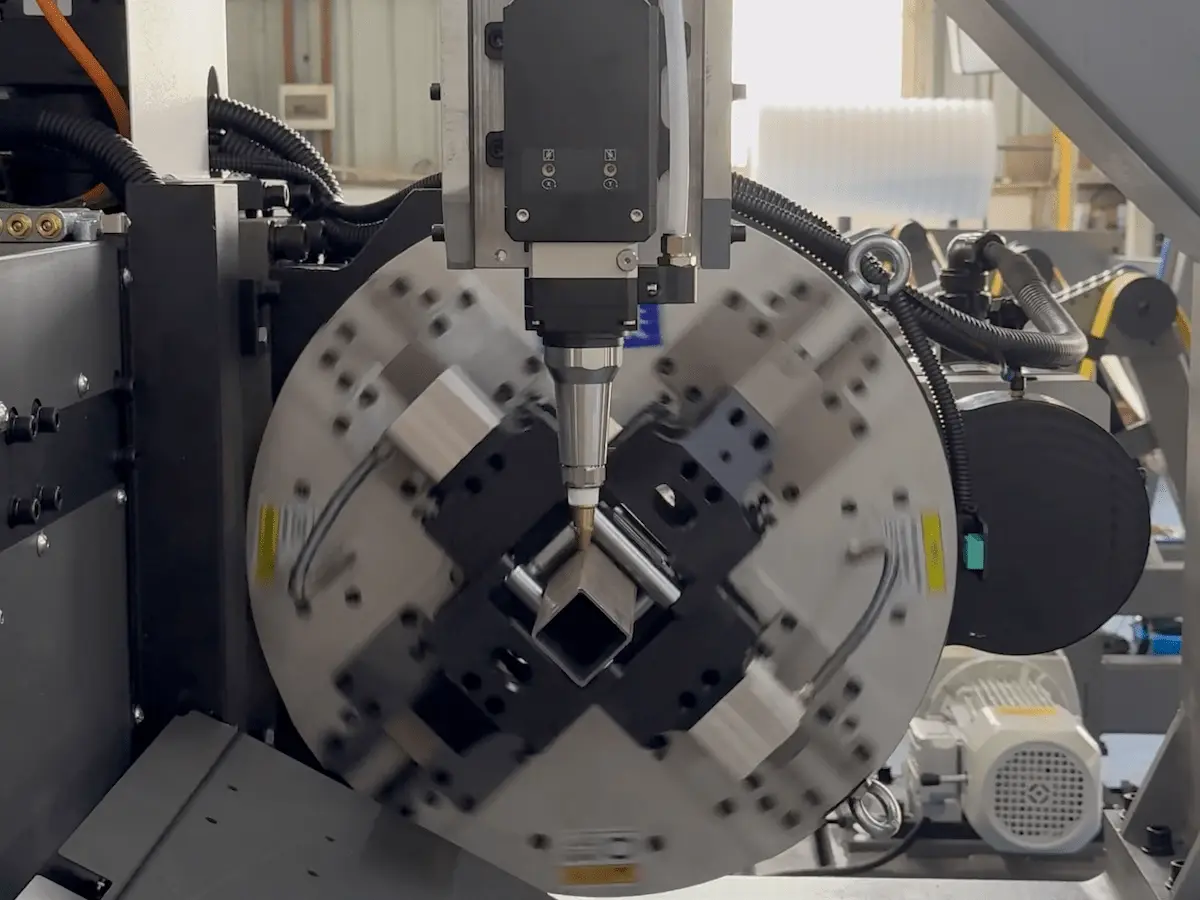
Because of their role in alignment rather than material processing, pipe lasers are often confused with industrial laser cutting systems—a distinction worth clarifying.
4. Pipe Laser vs. Pipe Laser Cutting Machine
Despite sharing similar terminology, these two tools serve completely different purposes.
| Pipe Laser (Construction) | Pipe Laser Cutting Machine (Industrial Fabrication) |
|---|---|
| Portable alignment tool for job sites | Large CNC machine used in factories |
| Projects a laser beam as a reference line | Uses high-power lasers to cut metal |
| Ensures correct pipe grade and alignment | Cuts, bevels, and shapes metal tubes |
| Used in civil and utility construction | Used in metal fabrication and manufacturing |
This article focuses exclusively on construction pipe lasers, which are used for alignment and grade control during installation.
5. How Does a Pipe Laser Work?
A pipe laser converts slope calculations into a visible laser reference line. Internally, it combines electronic sensors, precision motors, and a laser diode to project a beam at a precisely controlled angle.
Once positioned in a pipe or trench, the laser emits a beam along the intended pipeline path, allowing installers to align each pipe section accurately as work progresses.
6. Laser Beam Colors: Red vs. Green
Pipe lasers are commonly available with red or green laser beams. Both provide the same level of measurement accuracy; the difference lies in visibility and energy consumption.
| Recurso | Red Beam | Green Beam |
|---|---|---|
| Visibility | Good under typical conditions | Appears significantly brighter to the human eye |
| Best Use | Standard indoor or low-light environments | Bright outdoor or high-ambient-light conditions |
| Power Efficiency | Generally more energy-efficient | Typically consumes more power |
The choice between red and green usually depends on job site lighting conditions and expected operating time.
7. Understanding Pipe Grade
The “grade” of a pipeline refers to its slope, calculated as the vertical drop divided by the horizontal distance and expressed as a percentage. For example, a pipe that drops 2 units vertically over 100 units horizontally has a grade of −2.0%.
Pipe lasers allow operators to enter the required grade directly through a digital interface. The system then automatically adjusts the beam angle to match the specified slope, ensuring consistent gravity flow throughout the pipeline.
8. Self-Leveling and Cross-Axis Compensation
Modern pipe lasers include automated features that improve accuracy and reduce setup time:
Self-leveling: The laser automatically levels itself within its operating range, ensuring the projected grade is accurate without manual adjustment.
Cross-axis compensation (on equipped models): This feature detects and corrects sideways tilt caused by uneven trench surfaces, keeping the beam correctly aligned even when the housing is not perfectly level.
These functions allow crews to place the laser quickly and begin work with confidence.
9. Why Precision Matters in Gravity-Flow Pipelines
Gravity-driven pipelines rely entirely on consistent slope to function correctly. Professional-grade pipe lasers are capable of very high alignment accuracy, often measured in millimeters over long distances. This level of precision helps prevent the formation of sags or high points that can trap debris and cause long-term maintenance problems.
Compared with traditional manual leveling methods, pipe lasers significantly reduce the risk of rework, saving time, labor, and excavation costs.
10. Pipe Lasers vs. Traditional Alignment Methods
| Recurso | Pipe Laser | Traditional Methods |
|---|---|---|
| Precisão | Very high and repeatable | Dependent on operator skill |
| Setup Time | Fast and efficient | Slow and labor-intensive |
| Labor Requirements | Often single-operator | Typically requires multiple workers |
| Reliability | Stable reference over long distances | Susceptible to movement and environmental factors |
11. Productivity-Enhancing Features
Many modern pipe lasers include intelligent monitoring and control functions designed to improve job site efficiency, such as:
- Line monitoring alerts to detect movement or disturbance
- Vertical beam or line-check functions for rapid setup and verification
- Remote control operation to adjust settings without entering the trench
- Optional targets or receivers that assist with long-distance alignment and grade verification
The availability of these features varies by model, but they all serve the same purpose: reducing setup time and minimizing costly errors.
12. Conclusion
Pipe lasers have become a foundational tool in modern pipeline construction. By replacing manual alignment methods with a precise, stable laser reference, they enable faster installation, higher accuracy, and long-term reliability. Whether installing sewer lines, stormwater systems, or underground utilities, pipe lasers help ensure that critical infrastructure is built to perform as designed—efficiently, safely, and with lasting quality.
Perguntas frequentes
What is a pipe laser used for?
A pipe laser is used to accurately align and set the slope of underground pipelines, especially gravity-flow systems such as sewer and stormwater pipes.
Is a pipe laser the same as a laser cutting machine?
No. A pipe laser is an alignment and measurement tool used in construction, while a pipe laser cutting machine is an industrial system used to cut metal tubes.
How accurate is a pipe laser?
Professional pipe lasers can achieve very high accuracy, typically within a few millimeters over long distances, depending on the model and setup conditions.
Can pipe lasers be used in wet trenches?
Yes. Many pipe lasers are designed for underground environments and offer high levels of water and dust protection for use in wet or muddy conditions.
What is the difference between red and green pipe lasers?
Both provide the same accuracy, but green lasers appear brighter to the human eye, making them easier to see in bright environments.