الملخص التنفيذي: مرجع سريع استراتيجي
بينما يتحول التصنيع العالمي من “لماذا” الطباعة ثلاثية الأبعاد إلى “كيفية” التكامل الصناعي، فإن اختيار محرك الليزر الصحيح يحدد جدوى خط الإنتاج بأكمله. يحلل هذا الدليل تقنيات الليزر الخمس الرئيسية من منظور الأداء والتكلفة والعائد الاستراتيجي على الاستثمار.
| نوع الليزر | التطبيق الأساسي | الميزة الرئيسية | القيد الاستراتيجي |
|---|---|---|---|
| الألياف | تلبيد المعادن بالليزر (SLM) | أعلى كثافة نسبية؛ نظام بيئي ناضج. | إجهاد حراري عالٍ؛ معالجة لاحقة معقدة. |
| CO₂ | تلبيد البوليمر بالليزر (SLS) | أشكال هندسية بدون دعامات؛ تنوع في المواد. | دقة/تشطيب سطحي أقل من الأشعة فوق البنفسجية. |
| الأشعة فوق البنفسجية (UV) | الطباعة بالستيريوليثوغرافيا بالراتنج (SLA) | دقة فائقة وتشطيب سطحي ممتاز. | قوة مادة محدودة ومقاومة حرارة محدودة. |
| Nd:YAG | التكسية المعدنية/التصنيع الإضافي (AM) | امتصاص معدني محدد؛ استقرار الحالة الصلبة. | كفاءة أقل من أنظمة الألياف الحديثة. |
| الصمام الثنائي/الأشعة تحت الحمراء النبضية (IR) | الطباعة المساحية | نطاق ضخم؛ فصل التكلفة عن الإنتاجية. | سماكة طبقة ثابتة 25 ميكرومتر؛ تقنية ناشئة. |
مقدمة: الدور الاستراتيجي لليزر في الصناعة الحديثة
في مشهد “الصناعة 4.0” الحالي، نضجت تقنية الليزر من أداة مختبرية متخصصة إلى الأساس الجوهري للتصنيع عالي الدقة. لم يعد الليزر مجرد أدوات قطع؛ بل أصبح مهندسًا عالي الطاقة قادرًا على توليد أشكال هندسية معقدة لا يمكن للصب أو التشكيل التقليدي محاكاتها.
يستفيد هذا الدليل من خبرة عميقة في علوم المواد والفوتونيات لإزالة الغموض عن الأنواع الخمسة الأساسية لليزر: الألياف، وثاني أكسيد الكربون، والأشعة فوق البنفسجية، وNd:YAG، والصمام الثنائي/الأشعة تحت الحمراء النبضية. بينما تمثل مصادر الطاقة الأخرى مثل الصهر بالحزمة الإلكترونية (EBM) عملية رئيسية للمواد الهشة عالية الحرارة في بيئات التفريغ، تظل الأنظمة القائمة على الليزر القوة المهيمنة في سوق التصنيع الإضافي العالمي بسبب تنوعها ومرونتها الجوية.
ليزر الألياف: المتخصص في المعادن عالية الدقة
يحتفظ ليزر الألياف حاليًا بالهيمنة الاستراتيجية في قطاع التصنيع الإضافي للمعادن (AM)، في المقام الأول كمحرك للتلبيد الانتقائي بالليزر (SLM). يتم تعزيز موقعه في السوق من خلال نضج برمجي وميكانيكي كبير، مما يجعله “المعيار الذهبي” للتطبيقات الفضائية والطبية الحرجة.
مبدأ التوليد
تصحيح: تعمل ليزرات الألياف عند أطوال موجية تبلغ حوالي 1.06-1.07 ميكرومتر (عادةً 1040 نانومتر أو 1064 نانومتر)، وليس 1.09 ميكرومتر كما يُستشهد أحيانًا. عادةً ما تكون ليزرات الألياف الحديثة المستخدمة في التصنيع الإضافي عبارة عن ليزرات ألياف مشوبة بالإيتربيوم (Yb) يتم ضخها بواسطة ليزرات الصمام الثنائي عند 950-980 نانومتر. تُقدَّر هذه الأنظمة لكفاءة التحويل الكهروضوئي العالية (حوالي 25٪) ووضع حزمة يطابق الوضع الأساسي (TEM00) عن كثب. في تكوين SLM، يتم توجيه الليزر عبر سلسلة بصرية متطورة—بما في ذلك موسعات الحزمة وعدسات التركيز F-θ—لصهر طبقات مسحوق المعدن بدقة.
طبقة “إذن ماذا؟”: القيمة الاستراتيجية
الطول الموجي 1.06-1.07 ميكرومتر محسّن خصيصًا للامتصاص العالي في المعادن الصناعية مثل التيتانيوم والفولاذ المقاوم للصدأ وسبائك النيكل. من خلال تركيز هذه الطاقة في بقعة دقيقة للغاية، تحقق ليزرات الألياف كثافة نسبية تقترب من 100٪. تسمح هذه السلامة المعدنية للأجزاء المطبوعة بالوصول إلى مستويات أداء ميكانيكي مماثلة للمكونات المطروقة، متجاوزةً بذلك الصب التقليدي بكثير.
الاستخدام الصناعي وسيناريوهات التطبيق
- الفضاء الجوي: أجزاء هيكلية عالية التحميل ومكونات توربينية.
- الطب: غرسات عظمية مخصصة للمرضى ذات هياكل مسامية معقدة.
- الإلكترونيات: مشتتات حرارية متخصصة وأغلفة موصلة.
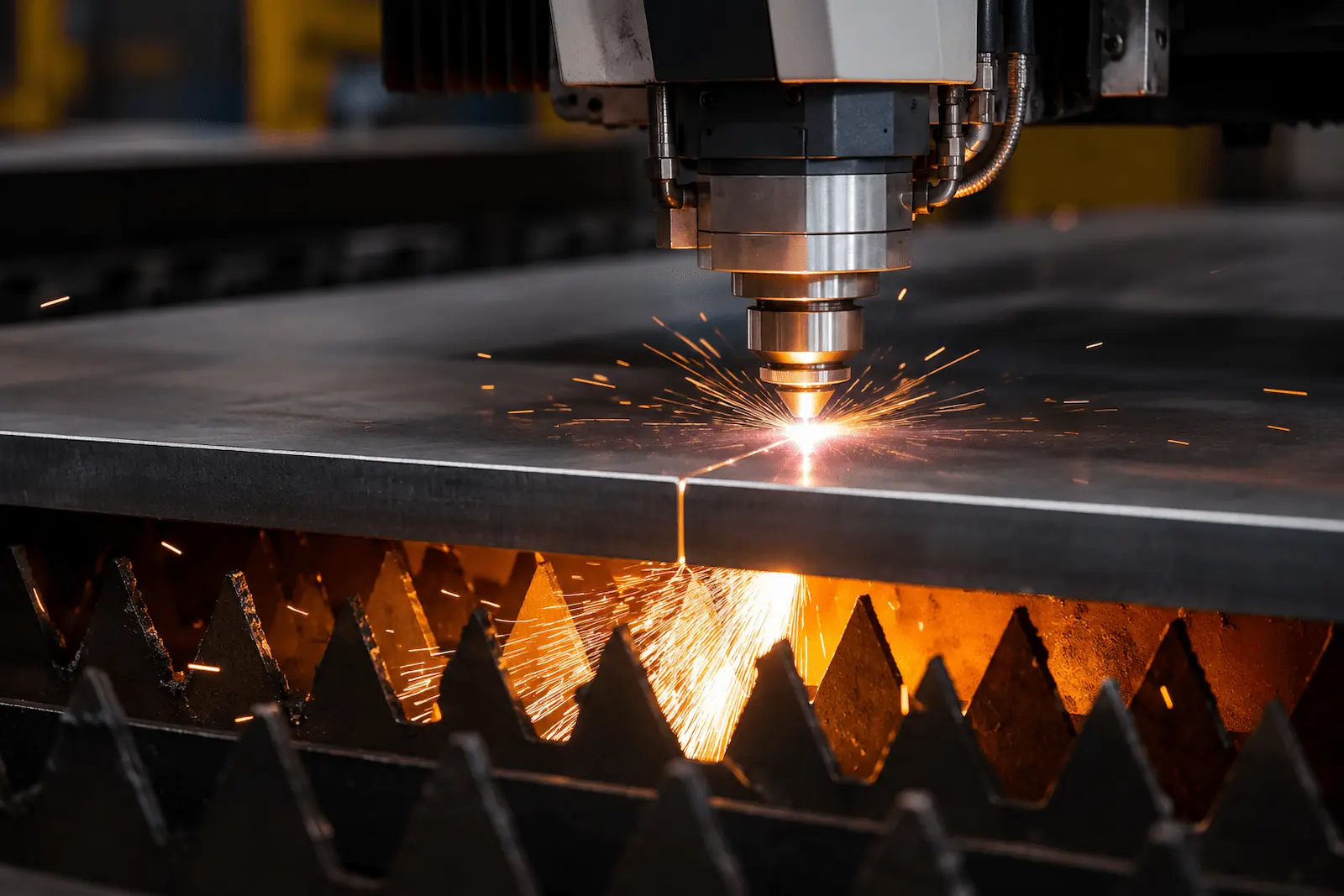
- التصنيع: بعيدًا عن التصنيع الإضافي، تتيح ليزرات الألياف قطعًا عالي الدقة آلات القطع بليزر الألياف لتصنيع الصفائح المعدنية وإنتاج المكونات الصناعية.
التلبيد الانتقائي بالليزر (SLM) هو حاليًا أكثر عمليات التصنيع الإضافي للمعادن نضجًا. تكمن ميزته في “التسليم المباشر” للأجزاء الوظيفية. ومع ذلك، يجب على المستشارين مراعاة المعالجة اللاحقة: عادةً ما تكون الأجزاء ملحومة بلوحة البناء وتتطلب قطعًا بالأسلاك الكهربائية (EDM) أو طحنًا باستخدام الحاسب الآلي (CNC) لإزالتها، مما يضيف إلى التكلفة الإجمالية للملكية.
ليزرات ثاني أكسيد الكربون: المهندس المعماري متعدد الاستخدامات للمواد غير المعدنية
بينما تمتلك ليزرات الألياف مجال المعادن، تظل ليزرات ثاني أكسيد الكربون الأساس للمعالجة الصناعية غير المعدنية، خاصةً في التلبيد الانتقائي بالليزر (SLS).
مبدأ التوليد
ليزر ثاني أكسيد الكربون هو نظام قائم على الغاز يعمل بطول موجة 10.6 ميكرومتر (مع أطوال موجية بديلة عند 9.3 ميكرومتر و9.6 ميكرومتر متاحة لمواد محددة). يمسح الليزر عبر طبقة مسحوق مسخنة مسبقًا. بدلاً من الذوبان الكامل، يوفر الليزر الطاقة الحرارية اللازمة “لتلبيد” أو ربط البوليمرات والسيراميك جزيئيًا تحت تحكم كمبيوتر دقيق.
عوامل التمييز الرئيسية: المشهد التنافسي
يسهل ليزر ثاني أكسيد الكربون نطاقًا أوسع من المواد الوظيفية، بما في ذلك النايلون (PA12) والبوليمرات المتخصصة. على عكس الأنظمة القائمة على المعادن، يستخدم SLS طبقة المسحوق غير الملبدة كدعم طبيعي. يوفر هذا طفوًا طبيعيًا واستقرارًا للجزء أثناء البناء، مما يتيح أشكالًا هندسية “بدون دعامات”.
الاستخدام الصناعي وسيناريوهات التطبيق
- السيارات: مجاري الهواء، والمشعبات، ومكونات داخلية وظيفية عالية المتانة.
- النماذج الأولية: تكرار سريع للنماذج الهندسية المعقدة دون الحاجة إلى إزالة الدعامات.
- السلع الاستهلاكية: أجزاء نهائية عالية القوة ومقاومة للبيئة.
إن عدم وجود هياكل دعم مطلوبة في عمليات SLS بليزر ثاني أكسيد الكربون يقلل بشكل كبير من تكاليف العمالة في المعالجة اللاحقة ويسمح بكثافة “تداخل” أعلى داخل غرفة البناء، مما يزيد من الإنتاجية لكل دورة.
ليزرات الأشعة فوق البنفسجية (UV): سيد البلمرة عالية الدقة
ليزرات الأشعة فوق البنفسجية هي الخيار الاستراتيجي للتطبيقات التي تكون فيها جماليات السطح والدقة الأبعادية هي مؤشرات الأداء الرئيسية الأساسية، حيث تعمل كمصدر طاقة للطباعة بالستيريوليثوغرافيا (SLA).
مبدأ التوليد
UV lasers utilize high-frequency ultraviolet light (typically 355 nm or 405 nm wavelengths) to trigger photopolymerization. As the laser scans the surface of a liquid photosensitive resin, it causes a localized chemical reaction that solidifies the liquid into a solid polymer layer-by-layer.
The “So What?” Layer: Precision vs. Strength
The short wavelength of UV light allows for a smaller focal point, making it the industry benchmark for resolution. While UV-cured resins typically lack the mechanical strength or heat resistance of metals or SLS polymers, they offer a surface finish that is often assembly-ready without aggressive sanding.
Strategic Comparison: SLA (UV) vs. SLM (Fiber)
| الميزة | SLA (UV Laser) | SLM (Fiber Laser) |
|---|---|---|
| Surface Quality | Superior / Smooth | Medium (Grainy) |
| تعددية استخدام المواد | Limited (Photosensitive resins) | High (Various Metals/Alloys) |
| Part Size Capability | Small to Medium | Small to Large |
| المعالجة اللاحقة | Washing and UV Curing | Stress relief, EDM removal, Grinding |
| Mechanical Integrity | Brittle; low heat resistance | High; comparable to forged parts |
For dental models and high-precision injection molds, the UV laser’s ability to eliminate visible “layer lines” reduces secondary finishing costs, justifying the higher cost of resin consumables.
5. Nd:YAG Lasers: The Solid-State Foundation
The Nd:YAG (Neodymium-doped Yttrium Aluminum Garnet) laser is a traditional solid-state pillar that continues to play a role in specialized direct metal forming.
مبدأ التوليد
Nd:YAG lasers operate at a 1.064 µm wavelength (1064 nm). Although they share similar wavelengths with some Fiber lasers, the generation of the beam through a solid-state crystal provides a different stability profile and power delivery characteristic. The laser uses a neodymium-doped YAG crystal as the gain medium, pumped by flashlamps or diode lasers.
Evaluate the Impact
Historically, Nd:YAG was the primary heat source for early SLM systems. Today, while Fiber lasers have captured the majority of the AM market due to higher efficiency (fiber lasers achieve ~25% wall-plug efficiency vs. ~2% for lamp-pumped Nd:YAG), Nd:YAG remains relevant in Laser Cladding and heavy industrial repair applications where its specific absorption profile is preferred for building up material on existing large-scale components.
6. Diode & Pulsed IR Lasers: The Disruptor of Scaled Production
The emergence of “Area 3D Printing,” pioneered by companies like Seurat Technologies, represents a strategic pivot from single-point scanning to mass-scale production.
Generation Principle: The OALV Mechanism
This technology utilizes a modular pulsed infrared (IR) laser source combined with an Optically Addressable Light Valve (OALV). The system contains over 2.3 million individually addressable pixels. The process follows a specific four-step polarization sequence:
- Beam Shaping: The pulsed IR laser is shaped into a uniform square field (approximately 15×15 mm).
- Pattern Projection: A blue light projector overlays the part’s geometry (over 2.3 million pixels) onto the IR field.
- Polarization Control: The OALV changes the polarization of the IR beam: IR light overlapping with blue light pixels becomes horizontally polarized, while non-overlapping light becomes vertically polarized.
- Selective Melting: A polarizing mirror splits the beams, directing only the patterned (horizontally polarized) IR light to the powder bed to melt the entire area in one pulse.
The “So What?” Layer: Breaking the Cost Barrier
This “masking” approach allows for power levels 10-150x higher than a single laser system. Crucially, it decouples build rate from hardware cost. In traditional systems, doubling speed requires doubling the expensive laser heads; in Area Printing, speed is scaled by increasing the pulse frequency and energy density.
Scaling Roadmap & Milestones
NOTE: The following projections are company claims and should be viewed as targets rather than verified achievements:
- Current (Gen 1): Claimed manufacturing costs at lower rates than traditional AM.
- Future Generations: Company projections suggest significant cost reductions and speed improvements in coming years.
Unlike SLM, Area Printing introduces new constraints: pulse energy control, pattern size limitations, and a fixed layer thickness of 25 µm.
7. Conclusion: Choosing the Right Laser for the Future
The five types of lasers—Fiber, CO₂, UV, Nd:YAG, and Diode/Pulsed IR—constitute a complete toolkit for modern manufacturing. Strategic selection should be guided by key Selection Principles:
- Usage Requirements: Determine if the end-goal is a non-functional prototype (SLA/UV) or a high-load final component (SLM/Fiber).
- Material Quality: Assess the required relative density. Metals require Fiber or Nd:YAG; polymers utilize CO₂.
- Procurement & External Environment: Consider the total cost of ownership, including the specialized labor required for SLM vs. the simplified workflow of SLS.
- Post-Processing Costs: Factor in the “hidden” costs of support removal, thermal stress relief, and surface grinding, which can often exceed the cost of the print itself.
As the industry moves toward 2030, the shift to Area Printing and other emerging technologies suggests a future where additive manufacturing is no longer a niche prototyping tool, but potentially a primary mass-production technology.
For further technical standards on additive manufacturing processes, refer to the ISO/ASTM 52900 Standards.
الأسئلة المتداولة
1. What is the most widely used laser type in metal additive manufacturing?
ليزر الألياف are currently the most widely used and mature laser technology for metal additive manufacturing, particularly in Laser Powder Bed Fusion for Metals (PBF-LB/M) systems.
They offer high energy efficiency, excellent beam quality, and stable melting behavior, enabling metal parts to achieve relative densities above 99.5% under optimized conditions.
2. Why are fiber lasers preferred over CO₂ lasers for metal 3D printing?
Fiber lasers operate at a wavelength (~1.07–1.09 μm) that is well absorbed by most industrial metals, such as steel, titanium, aluminum, and nickel alloys.
In contrast, CO₂ lasers (10.6 μm) are poorly absorbed by metals but highly effective for polymers, making them unsuitable for metal powder bed fusion.
3. Are CO₂ lasers still relevant in industrial additive manufacturing?
Yes. CO₂ lasers remain the industry standard for polymer powder bed fusion (PBF-LB/P).
They are widely used to process materials such as PA12 and PA11, offering support-free printing, high batch productivity, and stable performance for functional polymer parts.
4. What is the main advantage of CO₂-based SLS compared to metal PBF systems?
The key advantage is that no support structures are required.
Un-sintered powder naturally supports the part during printing, which reduces post-processing labor, lowers production costs, and allows higher nesting density within the build chamber.
5. Why do SLA systems use UV lasers instead of fiber or CO₂ lasers?
SLA and other vat photopolymerization processes rely on photopolymerization, which requires ultraviolet (UV) light to cure liquid resin.
UV lasers offer short wavelengths and small focal spots, enabling exceptional surface finish and dimensional accuracy that cannot be achieved with infrared lasers.
7. What is the difference between fiber lasers and Nd:YAG lasers in metal AM?
Both fiber and Nd:YAG lasers operate near a 1 μm wavelength and can process metals effectively.
However, fiber lasers offer higher efficiency, better beam quality, and lower maintenance, which is why they have largely replaced Nd:YAG lasers in modern metal powder bed fusion systems.
Nd:YAG lasers are now mainly used in directed energy deposition (DED) and repair applications.