執行摘要:策略性快速參考
隨著全球製造業從3D列印的「為何」轉向工業整合的「如何」,選擇正確的雷射引擎決定了整個生產線的可行性。本指南從性能、成本與策略性投資報酬率的角度,分析五種主流雷射技術。.
| 雷射類型 | 主要應用 | 關鍵優勢 | 策略性限制 |
|---|---|---|---|
| 光纖 | 金屬SLM | 最高相對密度;生態系統成熟。. | 高熱應力;後處理複雜。. |
| CO₂ | 聚合物SLS | 免支撐幾何結構;材料多樣性。. | 精度與表面光潔度低於UV。. |
| 紫外線 | 樹脂SLA | 卓越的解析度與表面光潔度。. | 材料強度與耐熱性有限。. |
| Nd:YAG | 金屬熔覆/AM | 特定金屬吸收率;固態穩定性。. | 效率低於現代光纖系統。. |
| 二極體/脈衝紅外線 | 區域列印 | 大規模;成本與生產力脫鉤。. | 固定25 µm層厚;新興技術。. |
引言:雷射在現代工業中的策略性角色
在當前的「工業4.0」格局中,雷射技術已從專業實驗室儀器成熟為高精度製造的關鍵基石。雷射不再只是切割工具;它們是能夠生成傳統鑄造或鍛造無法複製之複雜幾何結構的高能量建築師。.
本指南運用材料科學與光子學的深厚專業知識,深入解析五種核心雷射類型:光纖、CO₂、UV、Nd:YAG與二極體/脈衝紅外線。雖然其他能源如電子束熔融(EBM)代表著真空環境下高熱、脆性材料的主流製程,但基於雷射的系統因其多功能性與大氣環境適應性,仍是全球AM市場的主導力量。.
光纖雷射:高精度金屬專家
光纖雷射目前在金屬積層製造(AM)領域佔有策略性主導地位,主要作為選擇性雷射熔融(SLM)的引擎。其市場地位得益於成熟的軟體與機械系統,使其成為關鍵航太與醫療硬體的「黃金標準」。.
生成原理
修正說明:光纖雷射的運作波長約為1.06-1.07 µm(通常為1040 nm或1064 nm),而非有時引用的1.09 µm。現代AM用光纖雷射通常為摻鐿(Yb)光纖雷射,由950-980 nm的二極體雷射泵浦。此類系統因高電光轉換效率(約25%)以及接近基模(TEM00)的光束模式而備受重視。在SLM配置中,雷射透過精密光學鏈——包括光束擴束器與F-θ聚焦透鏡——精確熔融金屬粉末床。.
「那又怎樣?」層面:策略價值
06-1.07 µm波長專為鈦、不鏽鋼與鎳合金等工業金屬的高吸收率而最佳化。透過將能量聚焦於極細光點,光纖雷射可實現接近100%的相對密度。這種冶金完整性使列印零件能達到與鍛造件相當的機械性能,遠超傳統鑄造。.
工業用途與應用場景
- 航太:高負載結構件與渦輪元件。.
- 醫療:具複雜多孔結構的患者專用骨科植入物。.
- 電子:特殊散熱片與導電外殼。.
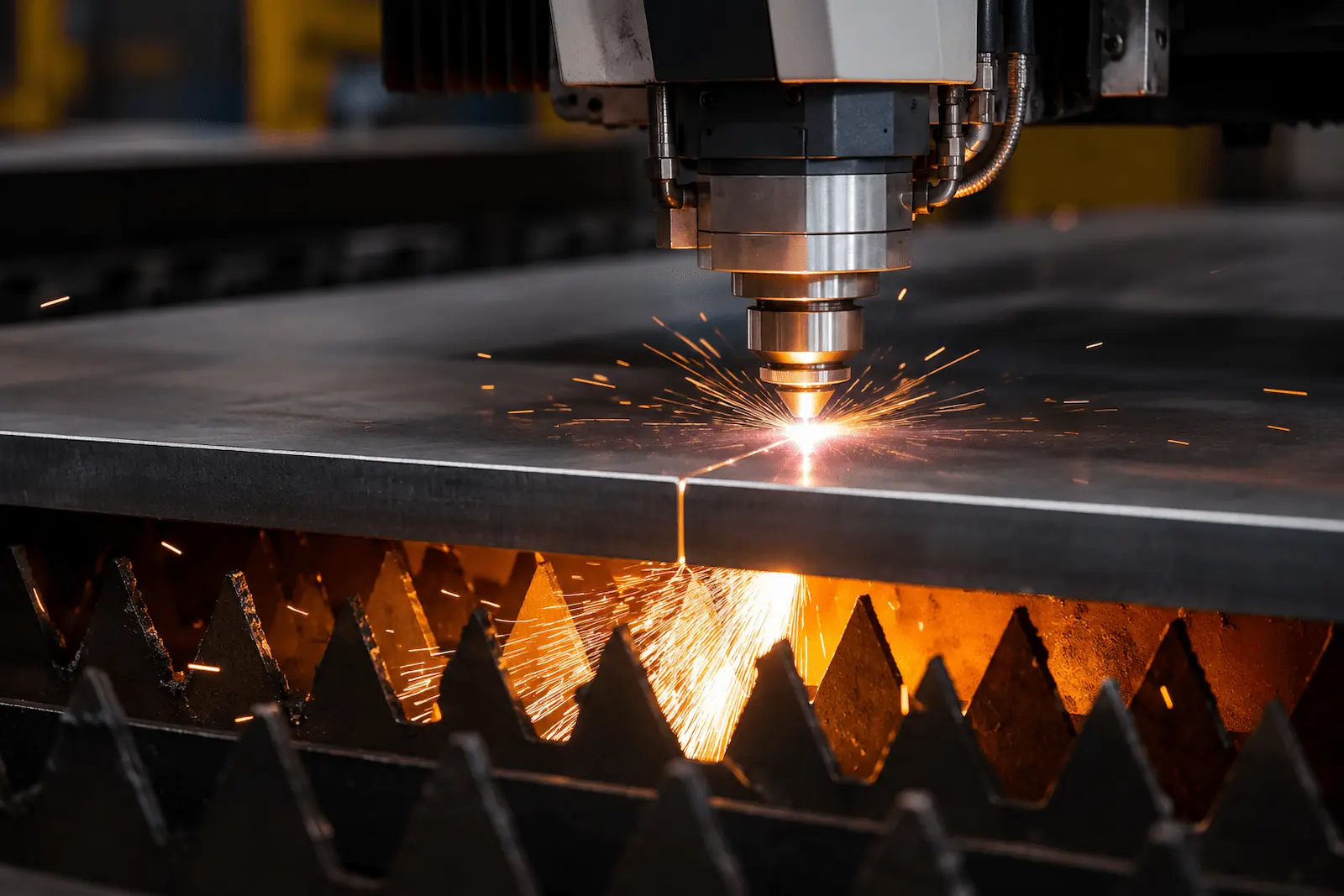
- 製造:除積層製造外,光纖雷射亦驅動高精度 光纖雷射切割機 應用於鈑金加工與工業零件生產。.
選擇性雷射熔融(SLM)目前是最成熟的金屬AM製程。其優勢在於功能零件的「直接交付」。然而,顧問必須考量後處理:零件通常焊接於建構平台上,需以線切割放電加工或CNC銑削移除,這增加了總持有成本。.
CO₂雷射:非金屬材料的多功能建築師
雖然光纖雷射主導金屬領域,CO₂雷射仍是非金屬工業加工的基礎,特別是在選擇性雷射燒結(SLS)中。.
生成原理
CO₂雷射為氣體系統,運作波長為10.6 µm(另有9.3 µm與9.6 µm波長可供特定材料使用)。雷射掃描預熱的粉末床。與完全熔融不同,雷射提供精確電腦控制下「燒結」或分子鍵結聚合物與陶瓷所需的熱能。.
關鍵差異化因素:競爭格局
CO₂雷射支援更廣泛的功能性材料,包括尼龍(PA12)與特種聚合物。與金屬系統不同,SLS利用未燒結的粉末床作為天然支撐。這在列印過程中為零件提供天然浮力與穩定性,實現「免支撐」幾何結構。.
工業用途與應用場景
- 汽車:管道、歧管與高耐久性功能內飾零件。.
- 原型製作:無需移除支撐即可快速迭代複雜幾何模型。.
- 消費品:高強度、耐環境的最終使用零件。.
CO₂ SLS製程無需支撐結構,顯著降低後處理的人工成本,並允許在建構腔體內實現更高的「嵌套」密度,最大化每週期的產出量。.
紫外線(UV)雷射:高解析度聚合反應大師
UV雷射是表面美觀度與尺寸精度為主要KPI之應用的策略性選擇,作為立體光刻(SLA)的能量來源。.
生成原理
UV lasers utilize high-frequency ultraviolet light (typically 355 nm or 405 nm wavelengths) to trigger photopolymerization. As the laser scans the surface of a liquid photosensitive resin, it causes a localized chemical reaction that solidifies the liquid into a solid polymer layer-by-layer.
The “So What?” Layer: Precision vs. Strength
The short wavelength of UV light allows for a smaller focal point, making it the industry benchmark for resolution. While UV-cured resins typically lack the mechanical strength or heat resistance of metals or SLS polymers, they offer a surface finish that is often assembly-ready without aggressive sanding.
Strategic Comparison: SLA (UV) vs. SLM (Fiber)
| 特色 | SLA (UV Laser) | SLM (Fiber Laser) |
|---|---|---|
| Surface Quality | Superior / Smooth | Medium (Grainy) |
| 材料通用性 | Limited (Photosensitive resins) | High (Various Metals/Alloys) |
| Part Size Capability | Small to Medium | Small to Large |
| 後處理 | Washing and UV Curing | Stress relief, EDM removal, Grinding |
| Mechanical Integrity | Brittle; low heat resistance | High; comparable to forged parts |
For dental models and high-precision injection molds, the UV laser’s ability to eliminate visible “layer lines” reduces secondary finishing costs, justifying the higher cost of resin consumables.
5. Nd:YAG Lasers: The Solid-State Foundation
The Nd:YAG (Neodymium-doped Yttrium Aluminum Garnet) laser is a traditional solid-state pillar that continues to play a role in specialized direct metal forming.
生成原理
Nd:YAG lasers operate at a 1.064 µm wavelength (1064 nm). Although they share similar wavelengths with some Fiber lasers, the generation of the beam through a solid-state crystal provides a different stability profile and power delivery characteristic. The laser uses a neodymium-doped YAG crystal as the gain medium, pumped by flashlamps or diode lasers.
Evaluate the Impact
Historically, Nd:YAG was the primary heat source for early SLM systems. Today, while Fiber lasers have captured the majority of the AM market due to higher efficiency (fiber lasers achieve ~25% wall-plug efficiency vs. ~2% for lamp-pumped Nd:YAG), Nd:YAG remains relevant in Laser Cladding and heavy industrial repair applications where its specific absorption profile is preferred for building up material on existing large-scale components.
6. Diode & Pulsed IR Lasers: The Disruptor of Scaled Production
The emergence of “Area 3D Printing,” pioneered by companies like Seurat Technologies, represents a strategic pivot from single-point scanning to mass-scale production.
Generation Principle: The OALV Mechanism
This technology utilizes a modular pulsed infrared (IR) laser source combined with an Optically Addressable Light Valve (OALV). The system contains over 2.3 million individually addressable pixels. The process follows a specific four-step polarization sequence:
- Beam Shaping: The pulsed IR laser is shaped into a uniform square field (approximately 15×15 mm).
- Pattern Projection: A blue light projector overlays the part’s geometry (over 2.3 million pixels) onto the IR field.
- Polarization Control: The OALV changes the polarization of the IR beam: IR light overlapping with blue light pixels becomes horizontally polarized, while non-overlapping light becomes vertically polarized.
- Selective Melting: A polarizing mirror splits the beams, directing only the patterned (horizontally polarized) IR light to the powder bed to melt the entire area in one pulse.
The “So What?” Layer: Breaking the Cost Barrier
This “masking” approach allows for power levels 10-150x higher than a single laser system. Crucially, it decouples build rate from hardware cost. In traditional systems, doubling speed requires doubling the expensive laser heads; in Area Printing, speed is scaled by increasing the pulse frequency and energy density.
Scaling Roadmap & Milestones
NOTE: The following projections are company claims and should be viewed as targets rather than verified achievements:
- Current (Gen 1): Claimed manufacturing costs at lower rates than traditional AM.
- Future Generations: Company projections suggest significant cost reductions and speed improvements in coming years.
Unlike SLM, Area Printing introduces new constraints: pulse energy control, pattern size limitations, and a fixed layer thickness of 25 µm.
7. Conclusion: Choosing the Right Laser for the Future
The five types of lasers—Fiber, CO₂, UV, Nd:YAG, and Diode/Pulsed IR—constitute a complete toolkit for modern manufacturing. Strategic selection should be guided by key Selection Principles:
- Usage Requirements: Determine if the end-goal is a non-functional prototype (SLA/UV) or a high-load final component (SLM/Fiber).
- Material Quality: Assess the required relative density. Metals require Fiber or Nd:YAG; polymers utilize CO₂.
- Procurement & External Environment: Consider the total cost of ownership, including the specialized labor required for SLM vs. the simplified workflow of SLS.
- Post-Processing Costs: Factor in the “hidden” costs of support removal, thermal stress relief, and surface grinding, which can often exceed the cost of the print itself.
As the industry moves toward 2030, the shift to Area Printing and other emerging technologies suggests a future where additive manufacturing is no longer a niche prototyping tool, but potentially a primary mass-production technology.
For further technical standards on additive manufacturing processes, refer to the ISO/ASTM 52900 Standards.
常見問題
1. What is the most widely used laser type in metal additive manufacturing?
光纖雷射器 are currently the most widely used and mature laser technology for metal additive manufacturing, particularly in Laser Powder Bed Fusion for Metals (PBF-LB/M) systems.
They offer high energy efficiency, excellent beam quality, and stable melting behavior, enabling metal parts to achieve relative densities above 99.5% under optimized conditions.
2. Why are fiber lasers preferred over CO₂ lasers for metal 3D printing?
Fiber lasers operate at a wavelength (~1.07–1.09 μm) that is well absorbed by most industrial metals, such as steel, titanium, aluminum, and nickel alloys.
In contrast, CO₂ lasers (10.6 μm) are poorly absorbed by metals but highly effective for polymers, making them unsuitable for metal powder bed fusion.
3. Are CO₂ lasers still relevant in industrial additive manufacturing?
Yes. CO₂ lasers remain the industry standard for polymer powder bed fusion (PBF-LB/P).
They are widely used to process materials such as PA12 and PA11, offering support-free printing, high batch productivity, and stable performance for functional polymer parts.
4. What is the main advantage of CO₂-based SLS compared to metal PBF systems?
The key advantage is that no support structures are required.
Un-sintered powder naturally supports the part during printing, which reduces post-processing labor, lowers production costs, and allows higher nesting density within the build chamber.
5. Why do SLA systems use UV lasers instead of fiber or CO₂ lasers?
SLA and other vat photopolymerization processes rely on photopolymerization, which requires ultraviolet (UV) light to cure liquid resin.
UV lasers offer short wavelengths and small focal spots, enabling exceptional surface finish and dimensional accuracy that cannot be achieved with infrared lasers.
7. What is the difference between fiber lasers and Nd:YAG lasers in metal AM?
Both fiber and Nd:YAG lasers operate near a 1 μm wavelength and can process metals effectively.
However, fiber lasers offer higher efficiency, better beam quality, and lower maintenance, which is why they have largely replaced Nd:YAG lasers in modern metal powder bed fusion systems.
Nd:YAG lasers are now mainly used in directed energy deposition (DED) and repair applications.