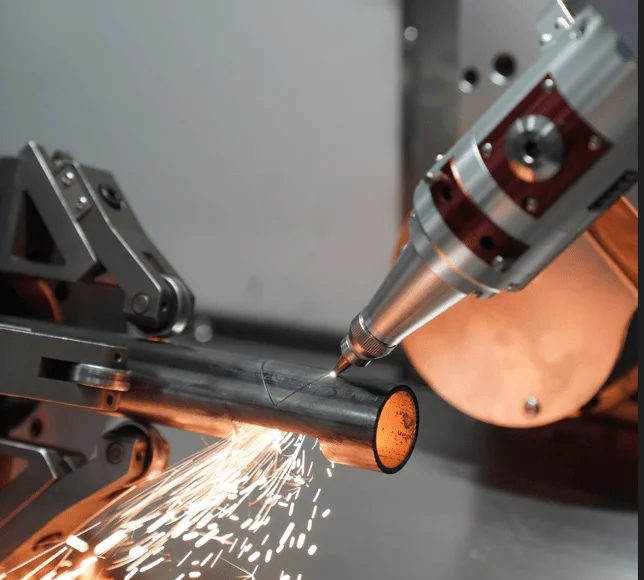
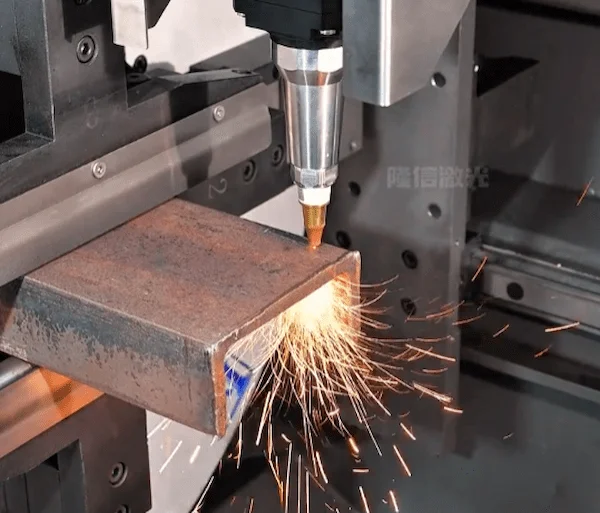
As a thermal cutting technology, pipe laser cutting requires a perforation process when cutting thick-walled pipes. The perforation process creates an initial hole in the material before continuous cutting begins.
There are two commonly used perforation methods in laser cutting:
- Blasting Perforation
- Pulse Perforation
The two methods differ significantly in hole diameter, penetration quality, spatter, processing time, and application requirements.
1. Blasting Perforation
In blasting perforation, the laser continuously irradiates the material at the beginning of the cutting process. As the material absorbs the laser energy, a molten pool and pit gradually form at the center of the target area.
At the same time, the high-pressure assist gas blows the molten material and slag away, eventually creating a hole through the pipe wall.
The diameter of the perforation hole is closely related to the material thickness. In general, the average hole diameter can be approximately half the thickness of the pipe, although the actual size depends on factors such as laser power, material, gas pressure, and process parameters.
As a result, blasting perforation on thick-walled pipes tends to produce:
- A relatively large perforation diameter
- An irregular hole shape
- More molten material and spatter
- A larger heat-affected area around the perforation
Another characteristic of blasting perforation is that the gas pressure used during perforation is relatively close to the pressure used during cutting. The high-pressure gas can therefore cause significant molten-metal splashing during the perforation process.
Because of these characteristics, blasting perforation is not suitable for applications with extremely high requirements for hole quality or surface integrity, such as certain precision oil-slotted tubes.
However, blasting perforation is simple, fast, and sufficient for many conventional pipe-cutting applications.
2. Pulse Perforation
Pulse perforation uses a different approach.
Instead of continuously irradiating the material, the laser operates in a high-peak-power pulsed mode. Each laser pulse melts or vaporizes a small amount of material, gradually creating a narrow hole through the pipe wall.
Oxygen or nitrogen can be used as the assist gas during the perforation process. The gas pressure is generally lower than the pressure used for normal cutting, which helps reduce the expansion of the perforation hole and minimize molten-metal splashing.
Because each laser pulse removes only a small amount of material, thick-walled pipes may require several seconds to complete the perforation process.
Once the perforation is complete, the assist gas can be switched to oxygen immediately, allowing the system to transition into the normal continuous cutting process.
Compared with blasting perforation, pulse perforation generally provides:
- A smaller perforation diameter
- A more regular hole shape
- Less spatter
- Better control of the heat-affected area
- Higher perforation quality
3. Why Pulse Perforation Requires Precise Process Control
The advantage of pulse perforation does not come from peak laser power alone.
The temporal and spatial characteristics of the laser beam are also important. These characteristics determine how the laser energy is delivered to the material during each pulse and directly affect the stability and quality of the perforation process.
For this reason, traditional cross-flow CO₂ lasers are generally not well suited to the requirements of modern pulse-perforation processes.
Pulse perforation also requires a reliable pneumatic control system. The system needs to accurately control:
- Assist gas type
- Gas pressure
- Gas switching time
- Perforation duration
- Transition from perforation to continuous cutting
The transition from pulse perforation to continuous, constant-speed cutting is particularly important.
If the transition is not properly controlled, the starting point of the cut may suffer from excessive melting, dimensional deviation, or an uneven cutting edge.
Therefore, when using pulse perforation, the transition between perforation and normal cutting should be optimized together with the laser and gas parameters.
4. Which Perforation Method Should You Choose?
Both methods have their own advantages.
| Feature | Blasting Perforation | Pulse Perforation |
|---|---|---|
| Perforation speed | Faster | Slower |
| Hole diameter | Relatively large | Smaller |
| Hole shape | More irregular | More regular |
| Spatter | More | Less |
| Process control | Relatively simple | More precise |
| System requirements | Lower | Higher |
| Perforation quality | Standard | Higher |
| Suitable applications | General pipe cutting | High-quality / precision cutting |
For most conventional pipe laser cutting applications, blasting perforation is sufficient.
The pipe-processing range of many laser cutting machines is around 300 mm in diameter or below, and most manufacturers using pipe laser cutting do not necessarily require pulse perforation.
However, when processing thick-walled pipes or components with strict requirements for perforation quality, pulse perforation can provide significant advantages.
The choice ultimately depends on the pipe material, wall thickness, laser power, required cutting quality, and the specific application.